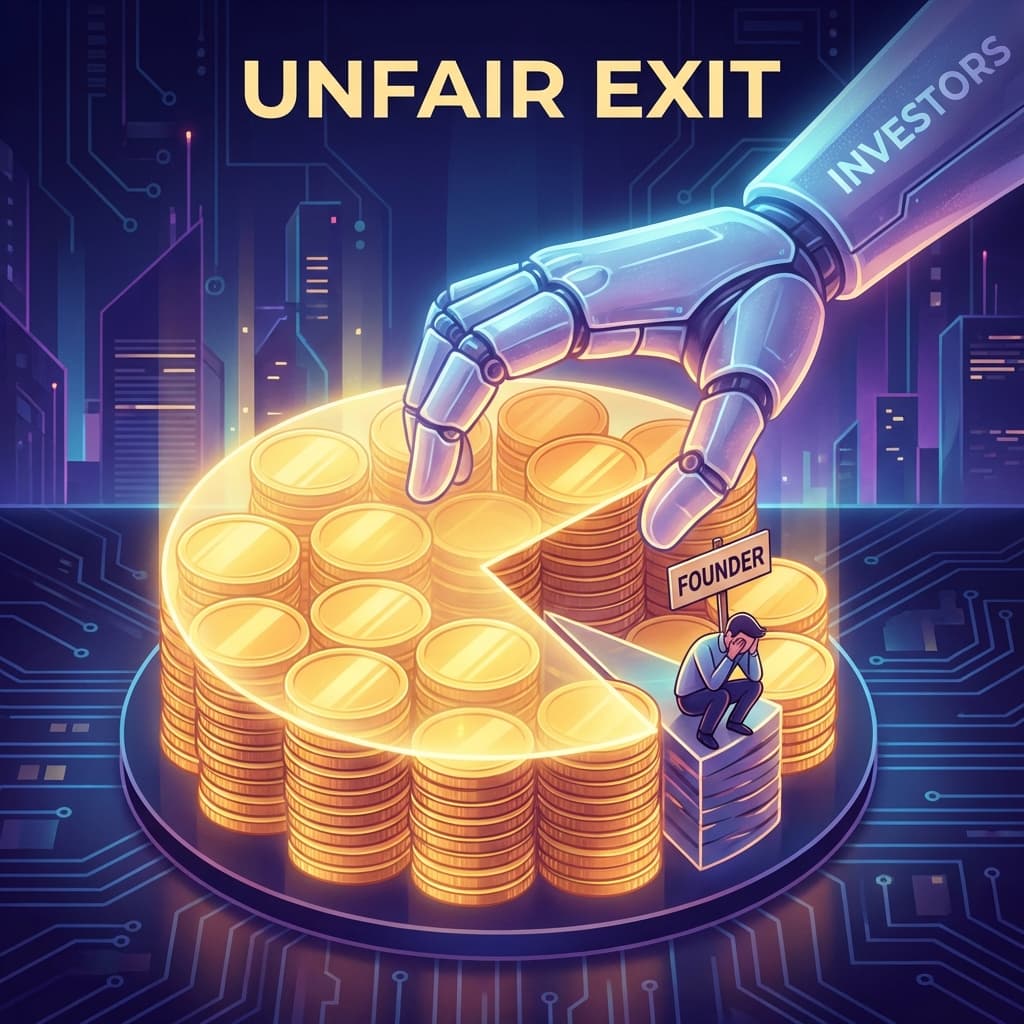
I recently attended a celebration dinner for a friend—let's call him "David." His startup, a SaaS analytics platform, had just been acquired by a private equity firm for $50 Million. In the world of tech, this is the dream. The TechCrunch headline was glowing. The LinkedIn likes were pouring in.
I poured him a glass of expensive champagne. "Cheers to the exit," I said. "What color Lamborghini are you buying?"
David didn't smile. He looked tired. He took a long sip and leaned in. "I'm not buying anything," he whispered. "I walked away with zero."
I thought he was joking. He wasn't.
"The investors had a 2x Liquidation Preference on their Series C. With Participation. They put in $20M. They took $40M off the top. The Series B took the remaining $10M. I am walking away with a job offer at the acquiring company and a retention package, but my equity? It's worth $0."
The champagne tasted flat after that.
This story is more common than you think. In the "Unicorn or Bust" era of 2021-2025, founders signed dirty term sheets to chase high valuations. Now, as the market corrects, those terms are coming back to haunt them. Let's dissect the financial weapon that kills founders: The Liquidation Preference.
Section 1: The "Valuation" Trap
To understand how David lost everything, you have to understand the game he was playing.
In 2023, David's company was doing well ($5M ARR). He wanted to raise a Series C. He wanted the status of a high valuation. A VC offered him a term sheet valuing the company at $200 Million post-money. This was way above market rate.
David was ecstatic. "I'm worth $200 Million on paper!" he thought.
But VCs aren't charities. If they give you a valuation that is too high, they protect their downside using Structure.
The VC said: "We will give you the $200M valuation, BUT we want a 2x Liquidation Preference on our $20M investment."
David, looking only at the headline number, signed it. He sold his future for a vanity metric.
Section 2: The Math of "Participating Preferred"
This is the technical part. This is where you lose your company.
There are two types of Preferred Stock:
- Non-Participating (The Standard): In an exit, the investor chooses one option: Either take their money back (Liquidation Pref) OR convert their shares to Common Stock and take their % ownership. They pick whichever is higher. This is fair.
- Participating (The Predator): The investor gets their money back (Liquidation Pref) AND THEN they also get to keep their % ownership of the remaining pot. It is "Double Dipping."
David signed a 2x Participating Preferred deal.
The Calculation on a $50M Exit:
- Total Exit Price: $50,000,000
- Step 1: Series C Liquidation Pref (2x on $20M): The Series C investors take $40,000,000 off the top immediately.
- Problem: Only $10,000,000 is left.
- Step 2: Series B Liquidation Pref (1x on $10M): The Series B investors take the remaining $10,000,000.
- Step 3: Common Stock (Founders/Employees): There is $0 left in the pot. The "Waterfall" has run dry.
Even though David owned 20% of the company on paper, 20% of Zero is Zero.
Section 3: The "Acqui-hire" Washout
Most exits aren't IPOs. They aren't $10B outcomes. They are "Asset Sales" or "Acqui-hires" in the $50M - $200M range.
In this range, the Liquidation Stack is the only thing that matters.
Imagine the Exit Waterfall as a line of people waiting for a buffet:
- The Government (Taxes): First in line.
- Debt Holders (Venture Debt): Banks always get paid.
- Transaction Fees (Lawyers/Bankers): $2M - $5M gone instantly.
- Series D/E/F (Late Stage): Usually have the most aggressive Senior Preferences.
- Series A/B/C: The early VCs.
- Common Stock (You): You are holding a bucket at the end of the line, hoping some water spills over.
If you raised $100M in total funding, and you sell for $80M, the Common Stock bucket is empty. It's that simple.
Your employees, who worked for 4 years for "Options," get nothing. Their options are "underwater."
Section 4: The Poison of "Pay-to-Play"
It gets worse. In a down-round (which is common in 2026), VCs can trigger "Pay-to-Play" provisions.
This forces existing investors to put in more money to keep their preferred status. If they don't (or if the Founders/Employees can't afford to), their stock gets converted to Common Stock... often at a 10:1 reverse split ratio.
I saw a company where the founders were washed out from 25% ownership to 0.5% ownership in a single "Cram Down" round. The VCs took 99.5% of the company just to keep the lights on.
Section 5: How to Defend Yourself
How do you avoid David's fate?
1. Avoid "Dirty" Term Sheets
If a VC offers "Participating Preferred" or ">1x Liquidation Preference," treat it as a hostile act. It is better to take a lower valuation ($100M clean) than a high valuation ($200M dirty).
Golden Rule: 1x Non-Participating Preferred is the only acceptable standard for early stage.
2. Raise Less Money
Every dollar you raise increases the "Liquidation Overhang." If you raise $5M, you only need to sell for $10M to make money. If you raise $100M, you need a massive exit just to break even.
Bootstrap longer. Retain leverage.
3. Build for EBITDA, Not Exits
The ultimate defense against VCs is Optionality.
If your startup is profitable (Default Alive), you don't have to raise the next round. You can say "No" to the dirty term sheet.
David couldn't say no. He was burning $1M/month and had 2 months of runway left. The VCs smelled blood. They gave him the predatory terms because they knew he had no choice.
Section 6: The Employee Perspective
If you are an employee joining a Series C/D startup, you must ask about the Liquidation Stack.
Ask the founder: "What is the total Liquidation Preference overhang on the company?"
If they refuse to tell you, don't join. They are hiding the fact that your equity is already worthless.
Also, ask about the "Strike Price" vs the "Preferred Price." If the spread is small, there is very little upside left for you.
Conclusion
The "Unicorn" status is a vanity metric. It feeds the ego, not the bank account.
David is now a "VP of Product" at the acquiring firm. He reports to a boss. He drives a Toyota. He still has the TechCrunch article framed on his wall, a reminder of the $50 Million lie.
Don't be David. Optimize for Clean Terms, not High Valuations.
Written by XQA Team
Our team of experts delivers insights on technology, business, and design. We are dedicated to helping you build better products and scale your business.