The Seduction of Decoupling
In 2024, our monolithic Rails app was showing its age. CI builds took 20 minutes. One bad commit could bring down the whole site. The solution seemed obvious: Microservices.
We read the Netflix engineering blogs. We attended KubeCon. We convinced management that breaking our application into small, independent services would allow our teams to ship features completely autonomously. We were wrong.
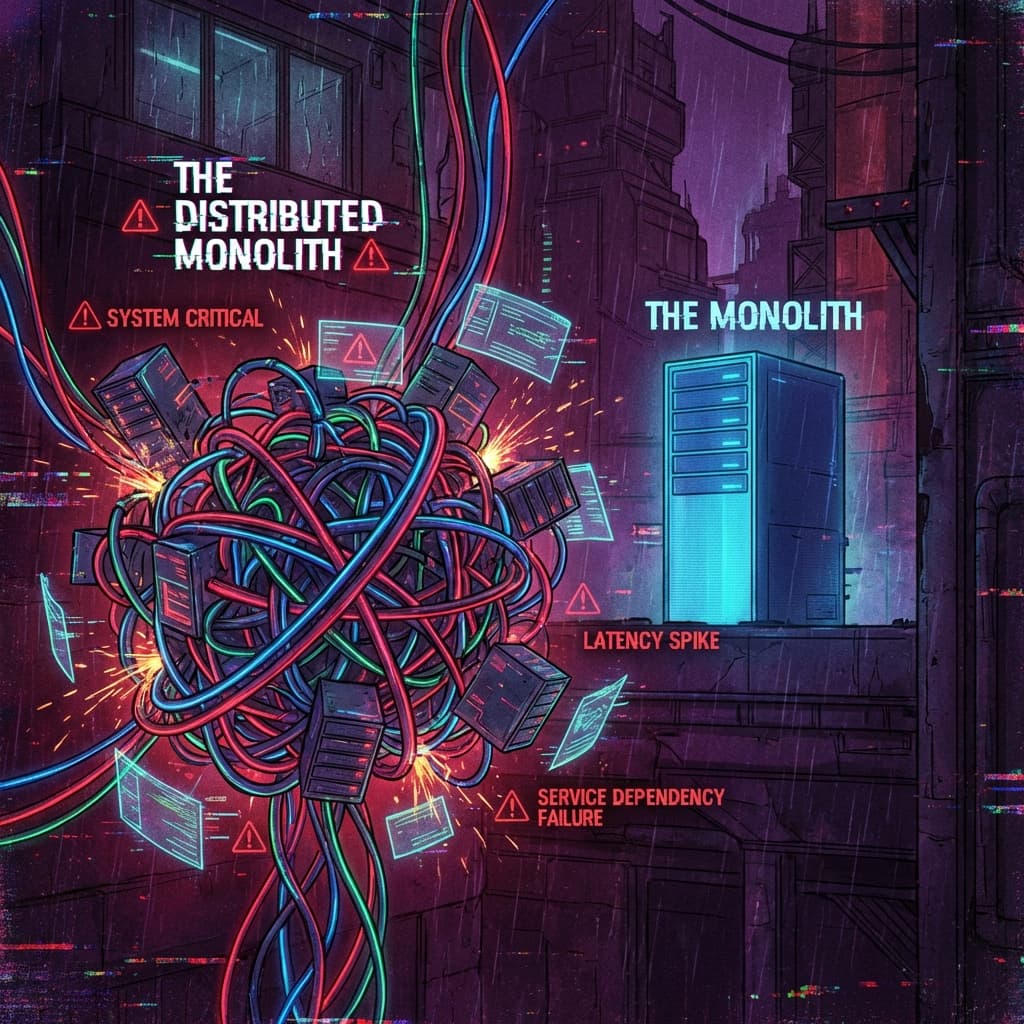
Two years later, we didn't have a sleek, decoupled architecture. We had a Distributed Monolith. And it was a nightmare.
Sign #1: The Deployment Lockstep
The promise of microservices is independent deployability. If Service A needs to change, you shouldn't need to touch Service B.
In reality, our services were so tightly coupled that deploying the "User Service" required also deploying the "Auth Service" and the "Billing Service" at the exact same time to avoid API contract breaking. We replaced a 20-minute CI build with a 4-hour "coordination meeting" where lead developers argued about deployment order in a slack channel.
If you have to deploy three services together, you don't have microservices. You have a monolith broken into pieces, with network latency added for fun. This created a culture of fear. Deployments became high-risk events. We drifted from "deploy multiple times a day" to "deploy once a week, on Thursday nights," just to manage the coordination overhead.
Sign #2: The 'Who Owns This Data?' Crisis
In a monolith, you have one database. You can join tables. It is glorious.
In our new world, we had 12 databases. When we needed to generate a report showing "Users who bought Product X in Region Y," we couldn't just run a SQL query. We had to write an "Aggregator Service" that fetched data from three other services, joined it in memory (inefficiently), and then crashed because of out-of-memory errors on large datasets.
We reinvented the relational database join layer in inconsistent application code. Data integrity became a myth. We had users who existed in the Billing system but not in the User system. We spent weeks writing "reconciliation scripts" to fix data drift.
The CAP Theorem Reality: We learned the hard way that you can have Consistency or Availability, but usually not both in a distributed system. We chose Availability, which meant our data was "eventually consistent." In practice, this meant "consistently wrong."
Sign #3: Observability Hell
Debugging a monolith is straightforward: you look at the stack trace.
Debugging a distributed monolith is a detective novel. A user reports a 500 error. The frontend logs say "Gateway Timeout." The Gateway logs say "User Service Timeout." The User Service logs say "Database Connection Pool Exhausted."
We spent more money on Datadog and Splunk implementation than we did on our actual infrastructure. We needed distributed tracing (OpenTelemetry) just to understand why a login took 4 seconds. We had to propagate trace IDs through HTTP management headers, message queues, and background workers.
When it worked, it was beautiful graphs. When it broke, it was searching for a needle in a haystack of needles.
The "Shared Lib" Dependency Nightmare
To "DRY" (Don't Repeat Yourself) our code, we created a shared library: `core-utils`. This library contained authorization logic, data models, and helper functions.
Every service imported this library.
Then we needed to update a function in `core-utils`. To propagate this change, we had to:
- Update the library version.
- Open PRs in 40 different microservice repositories to bump the version.
- Test 40 services.
- Deploy 40 services.
We had inadvertently created the world's hardest-to-update hard-linked dependency. It froze our development velocity.
The Way Back: Modular Monoliths
In 2026, the pendulum is swinging back. We didn't revert everything, but we consolidated. We merged 15 "tiny" services back into a core domain.
We adopted the Modular Monolith pattern. We enforce strict boundaries between code modules (using tools like Packwerk or simple folder structures), but we run them in a single deployable unit. We get the code organization benefits of microservices without the operational overhead of Kubernetes complexity.
My Advice: Do not start with microservices. Start with a monolith. If you build a messy monolith, you will build messy microservices. Learn to write clean, modular code first. Network calls are not a substitute for architectural discipline.
Microservices are not a default; they are a solution to a specific problem (organizational scale). If you don't have that problem (e.g. you have < 50 engineers), you are just paying a tax you don't owe.
Written by XQA Team
Our team of experts delivers insights on technology, business, and design. We are dedicated to helping you build better products and scale your business.