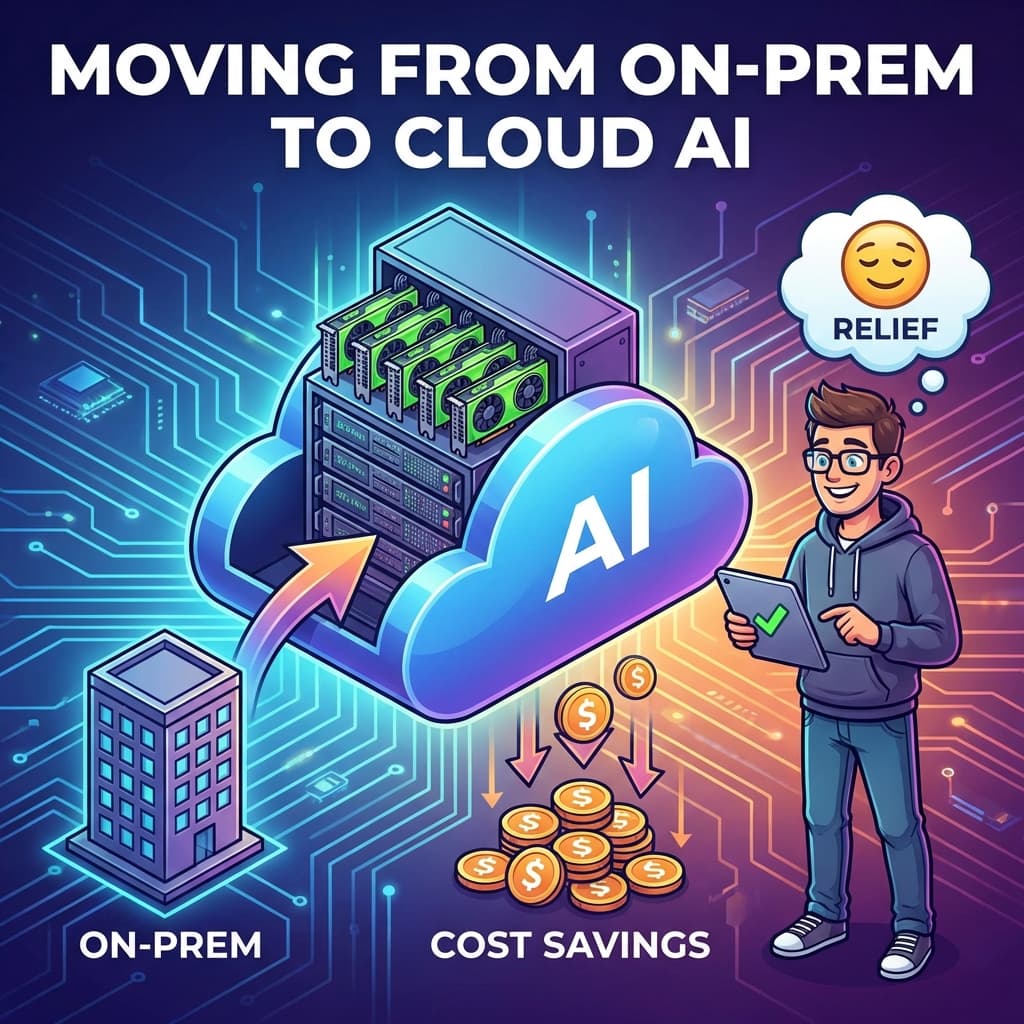
We were proud. We had built our own inference stack — two A100 GPUs, vLLM for batching, Triton for serving. "We own our AI destiny," I told the board.
Six months later, I was begging our CFO for $200,000 to undo everything.
The GPUs were at 15% utilization most of the time, then we'd get traffic spikes that overwhelmed them. The ML engineer who set it up quit. Nobody else could debug it. One driver update broke everything for 3 days. We lost a customer because of the outage.
We moved back to API-based inference (AWS Bedrock). It costs more per token — but we sleep at night.
Here's the honest math they don't tell you about "owning your AI infrastructure."
Section 1: The Seductive Math of On-Prem AI
The napkin math that convinced us to self-host was irresistible.
The Pitch:
- GPT-4 API cost: ~$15,000/month at our volume
- Two A100 GPUs: ~$30,000 one-time purchase
- Payback: 2 months!
On paper, a no-brainer. Own the hardware, eliminate the recurring cost, profit forever.
This math is a lie. Not because the numbers are wrong — they're technically correct. But because they ignore 80% of the actual costs.
What the Math Ignores:
1. Utilization Variance:
Cloud APIs charge per request. You pay for what you use. Self-hosted GPUs charge 24/7. You pay for capacity, not usage.
Our traffic pattern: 15% utilization baseline, spikes to 95% during peak hours. For 20 hours a day, those expensive GPUs sat mostly idle. During the 4 peak hours, they were overwhelmed.
You can't right-size hardware for spiky workloads. You either under-provision (and fail during peaks) or over-provision (and waste money during troughs).
2. Staffing:
Someone needs to maintain this infrastructure. GPU drivers. CUDA versions. Library compatibility. Cooling. Monitoring. On-call rotation.
We hired a senior ML infrastructure engineer: $180,000/year fully loaded. That's $15,000/month — exactly what we were "saving" on API costs.
3. Maintenance:
Hardware fails. Drivers update. Libraries have breaking changes. Every month brought a new crisis.
We spent an estimated 20 engineering hours per month just keeping the system running. At $150/hour, that's $3,000/month in hidden labor.
4. Opportunity Cost:
The 6 months we spent building and debugging inference infrastructure was 6 months we didn't spend building features. Our competitors shipped while we fought with CUDA errors.
The TCO Iceberg:
The visible cost (hardware) was 20% of total cost. The invisible costs (utilization waste, staffing, maintenance, opportunity cost) were 80%.
We learned this the expensive way.
Section 2: The Hidden Costs That Killed Us
Let me be specific about what went wrong.
Utilization Hell:
Our GPUs sat at 15% utilization for most of the day. Users were in different time zones, but traffic was still concentrated in a 6-hour window.
During peak hours, we'd hit 95% utilization. Requests would queue. Latency would spike. Users would complain.
We couldn't add more GPUs (too expensive for the marginal traffic). We couldn't reduce capacity (we needed it for peaks). We were stuck paying for hardware that was either idle or overwhelmed.
Cloud APIs don't have this problem. They scale elastically. You pay for peak capacity only when you need it.
Talent Dependency:
Our ML infrastructure engineer was brilliant. He understood the entire stack: PyTorch, vLLM, Triton, CUDA, the Linux kernel, the hardware.
Then he got a better offer. He left with 2 weeks notice.
Nobody else on the team could debug the system. When it broke (and it did), we were paralyzed. We hired contractors at $300/hour to firefight. It took 4 months to hire a replacement.
Single points of failure in critical infrastructure will fail. It's not a question of if, but when.
Maintenance Hell:
A sample of incidents from our 6 months of self-hosting:
- NVIDIA driver update broke compatibility with our CUDA version. 18 hours of downtime.
- vLLM released a new version with a memory leak. We didn't notice for 2 weeks until the system crashed.
- Cooling fan failed on one GPU. We didn't have a spare. 3 days to get a replacement.
- PyTorch upgrade required rewriting our inference code. 2 weeks of engineering time.
Every month brought a new crisis. The system was never "done." It was a perpetual maintenance burden.
Opportunity Cost:
The engineers working on infrastructure weren't working on product.
We estimate 6 months of senior engineering time went into building and maintaining the inference stack. At $200,000/year per engineer, that's $100,000 in opportunity cost — not counting the features we didn't ship and the competitive ground we lost.
Section 3: When Self-Hosting Actually Makes Sense
I'm not saying self-hosted AI is always wrong. There are contexts where it genuinely makes sense. But they're rarer than the hype suggests.
Massive, Predictable, Constant Volume:
If you're OpenAI, Google, or Anthropic, self-hosting makes sense. You have millions of requests per second, 24/7. Utilization is near 100%. The economics flip.
For most companies, volume is spiky and unpredictable. Cloud elasticity is worth the premium.
Strict Data Residency with No Cloud Option:
Some regulated industries (defense, certain healthcare, government) cannot send data to any cloud provider, period.
In these cases, self-hosting is not a choice — it's a requirement. You accept the costs because there's no alternative.
But for most companies, cloud providers (AWS, GCP, Azure) offer data residency options that satisfy compliance requirements.
Deep MLOps Expertise with Redundancy:
Self-hosting requires a team, not a person. You need redundancy in knowledge. If one engineer leaves, others can step in.
If your MLOps team is fewer than 3 people, you don't have redundancy. You have a ticking time bomb.
Reality Check:
Most startups — including us — meet none of these criteria. We had spiky traffic, no hard data residency requirements, and a one-person MLOps "team."
We should have known better. The allure of "owning our infrastructure" clouded our judgment.
Section 4: The "Managed AI" Middle Path
When we retreated from self-hosting, we didn't go back to raw OpenAI API. We found a middle ground: managed AI services.
AWS Bedrock, GCP Vertex, Azure OpenAI:
These services give you API simplicity with cloud-native benefits:
- No hardware to manage
- Elastic scaling (pay for what you use)
- Data stays within your cloud VPC (satisfies most compliance requirements)
- SLAs and support
We chose AWS Bedrock. Our data never leaves our AWS account. We get the privacy benefits we wanted without the operational burden.
Serverless Inference:
Some platforms offer serverless GPU inference: pay per request, not per GPU-hour.
This perfectly matches spiky workloads. Busy hour? Scale up automatically. Quiet hour? Scale to zero.
The per-request cost is higher than dedicated hardware at 100% utilization. But we're never at 100% utilization. For our traffic pattern, serverless was cheaper.
The Results:
- Cost: Up ~30% compared to our self-hosted "steady state" (but we never achieved steady state)
- Reliability: 99.9% uptime vs the ~95% we were achieving with self-hosting
- Engineering time: Near zero maintenance, freeing 2 FTEs worth of capacity
- Peace of mind: Priceless
The 30% cost increase was one of the best investments we made. We traded dollars for hours, and hours are more valuable.
Conclusion
The "own your AI infrastructure" narrative is seductive. It promises control, cost savings, and independence.
For most companies, it delivers none of these. It delivers complexity, hidden costs, and fragility.
Own your differentiation. Rent your infrastructure.
Your competitive advantage is not running GPUs. It's building products users love. Let AWS, GCP, or Azure run the GPUs. You focus on what matters.
The best infrastructure is the infrastructure you don't have to think about.
Written by XQA Team
Our team of experts delivers insights on technology, business, and design. We are dedicated to helping you build better products and scale your business.