The Board Meeting That Changed Everything
I walked into our Series B board meeting with confidence. Our metrics looked strong:
- Monthly growth: 12% MoM
- Logo churn: 6% annually
- Gross revenue retention: 94%
I presented the quarter's results with pride. We were growing, customers were staying, the flywheel was spinning.
Then the lead investor asked a question that exposed my ignorance: "What's your net revenue retention?"
I paused. We tracked gross retention religiously. Net retention? We hadn't formalized that metric.
She pulled up her phone calculator. "94% gross retention. How much expansion revenue from existing customers?"
I checked my notes. "About 5% of revenue comes from upsells and expansions."
She typed. "So your NRR is approximately 99%. You're losing roughly as much revenue to churn as you're gaining from expansion. That's not growth from existing customers—that's treading water."
The room felt smaller. "Your new customer acquisition is driving all your growth. If acquisition slows down—and it always does eventually—you'll stall. You need net retention above 100%. Preferably above 120%. That's how enduring SaaS companies are built."
That meeting changed how I think about SaaS metrics. Here's what I learned about why negative churn is the only metric that really matters.
Section 1: Why Most Retention Metrics Are Lying to You
Most SaaS companies track the wrong retention metrics—or track the right ones but misinterpret what they mean.
The Gross Retention Trap
Gross revenue retention (GRR) measures how much revenue you keep from existing customers, excluding expansion.
Formula: (Revenue at start of period - Churned revenue) / Revenue at start of period
A 94% GRR sounds great. But GRR ignores the other half of the equation: expansion. A company with 94% GRR and 0% expansion is slowly dying. A company with 85% GRR and 40% expansion is thriving.
GRR tells you about retention. It doesn't tell you about growth from existing customers.
The Logo Churn Distortion
Logo churn counts the number of customers who leave, regardless of revenue size.
Problem: not all logos are equal. Losing 10 $100/month customers hurts less than losing one $5,000/month customer. But logo churn treats them the same.
I've seen companies celebrate "low logo churn" while their largest customers quietly churned, decimating revenue. The vanity of logo-based metrics hid the revenue reality.
The Metric That Actually Matters: Net Revenue Retention
Net Revenue Retention (NRR) captures the complete picture:
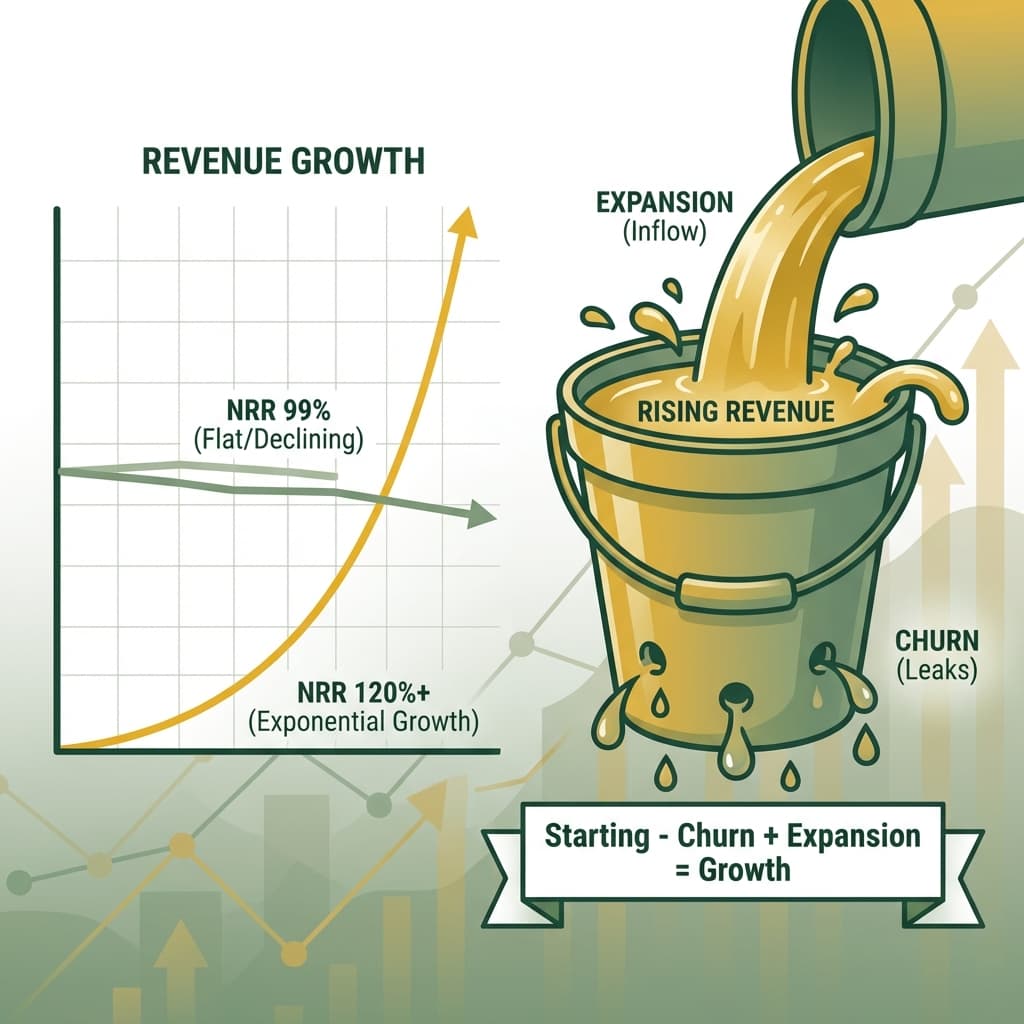
Formula: (Starting revenue - Churned revenue + Expansion revenue) / Starting revenue
NRR tells you: "If we acquired zero new customers, how much would revenue grow or shrink from our existing base?"
- NRR = 100%: You're replacing what you lose. Zero organic growth from existing customers.
- NRR = 80%: You're losing 20% of revenue annually from churn. Leaky bucket.
- NRR = 120%: Existing customers generate 20% more revenue year over year. Compounding growth engine.
Our 99% NRR meant we were barely breaking even on existing customers. All our growth came from new acquisition. That's expensive and unsustainable.
Section 2: The Magic of Negative Churn
"Negative churn" is when NRR exceeds 100%. Your existing customers generate more revenue than you lose to churn. It's called "negative" because the churn contribution to growth is negative—you're not shrinking, you're expanding from the base.
The Compounding Effect
Let's do the math.
Year 0: 100 customers paying $1,000/year = $100,000 ARR
Scenario A (NRR = 95%):
- Year 1: $95,000
- Year 2: $90,250
- Year 3: $85,737
Your original cohort is worth 85% of its initial value after 3 years.
Scenario B (NRR = 120%):
- Year 1: $120,000
- Year 2: $144,000
- Year 3: $172,800
Your original cohort is worth 173% of its initial value after 3 years.
That's the power of negative churn: your existing customers become a growth engine. You don't need new acquisition to grow—your base compound on its own.
Companies That Achieve Negative Churn
The most valuable SaaS companies have extraordinary NRR:
- Snowflake: 168% NRR (customers use more compute as data grows)
- Twilio: 143% NRR (usage-based pricing scales with customer growth)
- Datadog: 130%+ NRR (more infrastructure = more monitoring)
- MongoDB: 120%+ NRR (databases grow with application data)
Notice the pattern: usage-based pricing and products that grow with customer success. When customers win, revenue grows.
The Economic Flywheel
High NRR creates a virtuous cycle:
- Existing customers generate growth → Better unit economics
- Better unit economics → More capital for acquisition
- More acquisition capital → Faster new customer growth
- Faster growth → Higher valuations → More capital
Companies with 120%+ NRR can grow faster while spending less on acquisition. They're running downhill while low-NRR competitors run uphill.
Section 3: Why You Probably Don't Have Negative Churn
Most companies have NRR between 90-105%. Here's why—and how to fix it.
Reason 1: Flat-Rate Pricing
If every customer pays the same amount regardless of usage or success, there's no expansion path.
A customer paying $100/month on day one pays $100/month on day 1,000. There's no mechanism for revenue to grow.
Fix: Introduce usage-based or tiered pricing. Charge more as customers use more (seats, API calls, storage, compute).
Reason 2: Customer Success Focused on Retention, Not Expansion
Many CS teams are measured on "keep the customer from churning." This creates a defensive mindset: avoid problems, minimize risk, don't rock the boat.
But expansion requires a proactive mindset: identify growth opportunities, suggest upgrades, propose new use cases.
Fix: Give CS teams expansion quotas, not just retention targets. Measure them on NRR, not just GRR.
Reason 3: Product Stagnation
If your product is the same today as it was 2 years ago, why would customers pay more?
Expansion revenue requires new capabilities: features, integrations, modules. Customers pay more when they get more value.
Fix: Prioritize features that existing customers will pay more for, not just features that attract new logos.
The Expansion Playbook
Based on what worked for us, here are the levers for driving expansion revenue:
- Seat-based growth: Price per user; expansion happens naturally as teams grow
- Usage-based tiers: Free/Basic/Pro/Enterprise with increasing feature access
- Module add-ons: Sell additional capabilities as separate line items
- Cross-sell: Expand to new teams or departments within the same company
- Annual incentives: Offer discounts for annual prepayment with built-in price increases
Case Study: From 99% to 117% NRR
After the board meeting wake-up call, we restructured our pricing and CS approach:
Before:
- Flat rate per customer ($500/month regardless of usage)
- CS measured on logo churn
- No upsell motion
- NRR: 99%
After (12 months later):
- Usage-based pricing (base + per-seat + per-feature)
- CS measured on NRR by account
- Quarterly business reviews focused on expansion opportunities
- NRR: 117%
Key changes:
- Seat-based pricing component meant accounts grew as client teams grew
- Feature tiers gave CS a natural upsell path
- QBRs became revenue conversations, not just support check-ins
It took 12 months to see the full impact, but the transformation was dramatic. Our existing customers became a growth engine.
Section 4: Building an Organization Around NRR
Achieving negative churn requires organizational changes, not just pricing changes.
Customer Success as Revenue Center
The traditional split: Sales brings in new logos, CS keeps them. This creates a handoff that often drops the expansion ball.
Better model: CS owns net revenue retention. They're measured on both retention AND expansion. They're accountable for the full customer lifecycle.
This means:
- CS reps have expansion quotas
- CS compensation includes expansion commission
- CS career paths include "growth" roles, not just "retention" roles
Product Roadmap for Expansion
Most product teams prioritize features that attract new customers. That's acquisition-focused.
An NRR-focused product team asks: "What would our existing customers pay more for?"
This might mean:
- Power user features that justify upgrading tiers
- Admin/compliance features that unlock enterprise contracts
- Integrations with tools large customers already use
- Capabilities that expand use cases beyond the original purchase
Prioritize expansion revenue in roadmap decisions.
Pricing Architecture
Build expansion into pricing from day one:
- Usage dimensions: Identify what grows as customers succeed (seats, data, API calls, projects)
- Natural upgrade paths: Clear value differences between tiers that justify higher spend
- Annual incentives with escalation: Year 1 pricing lower than Year 2, built into the contract
If your pricing has no expansion mechanism, you're leaving money on the table.
Dashboard Obsession
Make NRR visible and constantly reviewed:
- Track NRR by cohort (when did the customer join?)
- Track NRR by segment (SMB vs. Mid-Market vs. Enterprise)
- Track NRR by CSM (which reps drive expansion?)
- Report NRR at board level alongside acquisition metrics
What gets measured gets managed. Make NRR a first-class metric.
The Hiring Profile
Traditional CS hires come from support backgrounds. They're great at solving problems and preventing churn.
NRR-focused CS hires need sales-adjacent skills: identifying opportunities, navigating conversations about money, building business cases for expansion.
Look for: account management experience, comfort with commercial conversations, and a consultative mindset.
Closing Thought
If your NRR is below 100%, you're filling a leaky bucket. Fix the bucket before pouring in more water.
We spent years pouring resources into acquisition while our bucket leaked. The investor's question—"What's your net retention?"—forced us to confront that we were running to stay in place.
Negative churn is the cheat code of SaaS. When existing customers generate growth, everything else gets easier: unit economics improve, fundraising gets simpler, and the compounding flywheel spins faster.
Track NRR. Fix NRR. Build your organization around NRR. Everything else is vanity.
Appendix: NRR Diagnostic
Quick questions to assess your expansion potential:
- Does your pricing include a usage component that scales with customer success?
- Do you have clear feature tiers with meaningful differences that justify upgrades?
- Are your CS reps measured on expansion, not just retention?
- Do you conduct regular reviews focused on growth opportunities (not just support)?
- Is NRR a board-level metric that gets executive attention?
If you answered "no" to 3+ questions, your expansion infrastructure is weak. Start there.
Written by XQA Team
Our team of experts delivers insights on technology, business, and design. We are dedicated to helping you build better products and scale your business.