The No-Meeting Wednesday Disaster
We launched "No-Meeting Wednesday" with great fanfare. The announcement went out on Monday morning. Engineers cheered. Product managers were cautiously optimistic. Leadership congratulated itself on prioritizing deep work and employee wellbeing.
The theory was sound: protect one full day per week for focused work. No interruptions. No context-switching. Just pure productivity.
Here's what actually happened.
Week 1: Wednesday was glorious. People coded for 6 straight hours. The quiet was palpable.
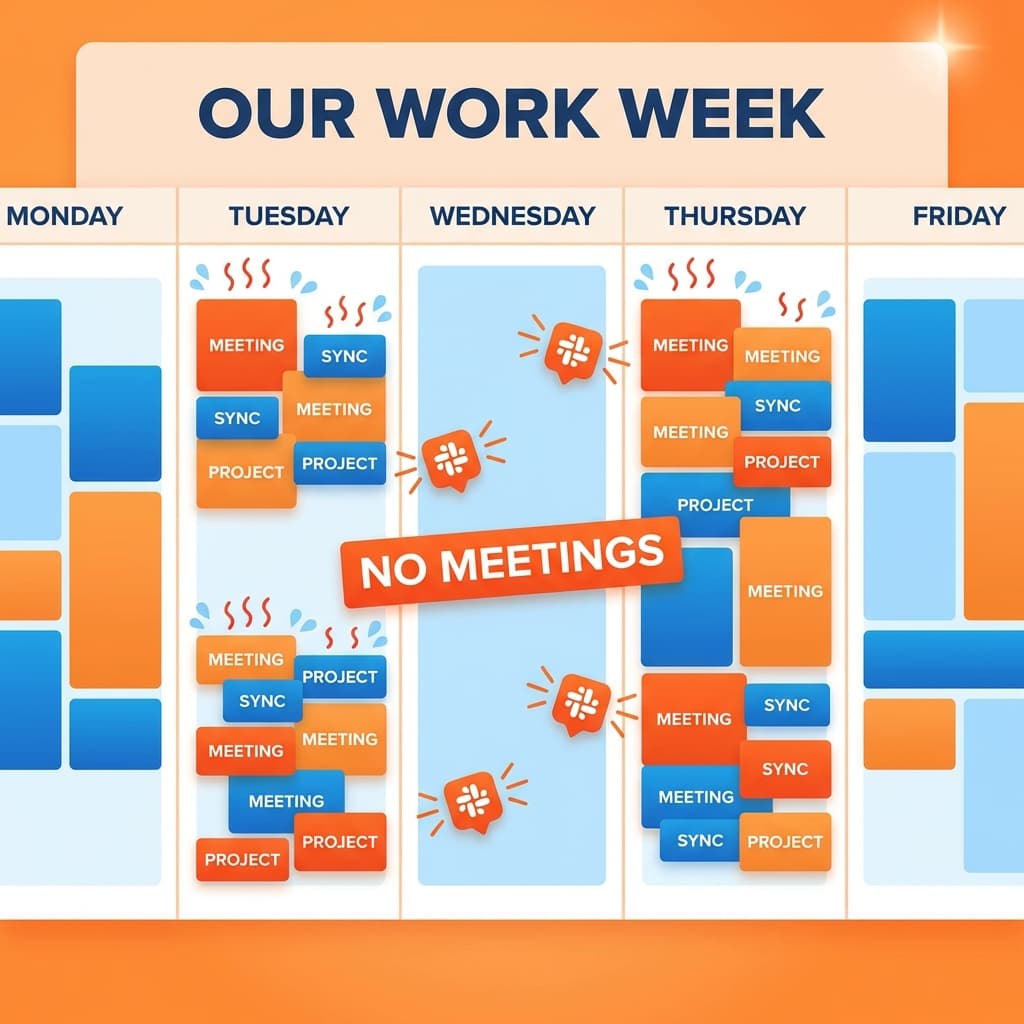
Week 2: Slack volume on Wednesday exploded. Without meetings, people turned to async messaging. Engineers received more Slack DMs on Wednesday than any other day.
Week 3: Tuesday and Thursday calendars filled completely. Every meeting that would have been on Wednesday got scheduled on the adjacent days. Both days became 8+ hours of meetings.
Week 4: People started scheduling "optional" meetings on Wednesday. "It's not a real meeting, just a quick sync." The policy eroded from the edges.
Month 3: We measured actual deep work time. Wednesdays had more uninterrupted work, but Tuesday and Thursday were so fragmented that the net result was worse than before. Total deep work hours per week decreased by 15%.
We hadn't fixed meeting culture. We had compressed it into a smaller space, making it denser and more exhausting.
Section 1: Why "No-Meeting" Policies Fail
Our failure wasn't unique. "No-meeting" policies fail for predictable reasons.
They Treat Symptoms, Not Disease
The symptom is "too many meetings." The disease is "bad meetings" and "meetings as default coordination mechanism."
No-meeting policies reduce meeting quantity on specific days without addressing why there are so many meetings in the first place. The underlying dynamics—decision-making habits, communication norms, lack of written culture—remain unchanged.
It's like treating a fever with ice baths while ignoring the infection causing it. You might reduce the temperature temporarily, but the problem persists.
The Compression Effect
Meetings don't disappear when you ban them from one day. They concentrate on other days.
If your team needs 20 hours of meetings per week, and you eliminate one day, those 20 hours compress into 4 days instead of 5. Each meeting-allowed day becomes 25% more crowded.
In our case:
- Pre-policy: 4-5 hours of meetings per day, spread across 5 days
- Post-policy: 0 hours Wednesday, 6-8 hours Tuesday and Thursday, unchanged Monday and Friday
The concentration on Tuesday and Thursday made those days worse than any pre-policy day. The net effect was negative.
The Async Explosion
When you ban meetings, you don't eliminate the need for coordination. You shift it to async channels.
On No-Meeting Wednesday, our Slack usage spiked. DMs doubled. Threads became lengthy debates. People felt obligated to respond immediately because "it's async, so don't delay."
Slack interruptions aren't less disruptive than meetings—they're often more so. A 1-hour meeting has a clear start and end. Slack creates continuous partial attention, which is worse for deep work than discrete meetings.
Decision Paralysis
Some decisions genuinely need real-time discussion. Complex trade-offs, nuanced disagreements, brainstorming—these don't work well in async.
When Wednesday became off-limits, urgent decisions that emerged on Wednesday stalled. People waited until Thursday to discuss them. That delay compounded through the week, slowing everything downstream.
We had traded meeting overhead for decision delay. Not a good trade.
Section 2: The Actual Problem
After the policy failed, we did a retrospective. The conclusion: the problem was never meeting quantity. It was meeting quality.
Bad Meetings Are the Enemy
We audited our meetings and found:
- No agenda: 62% of recurring meetings had no written agenda
- No decision owner: 44% of meetings ended without clear next steps or owners
- Too many attendees: Average attendance was 7 people, but most discussions involved only 3
- Wrong format: 30% of meetings were status updates that could have been written summaries
We were drowning in meetings not because meetings are inherently bad, but because our meetings were badly run.
The "Could This Be an Email?" Fallacy
The popular advice is "most meetings could be emails." This is half-right.
Status updates and one-way information sharing? Yes, those should be written.
But decisions, debates, brainstorms, relationship-building? Those often need real-time interaction. The alternative isn't "email"—it's "47-message Slack thread that takes 2 days and frustrates everyone."
The right question isn't "could this be async?" It's "is this meeting well-designed for its purpose?"
The Real Cost: Focus Fragmentation
The problem with bad calendar culture isn't time-in-meetings. It's the fragmentation of focus.
A day with 3 one-hour meetings isn't a 5-hour workday with 3 hours of meeting overhead. It's a day chopped into 6 fragments, each too short for meaningful work. Context-switching costs between each fragment drain productivity further.
Studies show it takes 23 minutes to regain focus after an interruption. With 6 context switches per day, you're losing 2+ hours just to recovery—even if you only spent 3 hours in meetings.
The goal isn't fewer meetings. It's fewer interruptions.
Section 3: What Actually Worked
After No-Meeting Wednesday failed, we tried something different: fix the meetings instead of banning them.
Intervention 1: Default 25/50 Minute Meetings
We changed all calendar defaults from 30/60 minutes to 25/50 minutes.
The immediate effect: 5-10 minute gaps appeared naturally between meetings. People had time to use the bathroom, grab coffee, or prepare for the next meeting.
The subtle effect: shorter time boxes forced tighter agendas. Meetings couldn't sprawl because the clock was visible.
Outcome: Average meeting duration dropped 15% with no reduction in perceived effectiveness.
Intervention 2: Mandatory Agendas
We implemented a simple rule: no agenda in the calendar invite = meeting auto-canceled 24 hours before.
This was enforced by a bot that checked calendar invites and sent reminders. If no agenda was added, the meeting was canceled and invitees notified.
Initially, people grumbled. Then they adapted. Agendas appeared. Meetings became more focused because attendees could prepare.
Side effect: About 20% of recurring meetings were quietly abandoned. People realized they didn't have enough to discuss regularly, so they converted to "as-needed" instead of weekly.
Intervention 3: Attendee Limits
Meetings with more than 5 people required VP approval. Not "informational" approval—a 2-minute Slack conversation explaining why this topic required 6+ people.
Most organizers discovered they didn't need 7 people. They needed 4 people, with the other 3 getting a written summary afterward.
Average meeting size dropped from 7 to 4.2. This cascading improvement reduced total person-hours in meetings significantly.
Intervention 4: Async-First for Status Updates
We killed all weekly status update meetings. Every team moved to written updates instead:
- Each team member posts a weekly update (5-10 bullet points) by Friday 3pm
- Manager compiles and shares a summary
- Meetings reserved for discussion of the updates, not delivery of the updates
This cut meeting time by about 30-45 minutes per person per week while improving information quality. Written updates are searchable, shareable, and don't require everyone to be present simultaneously.
Results After 6 Months
- Meeting hours: Down 35% company-wide
- Meeting effectiveness rating: Up from 3.2/5 to 4.1/5 (internal survey)
- Deep work blocks: Up 60% (measured via calendar analysis)
- Employee satisfaction with calendar: Up 40%
The improvements came from fixing meetings, not eliminating them.
Section 4: The Meeting Culture Playbook
Based on what worked for us, here's a framework for fixing calendar culture at your organization.
Level 1: Hygiene (Quick Wins)
These are non-negotiable basics:
- Agendas required: Every meeting has a written agenda in the invite
- Time boxing: Default to 25/50 minutes, not 30/60
- Clear owners: Every meeting has a designated facilitator and note-taker
- Written outcomes: Action items documented and shared within 24 hours
If you're not doing these, start here. They're low-cost and high-impact.
Level 2: Defaults (Cultural Shifts)
Defaults shape behavior more than policies:
- Attendee limits: Default to small (3-4 people); require justification for larger
- Recurring meeting audits: Every 90 days, review all recurring meetings for necessity
- Spech hours: Designate specific hours as "meeting-free" rather than entire days
- Optional by default: Assume attendance is optional unless explicitly required
Level 3: Cultural Norms (Behavioral Change)
Policies only work if culture supports them:
- "Decline without guilt" culture: Normalize declining meetings that aren't essential for you
- Meetings as sacred commitments: If you accept, you attend prepared. If you can't, decline.
- Punctuality as respect: Start on time, end on time, always.
- Presence over attendance: Phones and laptops closed unless taking notes
Level 4: Structural Changes (System Redesign)
For deeper transformation:
- Async-first decision logs: All major decisions documented in writing, with rationale
- Recorded video updates: Loom-style updates replace many "presentation" meetings
- Written RFCs: Complex decisions start with written proposals, not brainstorm meetings
- Meeting retrospectives: Periodically review "was this meeting worth everyone's time?"
The Frame Shift
Stop asking: "How do we have fewer meetings?"
Start asking: "How do we make meetings worth attending?"
Good meetings are valuable. They build alignment, unlock decisions, and strengthen teams. The goal isn't fewer meetings—it's zero bad meetings.
Closing Thought
No-meeting policies are bandaids. Meeting culture requires surgery.
We tried the quick fix and it backfired. The compression effect, async explosion, and decision paralysis made things worse. What worked was addressing the root causes: poor hygiene, bloated attendee lists, status-update meetings, and lack of accountability.
Your calendar is a reflection of your culture. If your calendar is broken, don't reach for a policy. Reach for a cultural intervention.
Appendix: Calendar Health Assessment
Score your meeting culture 1-5 on each dimension:
- Agenda discipline: Do all meetings have written agendas?
- Time discipline: Do meetings start and end on time?
- Attendance discipline: Is the average meeting 5 or fewer people?
- Outcome discipline: Do meetings result in documented action items?
- Necessity discipline: Are recurring meetings audited regularly?
If you average below 3, fix meeting quality before worrying about meeting quantity.
Written by XQA Team
Our team of experts delivers insights on technology, business, and design. We are dedicated to helping you build better products and scale your business.