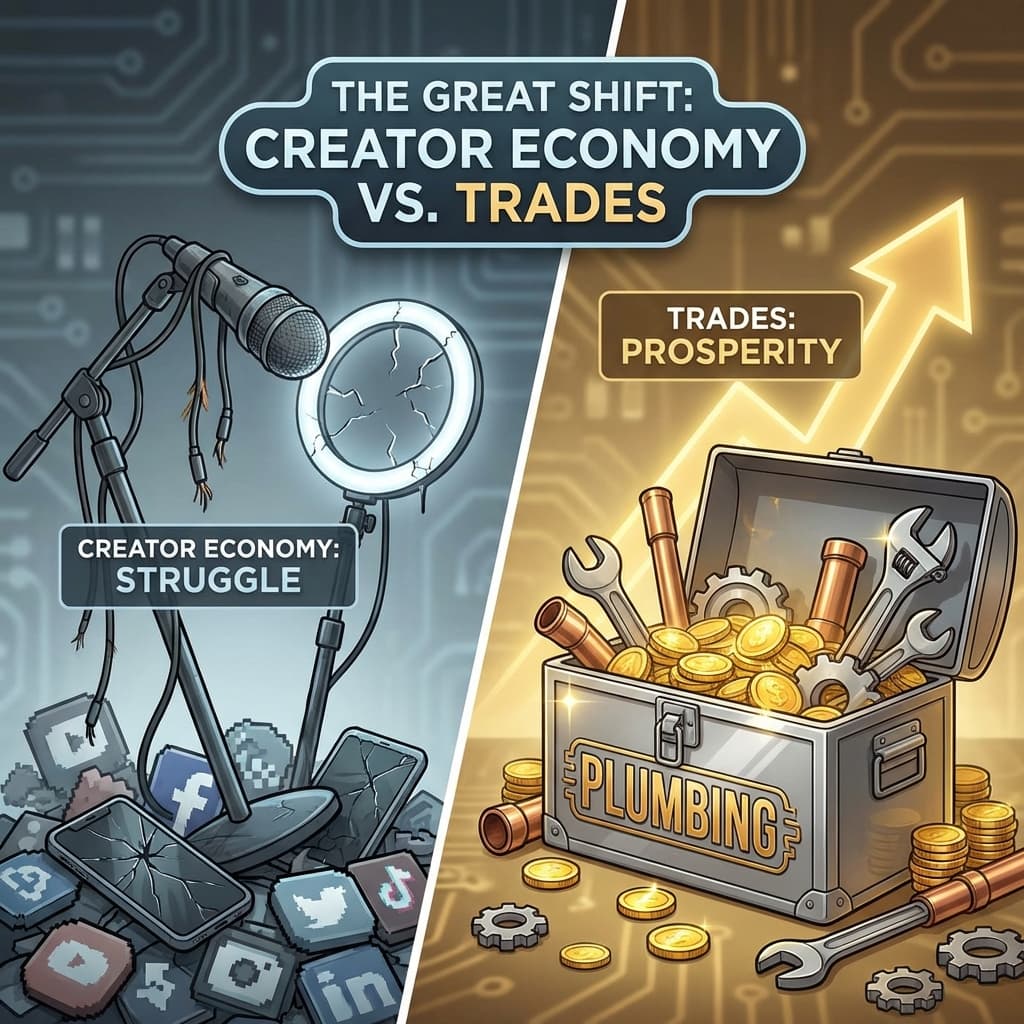
In 2021, the internet told me to "Follow My Passion." I was a software engineer, but every influencer said the future was in "The Creator Economy."
So, I started a podcast. I bought a $400 microphone. I bought the $200/year editing software. I designed a logo. I published 50 episodes over 18 months.
I made $47.00. Total.
That is not a typo. Forty-seven dollars. For 500+ hours of work.
Around the same time, my HVAC guy came to fix my air conditioner. He drove a Ford F-150 Platinum ($70,000 truck). He told me he had a 3-week waitlist. He didn't ask me to "Subscribe to his newsletter." He just fixed the AC and left with a $400 check.
I realized something that day. The "Passion Economy" is a lie. It is a story sold by platforms (Substack, Patreon, Gumroad) that profit from your content, while you fight for scraps.
The real wealth is being built in "Boring Services" by people who don't have Twitter followers, but have skills that the world desperately needs.
Here is the data-backed case for abandoning the Creator Dream and learning to fix an air conditioner.
Section 1: The "Creator Economy" Crash of 2025
Let's look at the numbers.
The Attention Supply/Demand Mismatch:
In 2020, there were roughly 50 million content creators globally (YouTube, Podcast, Substack, etc.).
In 2025, there are over 200 million.
The supply of content quadrupled. Did the audience quadruple? No. There are still only 24 hours in a day. Attention is finite.
The result is Winner-Take-All dynamics. The top 1% of creators take 90% of the revenue. The other 99% split the crumbs.
The Platform Risk:
Your "Creator Business" is built on rented land.
- YouTube changes the algorithm. Your views drop 80% overnight. (Happened to thousands in 2024).
- TikTok gets banned (or almost banned). Your audience vanishes.
- Substack raises its take rate. Your margins evaporate.
You have zero control. You are a digital sharecropper.
The "Hustle Porn" Delusion:
The advice you hear is: "Just be consistent! Post every day for 3 years!"
This is survivorship bias. You hear from the 1% who made it. You don't hear from the 99% who posted every day for 3 years, burned out, and quit with nothing.
Consistency is necessary but not sufficient. You also need luck, timing, and an audience that happens to care about your niche.
Section 2: The "Supply Chain" of Skilled Labor is Broken
Meanwhile, in the "Boring" economy, a different story is unfolding.
The Boomer Retirement Wave:
The Baby Boomers (born 1946-1964) are retiring at a rate of 10,000 per day. Many of them were Plumbers, Electricians, Welders, and HVAC technicians.
When they retire, their skills leave with them. There is no "Knowledge Transfer." The apprenticeship pipeline has been broken for decades.
The College Lie:
For 30 years, we told every young person: "Go to college. Get a degree. Avoid 'Blue Collar' work."
Gen Z listened. They went to college. They got $100,000 in student debt. They graduated with Psychology degrees.
Now, they are baristas. They cannot find a job. Meanwhile, the Plumber who skipped college is booked solid and makes $150,000/year.
The Price Signal:
Economics is about supply and demand. When supply of a skill drops and demand stays constant, the price rises.
- A licensed Plumber in Texas charges $150/hour.
- A freelance Graphic Designer on Fiverr charges $15/hour.
Which career has more "Passion Content" on the internet? Graphic Design. Which career pays 10x more? Plumbing.
The market is screaming at you. Stop designing logos. Learn to sweat a pipe.
Section 3: The "Productized Service" Model
If you are a white-collar knowledge worker, you might be thinking: "I'm not going to become a Plumber."
Fair. But you can own a plumbing business without ever touching a wrench.
The "Productized Service" Formula:
- Pick a "Boring Service" (Lawn Care, Junk Removal, Pressure Washing, Pool Cleaning).
- Build a simple website with online booking and instant quotes.
- Use software to generate quotes automatically (e.g., AI analyzes a satellite image of the lawn, calculates square footage, outputs a price).
- Hire contractors (or employees) to do the actual work.
- You handle Sales, Marketing, and Operations. They handle Execution.
The Moat:
Your moat is not software. Anyone can copy your website.
Your moat is Trust + Local Reputation + Network. The homeowner trusts "Mike's Lawn Care" because their neighbor uses Mike. That trust takes years to build and is nearly impossible to replicate.
Case Study: Jobber Unicorns:
Jobber (a scheduling software for home service businesses) has published data on their users. The average Jobber customer (a small home service business) generates $500k+ in annual revenue with 3-5 employees.
These are not venture-funded startups. They are boring businesses printing cash.
Section 4: Why White-Collar Workers Should Learn a Trade
Even if you don't start a business, learning a trade is the ultimate Career Hedge.
The Layoff Insurance:
In 2024 and 2025, over 300,000 tech workers were laid off. Many are still unemployed. The job market is brutal.
If you can weld, you can always find work. If you can only "write Jira tickets," you are competing with 10,000 other laid-off PMs for 3 open roles.
The Recession-Proof Income:
When the economy crashes, people stop buying SaaS subscriptions. They do not stop needing their toilets fixed.
Trades are tied to essential physical needs (Shelter, Water, Heat). SaaS is tied to discretionary corporate spending. One of these is more stable than the other.
The Weekend Strategy:
You don't have to quit your tech job. Keep the salary. But on weekends, take a welding class at the community college. Learn to wire an electrical panel. Get a contractor's license.
You are building a fallback. If the AI wave eliminates your coding job, you have a Plan B that no AI can do (yet).
Conclusion
The world needs fewer "Thought Leaders" and more people who can fix a leaking pipe.
The "Passion Economy" was a beautiful dream. But the math never worked. For every Mr. Beast, there are a million failed YouTubers.
The "Boring Services" economy is smaller, quieter, and less glamorous. But the odds of making a living are 100x higher.
Stop chasing followers. Start chasing skills.
Written by XQA Team
Our team of experts delivers insights on technology, business, and design. We are dedicated to helping you build better products and scale your business.