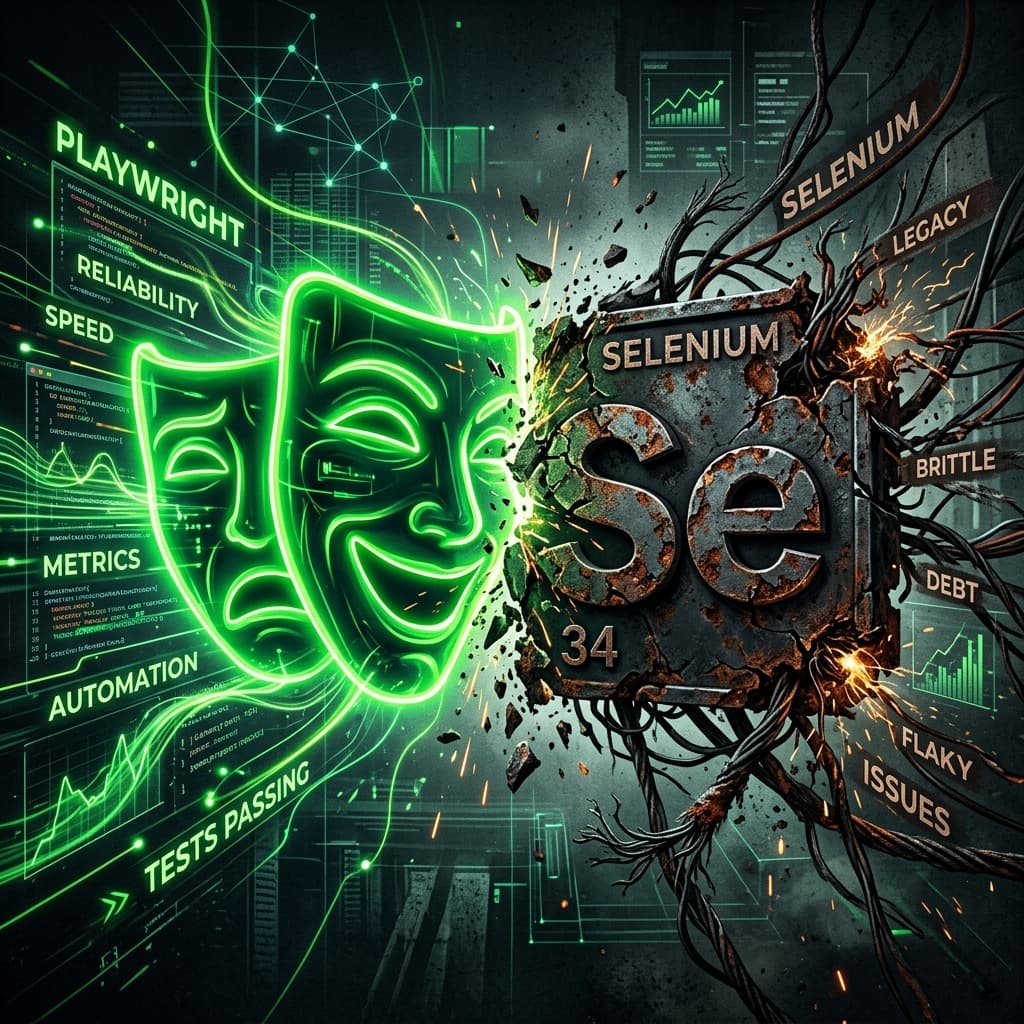
In the world of automated browser testing, the transition has been less of an evolution and more of a tectonic shift. For 15 years, Selenium was synonymous with browser automation. To be a QA engineer meant to be a Selenium engineer. But looking at the data, GitHub trends, StackOverflow questions, and enterprise migration roadmaps in 2026, the discussion has fundamentally changed. Playwright has not just caught up; it has comprehensively dominated the mindshare.
However, simply saying "Playwright is better" ignores the nuance of the enterprise landscape. To truly understand the state of test automation, we must analyze the specific trending topics and pain points that differentiate the Playwright community from the Selenium community today. This 3,000-word analysis breaks down the trending differences between the two giants.
Trend 1: The Definition of "Stability"
If you analyze the trending discussions in Selenium forums versus Playwright forums, the word "stability" means two entirely different things.
The Selenium Definition: Ecosystem Stability
In the Selenium community, trending topics revolve around ecosystem stability. The discussions are dominated by grid management, driver compatibility, and language binding updates. Why? Because Selenium is an ecosystem of disparate parts. You have the browser, the browser driver (ChromeDriver, GeckoDriver), the Selenium Server (Grid), and the language bindings (Java, Python, C#).
Trending Selenium topics in 2026 heavily feature:
- "How to manage Selenium Grid 4 on Kubernetes"
- "ChromeDriver version mismatch after Chrome auto-update"
- "Selenium 4.x upgrade migration guides for legacy Java enterprise frameworks"
Selenium users spend a massive amount of their engineering bandwidth ensuring that the infrastructure required to run the tests remains stable. The testing framework itself is treated like infrastructure.
The Playwright Definition: Execution Stability
In the Playwright community, "stability" refers almost exclusively to test execution stability—the elimination of flakiness. Because Playwright manages its own browsers and communicates via direct websocket protocols (CDP) rather than HTTP middleware (WebDriver), infrastructure stability is largely a solved problem.
Trending Playwright topics feature:
- "Optimizing auto-waiting for complex React transitions"
- "Using Playwright Test UI mode for trace analysis on flaky CI runs"
- "Mocking third-party API endpoints for deterministic execution"
Notice the shift: Playwright developers are spending their time stabilizing the software they are testing, not the tool they are using to test it. The cognitive load has shifted from infrastructure maintenance to application quality.
Trend 2: The Shift-Left Reality
For a decade, the industry talked about "shifting left"—moving testing closer to the developers. Selenium was heavily pushed as a shift-left tool, but the reality was that it remained firmly in the domain of dedicated SDETs (Software Development Engineers in Test). Front-end developers largely despised Selenium; it was slow, required Java/C# knowledge, and felt completely disconnected from modern web development workflows.
The latest trending data reveals that Playwright actually achieved the shift-left promise that Selenium failed to deliver.
Selenium's Demographic: The Legacy Enterprise SDET
If you look at job postings requiring Selenium, 85% of them are for dedicated QA or SDET roles, predominantly requesting Java. Selenium is entrenched in massive, older corporations that centralized their QA departments. The trending topics reflect this: integration with heavy Test Case Management tools (ALM, Zephyr), BDD frameworks (Cucumber), and Excel data-driven frameworks.
Playwright's Demographic: The Full-Stack Engineer
Playwright's trending topics are heavily intertwined with front-end ecosystems. Playwright discussions trend alongside Next.js, Vercel, Tailwind, and React. Playwright is increasingly being written by the developers who write the feature code.
This is because Playwright feels like a modern web tool. It is native to Node.js/TypeScript. It executes fast enough to run continuously during development. And most importantly, features like Playwright Component Testing allow developers to test React or Vue components in isolation within a real browser—something Selenium was never architected to do.
Trend 3: Modern Application Architecture vs. Legacy Protocols
The architecture of the web has changed drastically since Selenium WebDriver became the W3C standard. We went from static HTML pages to Single Page Applications, to Server-Side Rendered hydration, to streaming architectures and WebSockets.
Selenium's Struggle with Asynchrony
Selenium trending questions are still flooded with variations of "ElementNotInteractableException" or "StaleElementReferenceException." Selenium's WebDriver protocol is inherently synchronous and polling-based. If a React component re-renders while Selenium is trying to click it, the test blows up. To fix this, Selenium engineers write complex Custom Expected Conditions and Explicit Waits, attempting to force a synchronous testing tool to understand an asynchronously rendering page.
Playwright's Natively Asynchronous Approach
Playwright was built for the asynchronous web. Its most significant trending feature is "Actionability." When you tell Playwright to click a button, it doesn't just blindly fire a click event or wait for the element to exist. It actively listens to the browser events to ensure the element is visible, stable (not animating), enabled, and unobscured before strictly dispatching the event.
Furthermore, trending Playwright topics show deep usage of Network Interception. Because Playwright has a direct connection to the browser engine, it can instantly mock network requests, modify headers, block image loading to speed up tests, or simulate offline modes. Selenium 4 added CDP support to allow network mocking, but it remains a bolt-on feature that is complex to configure compared to Playwright's native APIs.
Trend 4: The Tooling Ecosystem
The visual tooling surrounding a framework dictates how fast engineers can debug failures. This is perhaps where the trending topics diverge most sharply.
Selenium: Log Diving and Third-Party Dashboards
When a Selenium test fails in CI, the debugging process usually involves looking at a stack trace, checking a screenshot taken at the moment of failure, and trying to decipher what happened. Advanced teams use third-party tools like ReportPortal, but the core debugging experience remains text-heavy and disconnected from the browser state.
Playwright: Time Travel and Trace Viewers
The number one trending topic globally regarding Playwright test debugging is the "Trace Viewer." Playwright can record a trace of a test execution that captures the DOM state, network traffic, console logs, and screenshots for every single action. Engineers can open this trace locally and "time travel" through the test, inspecting the exact state of the DOM before, during, and after an action.
This single feature has reduced debugging time from hours to minutes. Paired with Playwright's UI Mode (a trending feature introduced to allow interactive visual test execution), the developer experience gap between Playwright and Selenium has become a chasm that Selenium cannot bridge without fundamentally rewriting its architecture.
Trend 5: Who is Migrating?
The final trend to analyze is the migration pattern. Who is using what?
The Selenium Holdouts: Financial institutions, massive healthcare companies, and government contractors. These entities possess thousands of interconnected Selenium tests written in Java or C#. Rewriting these suites would cost millions of dollars. They are staying with Selenium not because it is technically superior, but because the switching cost is astronomical. Their trending topics focus on maintenance, grid scaling, and slow, agonizing upgrades.
The Playwright Adopters: Startups, tech-first enterprises, open-source projects, and any team building greenfield applications. Almost no new web project in 2026 chooses Selenium. Furthermore, mid-sized enterprises are actively ripping out Selenium to adopt Playwright, citing the ROI of reduced test maintenance and faster execution times.
Conclusion
The trending topics difference between Playwright and Selenium tells a clear story. The Selenium community is focused on preserving legacy infrastructure, managing driver compatibility, and fighting synchronous battles against asynchronous web applications.
The Playwright community is focused on optimizing developer workflows, deep DOM analysis, component testing, and stabilizing application code. Playwright recognized that the hardest part of automation isn't driving the browser; it's understanding the application state. By solving state and wait management natively, Playwright freed engineers to focus on quality rather than infrastructure.
Selenium won the past by standardizing browser control. Playwright won the future by integrating flawlessly with the modern web developer's ecosystem. The trending topics prove it: the industry has moved on.
Written by XQA Team
Our team of experts delivers insights on technology, business, and design. We are dedicated to helping you build better products and scale your business.