The $15,000 Mistake
Last year, we hired a "Prompt Engineering Consultant." His rate was $250/hour. Over six weeks, he delivered a 47-page document containing system prompts, few-shot examples, and "chain of thought" templates for our internal AI tools.
The work was meticulous. Each prompt was versioned. There were A/B test results. There was a taxonomy of "prompt patterns" complete with Greek-letter naming conventions (the "Alpha Pattern," the "Omega Pattern"). It felt very scientific.
We paid the invoice. $15,000. We felt smart. We had invested in a "strategic capability."
Three months later, Anthropic released "Projects" for Claude. It's a feature that lets you upload documents, set a persistent context, and give Claude a "persona" through a simple web form. It took me 8 minutes to replicate everything the consultant had done. And Claude's native implementation was faster, more reliable, and cost us $20/month instead of $15,000.
I don't blame the consultant. He was skilled. He delivered what we asked for. But we asked for the wrong thing. We hired for a job that was being automated in real-time.
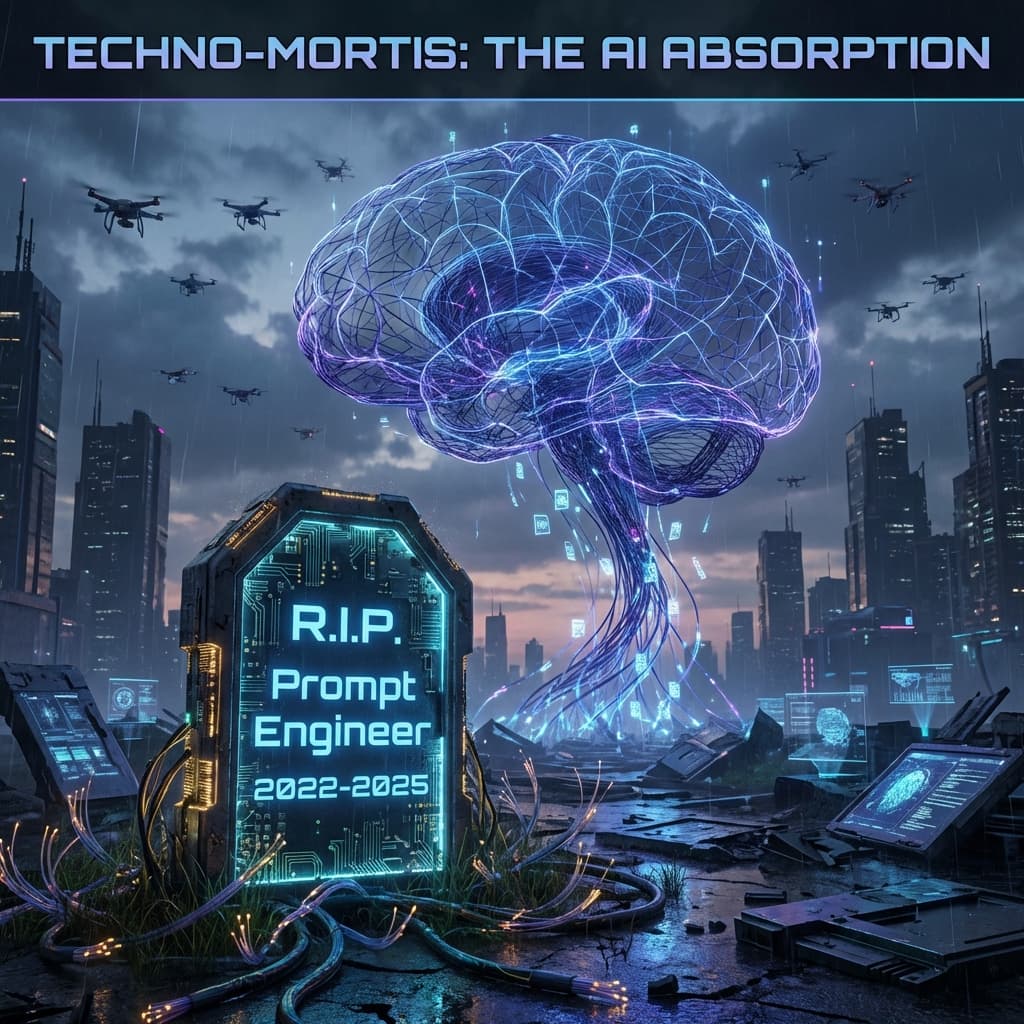
This is not just our story. This is the story of the entire "Prompt Engineering" industry. And it's ending faster than anyone expected.
Section 1: The Rise and Rapid Fall of the Prompt Engineer
To understand why "Prompt Engineer" is a dying role, you have to understand why it existed in the first place.
The Hype Cycle (2022-2024)
When ChatGPT launched in November 2022, the world discovered that talking to AI was hard. The models were powerful but stupid. They hallucinated. They forgot context. They interpreted instructions in bizarre, literal ways.
Early adopters quickly realized that the way you asked a question mattered enormously. A naive prompt like "Write me an essay about climate change" would produce generic slop. But a carefully crafted prompt—with role-playing, examples, constraints, and step-by-step instructions—could produce something genuinely useful.
This gap between "naive prompting" and "expert prompting" created a market. Companies needed someone who understood the dark arts. Job postings appeared on LinkedIn: "Prompt Engineer - $300,000/year." Bootcamps sprang up. Udemy courses proliferated. A cottage industry was born.
And for about 18 months, it was real. Prompt Engineers added genuine value. They were the "translators" between human intent and machine capability.
The Abstraction Thesis: Why Translation Jobs Disappear
But here's the thing about "translator" roles in technology: they always get automated away. Always.
In 1998, every company needed a "Webmaster." This was a person who knew HTML, understood how to FTP files to a server, and could configure Apache. They were essential. You couldn't have a website without one.
Then Squarespace happened. And WordPress. And Wix. The "Webmaster" didn't become unnecessary overnight, but the skill floor dropped. A marketing intern could now do 80% of what the Webmaster did, using a drag-and-drop interface.
The same pattern played out with "Social Media Manager" (tools like Hootsuite automated scheduling), "Data Entry Clerk" (APIs and integrations replaced manual input), and "IT Support" (self-service portals handled 70% of tickets).
The pattern is always the same: A new technology creates a temporary "skill gap." Specialists emerge to bridge that gap. Then the technology improves, narrows the gap, and absorbs the specialist role into itself.
Prompt Engineering is following this arc at warp speed. The gap between "naive user" and "expert prompter" is collapsing because the models are getting smarter and the interfaces are getting better.
Section 2: Why the Job is Evaporating Right Now
Let me be specific about why Prompt Engineering is dying. It's not speculation. It's three concurrent technical trends that are observable today.
Trend A: Model Improvement (The Models Don't Need Coaxing Anymore)
The dirty secret of early prompt engineering was that it was mostly about compensating for model failures. We wrote long, detailed prompts because GPT-3.5 was bad at inferring intent. We used "chain of thought" prompting because the model couldn't reason implicitly—we had to force it to "think step by step."
But GPT-4o, Claude 3.5 Sonnet, and Gemini 2.0 are fundamentally different beasts. They understand intent. They reason without being told to. They handle ambiguity gracefully.
I ran an experiment last month. I took our consultant's most complex prompt—a 1,200-token system prompt for generating QA test cases—and replaced it with a simple instruction: "Generate comprehensive QA test cases for this feature spec." Same output quality. Claude 3.5 didn't need the elaborate scaffolding. It just... worked.
This is not an isolated case. Across our tools, we've been systematically deleting prompt complexity. Our average system prompt length has dropped from 800 tokens to 150 tokens over 12 months. The "craft" of prompting is being absorbed into the model's baseline capability.
Trend B: Native UI (The Product is Becoming the Prompt Engineer)
The second death blow is the evolution of chat interfaces themselves. The major AI providers are baking "best practices" directly into their products.
Consider what's now available out-of-the-box in Claude's web interface:
- Projects: Persistent context windows with uploaded documents and custom instructions. No prompt engineering needed—just fill out a form.
- Artifacts: Structured output for code, documents, and diagrams. The model "knows" to use these formats automatically.
- Memory: Long-term memory across conversations. The model remembers your preferences without being re-prompted.
ChatGPT has similar features: Custom GPTs, the ability to upload files, web browsing, and code execution. These used to be "advanced prompt engineering techniques." Now they're checkboxes.
The product itself is absorbing the role of the Prompt Engineer. The skill is being commoditized into the UI.
Trend C: Agentic Frameworks (Prompts Become Code)
The third trend is perhaps the most important. As AI moves from "chatbots" to "agents," the unit of abstraction is shifting from "prompts" to "code."
In an agentic system (think: AutoGPT, LangGraph, CrewAI), you don't write a single clever prompt. You write an orchestration layer that coordinates multiple model calls, manages state, handles errors, and integrates with external systems.
Here's a simplified example. In the old "Prompt Engineering" world, you might write this:
system_prompt = """
You are a research assistant. When given a topic:
1. First, search the web for relevant sources
2. Then, synthesize the information
3. Finally, output a structured report
Think step by step.
"""
In the new "AI Engineering" world, you write this:
class ResearchAgent:
    def run(self, topic):
        sources = self.search_tool.search(topic)
        summaries = [self.llm.summarize(s) for s in sources]
        report = self.llm.synthesize(summaries)
        return self.format_report(report)
The "magic" is no longer in the prompt. It's in the orchestration logic: the loop, the error handling, the tool calls, the state management. This is software engineering, not prompt engineering.
The skill has evolved. And the new skill is called "AI Engineering" or "AI Systems Design." It requires understanding software architecture, not just natural language persuasion.
Section 3: What to Hire For Instead: The AI Systems Thinker
So if "Prompt Engineer" is the wrong hire, what's the right one? Based on our experience building AI-powered QA tools and consulting for enterprise clients, I believe the future belongs to a different archetype: The AI Systems Thinker.
This is not just a rebranding. The skill set is fundamentally different.
Core Competency 1: Domain Modeling
A Prompt Engineer asks: "How do I phrase this so GPT understands?"
An AI Systems Thinker asks: "How do I model this domain so any model can operate on it effectively?"
The difference is profound. Domain modeling means creating structured representations of the problem space: schemas, taxonomies, ontologies, and knowledge graphs. It means defining the "shape" of the data that flows through your AI system.
At XQA, our biggest breakthroughs came not from better prompts but from better data structures. When we modeled test cases as a formal JSON schema—with explicitly defined inputs, expected outputs, preconditions, and edge cases—every downstream AI operation improved automatically. The model didn't need clever prompting; it had a clear structure to work within.
Core Competency 2: Evaluation Design (Evals)
Prompt Engineers iterate by vibes. They tweak a prompt, look at the output, and decide if it "feels" better.
AI Systems Thinkers iterate by measurement. They design evaluation frameworks—often called "Evals"—that score model output against ground truth data.
This is arguably the most important skill in modern AI development. Without rigorous evals, you have no idea if your changes are improvements or just hallucinations of progress.
An eval might look like this:
- Take 500 historical inputs where you know the correct output.
- Run your AI system on all 500.
- Score each output on accuracy, completeness, and format compliance.
- Track the aggregate score over time.
This is how you know if a model upgrade actually helps. This is how you know if a prompt change is a regression. Without it, you're flying blind.
Core Competency 3: Orchestration Architecture
The final skill is the ability to design multi-step, multi-model systems. This is pure software architecture: defining components, managing state, handling failures, and optimizing for latency and cost.
A simple example: We have an agent that audits code changes for security vulnerabilities. It's not one prompt. It's a pipeline:
- Diff Parser: Extracts the changed lines from a Git commit.
- Classifier Model: A small, fast model that predicts if the change is "security-relevant."
- Vulnerability Analyzer: A larger model that analyzes security-relevant changes in depth.
- Report Generator: Formats the findings into a JIRA-friendly structure.
- Feedback Loop: If the user marks a finding as a false positive, we log it for retraining.
No single "prompt" can describe this system. It's an architecture. And designing it well requires the same skills as designing any complex software system: modularity, separation of concerns, fault tolerance, and observability.
Case Study: When "Systems Thinking" Saved a Project
Last quarter, we were struggling with an AI feature: automated test script generation. We had tried everything in the "Prompt Engineering" playbook. We wrote 30 different system prompts. We used few-shot examples. We tried chain-of-thought. Nothing worked consistently. Accuracy was stuck at 40%.
Then we stepped back and applied Systems Thinking. Instead of writing a better prompt, we built an evaluation loop:
- Generate a test script with the AI.
- Actually execute the test script against a sandbox environment.
- If it fails, capture the error message and feed it back to the model for correction.
- Repeat up to 3 times.
This is not prompt engineering. This is systems design. The "intelligence" is not in the prompt; it's in the feedback loop.
Accuracy jumped from 40% to 91%. Not because we found a magic prompt, but because we designed a system that could self-correct.
Section 4: The Contrarian Bet: Invest in "AI Taste," Not "AI Skill"
I want to close with a prediction that might sound strange: the most valuable "AI skill" in 2027 won't be a skill at all. It will be taste.
What is "AI Taste"?
Taste, in the design world, is the ability to recognize quality. A designer with good taste can look at 100 logos and instantly identify the 3 that are exceptional. They can't always explain why. It's pattern recognition refined by experience.
AI Taste is similar. It's the ability to look at 100 AI use cases and identify which 5 will actually work, which 10 are traps, and which 85 are distractions. It's knowing when to use AI and—critically—when not to.
This is the skill that cannot be automated. The model cannot tell you whether it's the right tool for the job. That judgment sits with the human operator.
I've seen companies waste millions building AI features that should have been a SQL query. I've seen engineers spend months on RAG pipelines that would have been better served by a simple search index. The failure wasn't technical; it was a failure of taste. They reached for AI because it was shiny, not because it was appropriate.
How to Develop AI Taste
Taste is developed through exposure and critique. Here's my prescription for anyone who wants to build this meta-skill:
- Curate 100 AI Use Cases: Read case studies, product launches, and postmortems. Build a "swipe file" of examples: what worked, what failed, and why.
- Critique Ruthlessly: For each use case, ask: "Was AI the right tool here? What would the non-AI alternative look like? Which is actually better?"
- Build for Contrast: Intentionally build a few things both with and without AI. Experience the tradeoffs firsthand. Sometimes the "dumb" solution wins.
- Study Failures: The most instructive cases are the failures. Why did Humane's AI Pin flop? Why did Google's Bard launch embarrass them? Failure teaches taste faster than success.
The Future Job Interview
In 2 years, I believe technical interviews will change. We won't ask candidates to "write a prompt." That's like asking a developer to "write a for loop"—it's table stakes, not a differentiator.
Instead, we'll present a business problem and ask: "How would you architect an AI solution for this? Where would you use a model? Where would you use a traditional algorithm? Where would you use a human in the loop? Defend your choices."
The answer reveals taste. It reveals judgment. It reveals whether the candidate sees AI as a hammer looking for nails, or as one tool among many in a well-stocked workshop.
Closing Provocation
In 2 years, asking "Do you know prompt engineering?" will be like asking "Do you know how to use Google?" The answer is assumed. The question is meaningless.
The real question will be: "Do you know when to use AI, when to avoid it, and how to architect systems that leverage both human and machine intelligence effectively?"
That's the job that will exist in 18 months. Start training for it now.
Appendix: Technical Reading List for the AI Systems Thinker
If you want to transition from "Prompt Engineer" to "AI Systems Thinker," here are the resources I recommend:
- Building LLM Applications: The LangChain and LlamaIndex documentation are dense but essential. Focus on the "Agents" and "Chains" sections.
- Evaluation: Read Anthropic's research on "Constitutional AI" and "RLAIF." Understanding how models are evaluated at the research level informs how you should evaluate your own systems.
- Orchestration: Study the architecture of open-source agentic frameworks like AutoGPT, BabyAGI, and CrewAI. The code is messy, but the patterns are instructive.
- Traditional ML: Don't forget the fundamentals. Precision, recall, F1 scores, confusion matrices—these concepts transfer directly to LLM evaluation.
The Prompt Engineer is dead. Long live the AI Systems Thinker.
Written by XQA Team
Our team of experts delivers insights on technology, business, and design. We are dedicated to helping you build better products and scale your business.