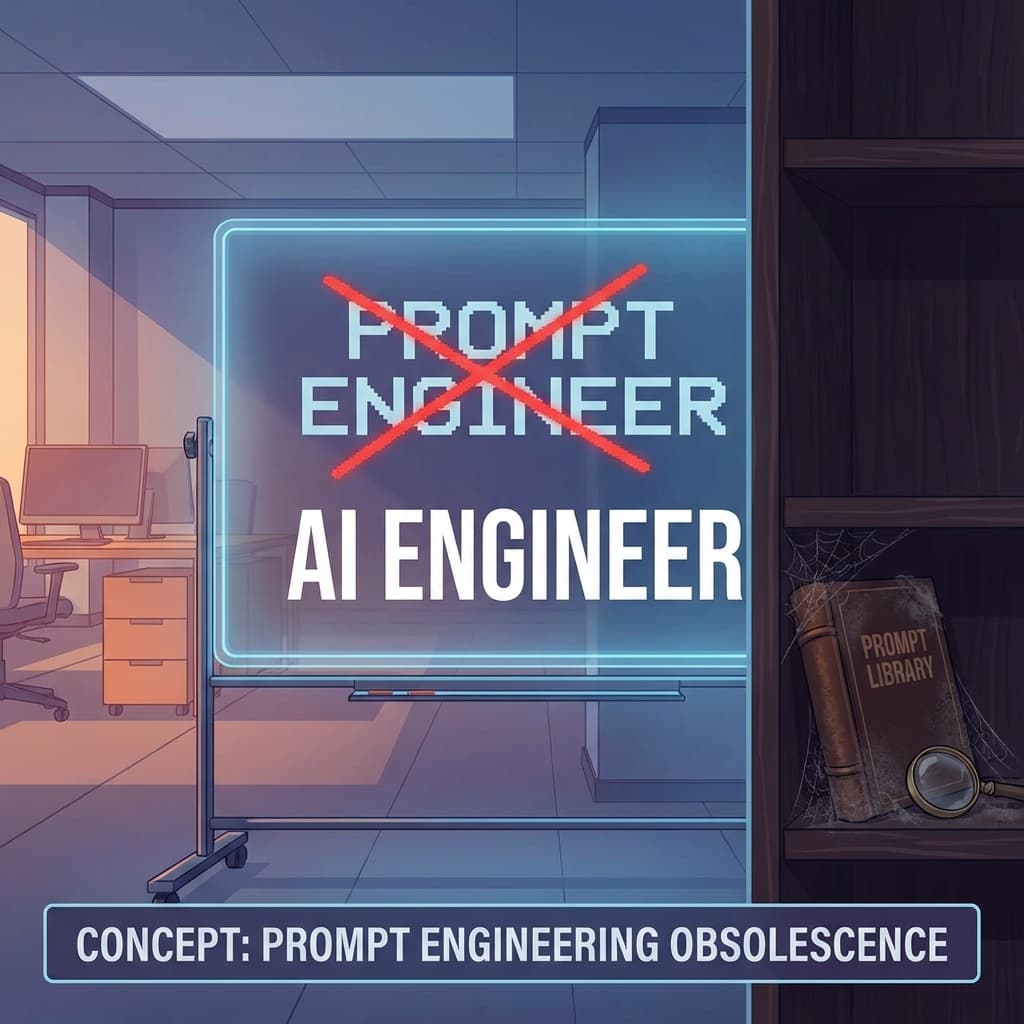
We built a 200-prompt library. Documented templates for every use case. Best practices. Training sessions. A dedicated Notion workspace. The works.
Three months later, I checked the analytics: 4 people had accessed it. Total.
The rest of the team? They just asked Claude or ChatGPT directly and iterated until it worked. No templates. No elaborate prompting techniques. Just plain English.
"Prompt engineering" was supposed to be the hot new skill. LinkedIn was flooded with "prompt engineers" charging $200/hour. Courses sold for thousands. It was the gold rush of 2023.
By 2025, the gold rush was over.
Models got good enough that prompting became trivial. The people who invested years in becoming "prompt experts" are watching their skill depreciate in real-time.
Here's why prompt engineering is already obsolete — and what actually matters now.
Section 1: The Rise and Fall of "Prompt Engineering"
Let's trace the arc of this "profession."
2022-2023: The Gold Rush
When GPT-3 and GPT-4 emerged, they were powerful but finicky. Getting good output required careful prompt construction:
- Chain-of-thought prompting ("Let's think step by step...")
- Few-shot examples (showing the model what you wanted)
- Specific formatting instructions (JSON, markdown, etc.)
- Role-playing ("You are an expert lawyer...")
This created a brief window where knowing these techniques was valuable. Companies hired "prompt engineers." Consultants emerged. A cottage industry was born.
2024: The Plateau
Models improved. Claude 3, GPT-4 Turbo, Gemini — all became dramatically better at following plain-language instructions.
"Summarize this document" just worked. You didn't need to craft elaborate prompts.
The techniques that required expertise became unnecessary. The skill gap closed.
2025: The Obsolescence
Today, prompt engineering is a commodity. Anyone can get good results from an LLM by describing what they want in normal English.
The techniques still exist. They marginally improve output in edge cases. But the 80/20 is gone. The low-hanging fruit has been picked by the models themselves.
The Skill Window:
Prompt engineering had a ~18-month skill window. Those who built entire careers on it are now pivoting.
This is not unusual in technology. Many "hot skills" have short half-lives. The difference is that prompt engineering's half-life was unusually short because AI improved so fast.
Section 2: Why Models Made Prompting Trivial
Understanding why prompting became trivial helps you see where value actually lies.
Instruction-Following Improved Dramatically:
Early models needed coaxing. You had to trick them into giving good output. Prompt engineering was essentially "tricking the model."
Modern models are trained specifically on instruction-following. They're designed to understand what you want on the first try.
"Write a professional email declining this meeting" produces a professional email. No tricks needed.
Context Windows Expanded:
GPT-3 had a 4k token context window. You had to carefully compress information into prompts.
Modern models have 100k-200k+ token windows. You can paste the entire document, the entire codebase, the entire conversation history.
This eliminates the need for clever prompt compression. Just give the model everything it needs.
System Prompts and Fine-Tuning Replaced User Prompting:
For production applications, the work shifted from user prompts to system configuration.
- System prompts set baseline behavior
- Fine-tuning customizes the model for your domain
- RAG provides relevant context automatically
The user doesn't need to prompt carefully. The system is configured to produce good output regardless of how the user asks.
The "Art" Became Commodity:
When everyone can get 90% of the result with zero effort, the remaining 10% isn't worth paying for.
Prompt engineering became like typing. Yes, some people type faster than others. But we don't hire "typing engineers." The skill is expected and commoditized.
Section 3: What Actually Matters Now
If prompting is trivial, where is the value?
Evaluation:
The hard skill is not writing prompts. It's knowing if the output is good.
Can you tell if the AI's legal analysis is correct? Can you spot the subtle bug in AI-generated code? Can you identify when the AI is confidently wrong?
Evaluation requires domain expertise. It requires understanding what "good" looks like. This is not a prompting skill — it's a knowledge skill.
We now hire for evaluation ability, not prompting ability. "Can you tell when Claude is wrong about X?" is the interview question.
Orchestration:
Production AI systems are not single prompts. They're pipelines:
- Retrieve relevant context (RAG)
- Call the model with that context
- Parse the output
- Handle errors and edge cases
- Chain multiple calls for complex tasks
This is software engineering, not prompt engineering. It requires understanding APIs, error handling, caching, rate limits, cost optimization.
The valuable skill is building reliable AI systems, not writing clever prompts.
Domain Expertise:
AI amplifies domain knowledge. A lawyer using AI is more powerful than a prompt engineer who doesn't know law.
The prompt engineer can craft a beautiful prompt, but they can't evaluate if the legal output is correct. The lawyer can.
In every domain, the formula is: Domain Expert + AI > AI Expert + No Domain Knowledge.
We've seen this in our own hiring. The best AI-assisted work comes from people who deeply understand the domain and use AI as a tool. Not from people who deeply understand AI but don't know the domain.
Section 4: Career Advice for Former Prompt Engineers
If you built skills in prompt engineering, here's how to pivot.
Pivot to AI Engineering:
The prompting knowledge is useful background for building AI systems. But you need to up-level:
- Learn to build production pipelines (LangChain, LlamaIndex, or just raw Python)
- Understand RAG architectures
- Learn to evaluate and test AI systems
- Understand fine-tuning and when to use it
AI engineering is the durable skill. Prompting was a stepping stone.
Up-level to Domain Expertise + AI:
Pick a domain. Become the "AI-powered [domain expert]."
- AI-powered legal researcher
- AI-powered financial analyst
- AI-powered content strategist
The domain expertise is hard to acquire. The AI augmentation is easy. Together, they're powerful.
What to Avoid:
- Selling prompt templates: The templates are worthless now. Models don't need them.
- Prompt engineering courses: You're teaching a skill that's depreciating in real-time.
- "AI whisperer" consulting: This positioning is already stale. Everyone can whisper now.
The window closed. Don't try to sell a skill that the market no longer values.
Conclusion
Prompt engineering was real. For about 18 months, it was a genuine skill that created genuine value.
That window is closed.
Models improved faster than the prompt engineering community expected. The techniques got absorbed into base model behavior. The skill gap vanished.
The next wave of AI value is in evaluation, orchestration, and domain expertise. Those are the skills to build.
The best prompts are the ones you don't have to think about.
Written by XQA Team
Our team of experts delivers insights on technology, business, and design. We are dedicated to helping you build better products and scale your business.