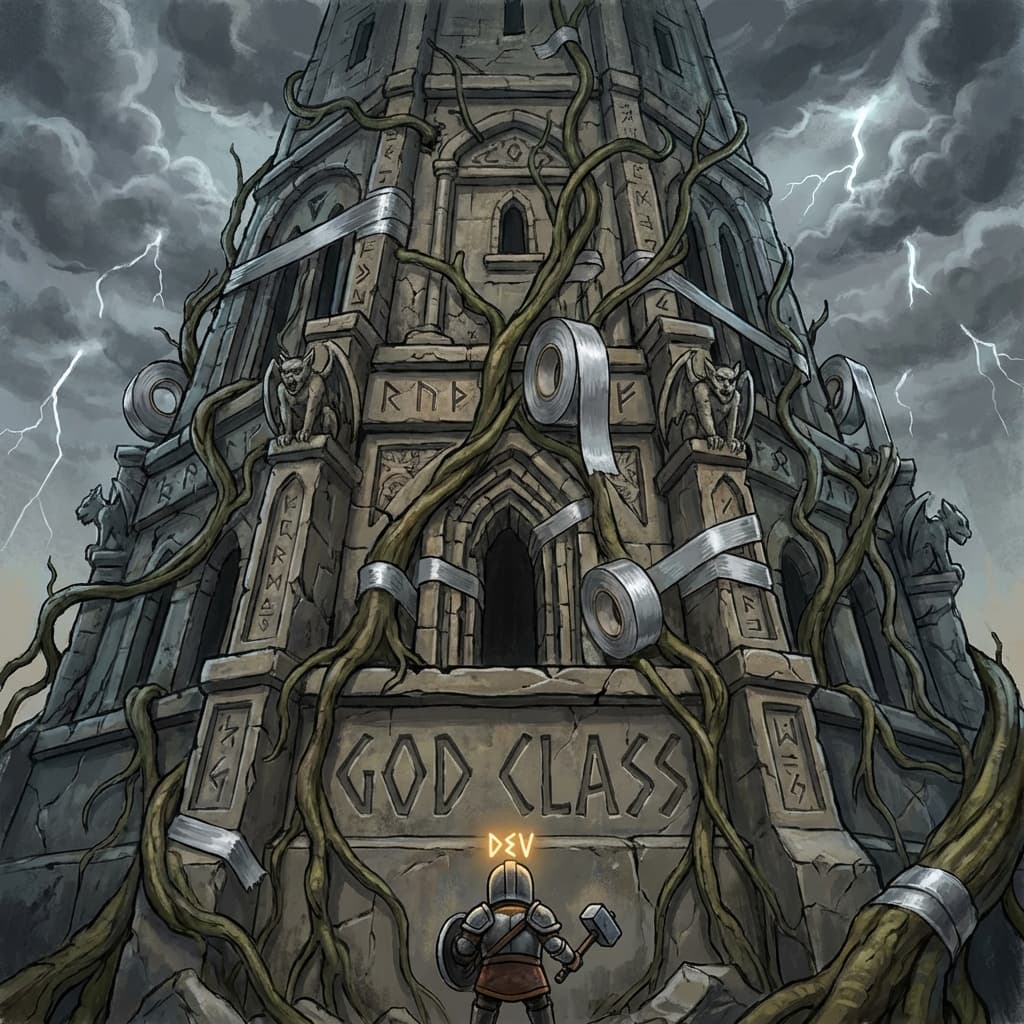
The Monster in the Codebase
Every legacy codebase has one. The file that everyone is afraid to touch. The file that has 5,000 lines of code, 400 imports, and a git history that reads like a war crime tribunal.
In our system, it was called eCommerceManager.java.
But we called it The God Class.
It didn't just manage e-commerce. It managed user authentication. It managed inventory logic. It sent emails. It parsed CSVs. It calculated tax rates. It even had a method called process_everything() that took 14 boolean arguments.
For 5 years, developers had simply patched it. "Just add one more if-statement," they said. "I don't have time to refactor it," they said.
Last month, I decided to kill it. It was the worst mistake of my life. And the best thing I ever did.
The Archaeology of Bad Code
Refactoring a God Class is not engineering. It is archaeology. You are digging through layers of sediment deposited by engineers who left the company years ago.
I found comments from 2018: "TODO: This is a hack, fix later."
I found variables named temp_fix_3 and dont_touch_this_or_site_crashes.
The class violated every principle of SOLID design. It was highly coupled and completely untestable. To test the "Tax Calculation" logic, you had to mock the entire Database, the Email Service, and the Redis Cache.
The Strategy: Strangling the Monolith
You cannot rewrite a God Class in one PR. If you try, you will fail. The PR will be 4,000 lines changed. No one will review it. You will merge it. Production will break. You will be fired.
I used the Strangler Fig Pattern (coined by Martin Fowler). The idea is to build a new system around the edges of the old one, slowly growing until the old system is strangled and dies.
- Identify a Seam: Find one small, isolated piece of logic. In my case, "Email Notifications."
- Create a New Service: I built a clean, new
NotificationServiceclass. - Route Calls: I went into the God Class and replaced the email logic with a call to the new service.
- Repeat: Do this 500 times.
The Deployment From Hell
It took me 3 weeks of late nights. I felt like I was defusing a bomb. One wrong move, one missed dependency injection, and the checkout flow would die.
Finally, I was ready. The PR was massive (bad), but I had 100% unit test coverage on the new services (good).
I hit merge.
The CI/CD pipeline turned green. Code went to production.
Silence.
Then, 5 minutes later, Sentry started screaming. NullPointerException in TaxCalculator.
I panicked. I rolled back.
The issue? The God Class relied on a side effect. One of the old methods was implicitly mutating a global state object that another method depended on. When I extracted the logic to a pure function, the side effect disappeared, and the downstream logic broke.
Lesson: In legacy code, bugs are often features.
The Second Attempt
I spent another week tracing every single side effect. I mapped the variable flow on a whiteboard that looked like a conspiracy theorist's basement. I added "Characterization Tests" to lock in the buggy behavior of the old system, just to ensure I didn't change it accidentally.
I redeployed. It worked.
The feeling wasn't triumph. It was relief.
Why We Do It
Why bother? Why not just leave the garbage alone?
Because garbage attracts rats.
A bad codebase destroys morale. It makes simple features take weeks. It creates a culture of fear, where developers are scared to deploy.
After the refactor, our build time went from 20 minutes to 4 minutes. Our bug rate dropped by 40%. New developers could actually understand the code.
Refactoring is the janitorial work of software engineering. It's not glamorous. No one gives you a medal for it. But it is the only thing standing between a healthy product and a rotting one.
Detailed Technical Breakdown
For the engineers reading this, here is exactly what I did:
Step 1: The Dependency Graph
I ran a static analysis tool (Structure101) to visualize the dependencies. The God Class was a black hole in the center of the graph, pulling everything in. I identified the "Leaf Nodes"—methods that didn't call other methods. I started there.
Step 2: Dependency Injection
The God Class instantiated its dependencies internally (new EmailService()). I changed this to Constructor Injection. This allowed me to pass in Mock objects for testing.
Step 3: Feature Flags
I wrapped the new calls in a Feature Flag: if (flags.useNewEmailService) { ... } else { ... }. This allowed me to test in production with a 1% traffic rollout before committing.
Advice for Refactorers
- Tests First: Never touch legacy code without a test harness. If there are no tests, write them.
- Small Batches: Commit every 30 minutes. Don't go into a coding cave for 3 days.
- Get Buy-in: Explain to your PM why this matters. "We are paying 20% interest on our technical debt. We need to pay down the principal."
The God Class is dead. Long live the Microservice.
Deep Dive: The Sociology of Legacy Code
Why do God Classes happen? They are rarely created by bad engineers. They are created by good engineers under bad incentives.
The God Class usually starts as a "Utils" file. It's convenient. "I just need a place to put this helper function." Then someone else adds another. Then another.
It grows because the Path of Least Resistance in a rush is always "modify the existing file" rather than "create a new file and set up dependency injection."
The "Broken Windows" Theory
In criminology, the Broken Windows Theory states that visible signs of disorder (like a broken window) encourage further crime. The same is true for code. Once a class is over 2,000 lines, developers stop caring. "It's already a mess," they think. "One more messy function won't hurt."
To stop this, you must police line counts aggressively. We now have a linter rule: Any file over 400 lines triggers a build warning. Any file over 800 lines triggers a build error. It effectively bans God Classes from being born.
Script: How to Sell Refactoring to Management
Engineers often struggle to get time for refactoring. Managers want features. Here is the script I used to get 3 weeks of dedicated time:
"Hey Boss. Right now, every feature we add to the Checkout flow takes 5 days. 3 of those days are spent fighting the legacy `UserManager` code. If we spend 15 days fixing `UserManager` now, future features will only take 2 days. The break-even point is 6 weeks. After that, we are printing free time. Do you want to be faster in Q4? Then we need to slow down in Q3."
Speak in terms of Velocity and Risk, not "Clean Code." Managers don't care about Clean Code. They care about shipping speed.
Technical Appendix: The "Strangler Fig" Implementation Details
Here is the exact code pattern we used to route traffic safely.
    // The "Toggle" Router
    class CheckoutService {
      constructor(oldSystem, newSystem, featureFlags) {}

      process(order) {
        if (this.featureFlags.isEnabled('new-checkout', order.userId)) {
          try {
             return this.newSystem.process(order);
          } catch (e) {
             logError(e);
             // Fallback to old system on failure (Safety Net)
             return this.oldSystem.process(order);
          }
        }
        return this.oldSystem.process(order);
      }
    }
This "fallback" mechanism is critical. It gave us the confidence to release to production knowing that if our new code blew up, the user would still get their order processed by the old junk code. It removed the fear of deployment.
Philosophical Note: The Ship of Theseus
Refactoring is the "Ship of Theseus" problem. If you replace every line of code in a system, is it still the same system?
Yes, because the intent remains. The domain knowledge remains. The hardest part of software isn't the syntax; it's the domain modeling. By refactoring, you are preserving the domain knowledge while discarding the implementation rot. You are honoring the engineers who came before you by keeping their creation alive, rather than letting it rot into obsolescence.
Written by XQA Team
Our team of experts delivers insights on technology, business, and design. We are dedicated to helping you build better products and scale your business.