The $480,000 Mistake
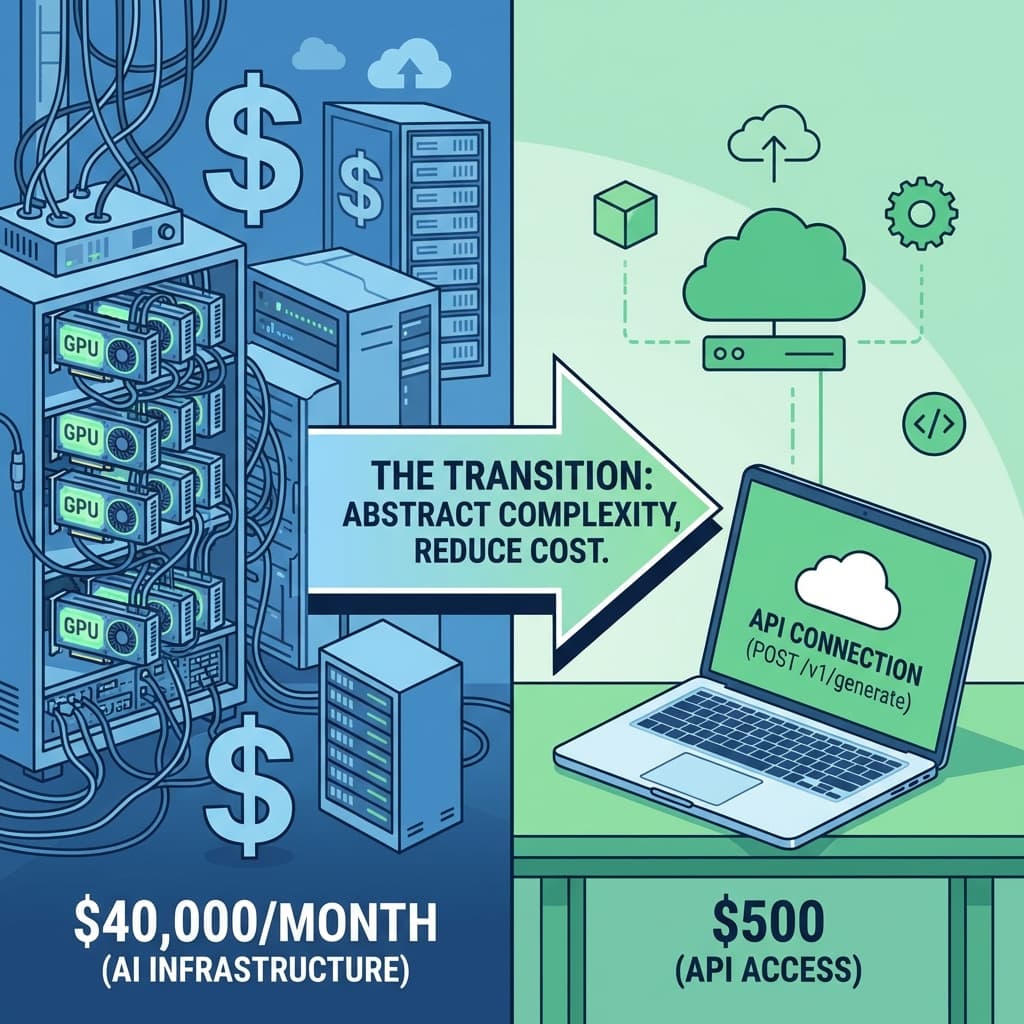
Let me describe our AI infrastructure as it stood 12 months ago:
- Self-hosted Llama 70B models running on dedicated GPU instances
- Custom vector database (Pinecone was "too expensive," so we built our own)
- A bespoke embedding pipeline with fine-tuned models
- A dedicated ML engineer whose full-time job was maintaining all of this
- DevOps overhead for GPU cluster management, scaling, and monitoring
Monthly cost: approximately $40,000.
We were proud of it. It felt serious. When prospects asked about our AI capabilities, we could say "we run our own infrastructure." It made us feel like a "real" AI company.
Then, during a quarterly planning session, someone asked an uncomfortable question: "What if we just... used Claude's API?"
We laughed. Surely our custom infrastructure was better than a simple API call. We had invested so much. We had optimized so carefully. We had built something meaningful.
But we decided to run an experiment—just to prove ourselves right.
Six weeks later, we had migrated everything to Claude's API. Same functionality. Same output quality. In some cases, better output quality.
New monthly cost: $500.
We had spent $480,000 over the previous year on infrastructure we didn't need. Here's the decision framework I wish I'd had before making that mistake.
Section 1: The "Enterprise AI Stack" Illusion
Why did we build all that infrastructure in the first place? Looking back, the reasons were mostly psychological, not technical.
The Ego Trap
"We need our own infrastructure" sounds serious. It signals that you're a sophisticated AI company, not just a wrapper around someone else's API. When VCs asked about our tech stack, saying "we run self-hosted models" felt impressive. Saying "we call Claude's API" felt... basic.
This is ego masquerading as strategy. The goal isn't to have impressive infrastructure. The goal is to solve customer problems profitably. If an API call solves the problem, the API call is the right answer—even if it feels less sophisticated.
The Vendor Narrative
AI infrastructure companies have a vested interest in making you feel inadequate with simple solutions. They sell GPUs, vector databases, MLOps platforms, and fine-tuning services. Their marketing subtly implies that "real" AI companies build their own stacks.
We fell for it. We read blog posts about companies running their own models. We saw conference talks about custom embeddings. We felt like we were behind if we just used OpenAI or Anthropic APIs.
In retrospect, most of those blog posts were from companies with genuinely different needs—massive scale, unique data, regulatory requirements. We had none of those. We just had FOMO.
What We Built vs. What We Needed
Let me be specific about the gap between what we built and what we actually needed.
What we built:
- Custom embedding pipeline with a fine-tuned model for our domain
- Self-hosted Llama 70B for text generation
- Custom vector database with optimized indexing
- RAG pipeline with sophisticated reranking
- Monitoring, logging, and alerting infrastructure
What we actually needed:
- An LLM that could answer questions based on documents
- Reliable, low-latency responses
- Reasonable cost per query at our volume (~50,000 queries/month)
Our requirements could be met with a single API call plus a cloud-hosted vector database. We had over-engineered by a factor of 10x.
The Sunk Cost Compounding
Once we'd invested $100,000, it felt insane to admit we didn't need it. So we invested more. We improved the fine-tuned embeddings. We optimized the vector indexing. We added caching layers.
Each investment made it harder to step back and ask: "Do we need any of this?"
The sunk cost fallacy compounded monthly. Admitting simplicity would work felt like admitting failure. So we kept building.
Section 2: The 5 Scenarios Where You Actually Need Custom AI Infrastructure
I'm not saying custom infrastructure is always wrong. There are legitimate use cases. But they're narrower than the hype suggests.
Scenario 1: True Scale (10M+ API Calls/Month)
If you're making 10 million API calls per month, the math changes. Commercial API costs scale linearly; infrastructure costs can be amortized.
Example: At 10M calls/month with Claude, you might spend $200,000/month on API fees. Self-hosted infrastructure might cost $80,000/month at that scale. The $120,000/month savings justifies the complexity.
Key insight: We were making 50,000 calls/month. At that volume, our $40,000 infrastructure was 10x more expensive than API calls would have been. Scale matters—and we weren't at scale.
Scenario 2: Regulatory Compliance (Data Cannot Leave Your Environment)
If you're in healthcare (HIPAA), finance (SOC2 with sensitive data), or government (FedRAMP), you may be legally required to keep data on-premise or in specific regions.
Example: A hospital cannot send patient records to OpenAI's servers. They need on-premise inference. The infrastructure cost is a compliance tax.
Key insight: We had no regulatory constraints. We built on-premise infrastructure to feel "enterprise-ready" for customers we didn't have yet.
Scenario 3: Latency-Critical Real-Time Applications
If you need sub-50ms response times for real-time applications (gaming, trading, robotics), commercial APIs introduce network latency that may be unacceptable.
Example: A high-frequency trading firm needs AI decisions in microseconds. They can't wait for a round-trip to an API server.
Key insight: Our latency requirement was "under 3 seconds." Commercial APIs deliver responses in 500ms-2s. We were optimizing for a constraint that didn't exist.
Scenario 4: Genuinely Proprietary Models
If you have truly unique training data worth millions—data that would give you an insurmountable competitive advantage if used for fine-tuning—custom infrastructure makes sense.
Example: A legal research company with 50 years of annotated case law. That data is genuinely proprietary and could create a model that outperforms general-purpose LLMs on legal tasks.
Key insight: Our "proprietary data" was... 15,000 examples of our product's documentation. Not exactly moat-worthy.
Scenario 5: AI Is Your Core Product
If you're selling AI capabilities directly—if the model itself is the product—you may need control over the entire stack.
Example: Anthropic, OpenAI, and Mistral build their own infrastructure because they sell the infrastructure outputs. Model quality is their differentiation.
Key insight: We weren't selling AI. We were selling a QA automation product that happened to use AI. The AI was a means to an end, not the end itself.
The Honest Assessment
Looking at those five scenarios, we met exactly zero of them. We weren't at scale. We had no regulatory constraints. We didn't need sub-50ms latency. Our data wasn't uniquely valuable. AI wasn't our core product.
We had built enterprise infrastructure for startup needs. That's a $480,000 lesson.
Section 3: The Migration—How We Went From $40k to $500 in 6 Weeks
Let me walk through exactly how we migrated and what we learned.
Week 1-2: The Audit
First, we audited what our infrastructure was actually doing. The results were embarrassing:
- The custom embedding model? Used in 3% of queries. The other 97% used a simple keyword fallback.
- The fine-tuned Llama 70B? Output quality was indistinguishable from Claude in blind tests.
- The custom vector database? We were using 5% of its capacity. Pinecone would have been cheaper.
- The sophisticated reranking? It improved results by 2%. Not worth the complexity.
80% of our infrastructure was either unused or provided marginal value. We had built for hypothetical future needs that never materialized.
Week 3-4: The MVP
We built a proof of concept using Claude's API plus Pinecone:
- Replaced custom embeddings with OpenAI's ada-002 (good enough)
- Replaced self-hosted Llama with Claude API (better quality)
- Replaced custom vector DB with Pinecone (managed, cheaper at our scale)
We ran both systems in parallel for 2 weeks. Results:
- Response quality: API-based system was slightly better (Claude > our fine-tuned Llama)
- Latency: Comparable (both under 2 seconds)
- Cost: $500/month vs. $40,000/month
The API-based system won on every metric.
Week 5-6: Edge Cases
We identified the edge cases where our custom infrastructure might have advantages:
- Handling very long documents (>100k tokens)
- Specific domain terminology understanding
- Consistent formatting of outputs
For each edge case, we asked: "Can better prompting solve this?" In most cases, yes. A well-crafted system prompt with examples achieved 95% of what our fine-tuned model did.
The remaining 5%? We decided it wasn't worth $39,500/month to solve.
The Uncomfortable Realization
Our $40k/month ML engineer—a talented person—was spending 80% of their time maintaining infrastructure. Only 20% was improving AI quality.
After the migration, we redeployed them to work on product features. Their impact 10x'd because they were no longer fighting DevOps fires.
The infrastructure wasn't just expensive in dollars. It was expensive in attention and opportunity cost.
Section 4: The Build vs. Buy Decision Tree for AI
Based on this experience, here's the decision framework I now use.
Step 1: Define the Use Case Precisely
Vague use cases lead to over-engineered solutions. "We need AI for our product" is not a use case. "We need to answer customer questions based on our documentation with 90% accuracy and <3s latency" is a use case.
Be specific about:
- What input does the AI receive?
- What output does it produce?
- What's the acceptable latency?
- What's the acceptable error rate?
- How many calls per month?
Don't design for hypothetical future requirements. Design for what you need today.
Step 2: Can a Commercial API Solve This at Your Current Scale?
Before building anything, test whether a commercial API (Claude, GPT-4, Gemini) solves the problem.
Calculate the cost:
- Estimate tokens per query
- Multiply by queries per month
- Apply API pricing
If the monthly API cost is under $5,000 and quality is acceptable, you probably don't need custom infrastructure. Ship with the API and revisit when you have 10x the volume.
Step 3: Will You Hit 1M+ Monthly API Calls Within 12 Months?
If yes, start planning for scale now. If no, don't pre-optimize.
The mistake we made: we built for scale we hoped to achieve, not scale we actually had. "We might need this someday" is not a reason to build infrastructure today.
Build for today's requirements. Scale when you have today's scale problems.
Step 4: Is "Custom AI" a Competitive Advantage, or Is "Shipping Faster" the Real Advantage?
Ask yourself: will customers pay more for your product because you run your own models? Or will they pay more because you shipped features faster?
For most B2B products, customers don't care about your AI infrastructure. They care about whether your product solves their problem. Every month spent on infrastructure is a month not spent on product.
We spent 4 months building AI infrastructure. During those 4 months, competitors shipped features. We fell behind on product while perfecting infrastructure no customer ever asked about.
The Decision Flowchart
- Does an API solve the problem acceptably? → Yes → Use the API. Stop.
- Is monthly API cost >$10,000 at current volume? → No → Use the API. Stop.
- Do you have regulatory constraints requiring on-premise? → No → Use the API. Stop.
- Is AI your core product (not a feature)? → No → Use the API. Stop.
- Only if you hit all these: consider custom infrastructure.
Closing Provocation
Here's the uncomfortable truth: the best AI infrastructure is often no infrastructure at all.
Infrastructure is a liability, not an asset. It requires maintenance, monitoring, updates, and expertise. Every dollar spent on infrastructure is a dollar not spent on product, growth, or customers.
The goal isn't to have impressive infrastructure. The goal is to solve problems profitably. Sometimes that means running your own GPU clusters. Usually, it means making an API call.
We spent $480,000 learning this lesson. Now we spend $500/month on AI that works better than what we built. Don't make our mistake.
Appendix: Quick Assessment Checklist
Before building AI infrastructure, answer these questions:
- Have I tested a commercial API on my actual use case? (If no, do that first.)
- At current volume, would API costs exceed $10,000/month? (If no, use the API.)
- Do I have regulatory constraints that prohibit third-party APIs? (If no, use the API.)
- Will custom infrastructure take >2 months to build? (If yes, that's 2 months of product delay.)
- Is "we run our own models" actually a selling point for customers? (Be honest.)
If you're building infrastructure despite answering "no" to most of these, you might be falling into the same trap we did.
Written by XQA Team
Our team of experts delivers insights on technology, business, and design. We are dedicated to helping you build better products and scale your business.