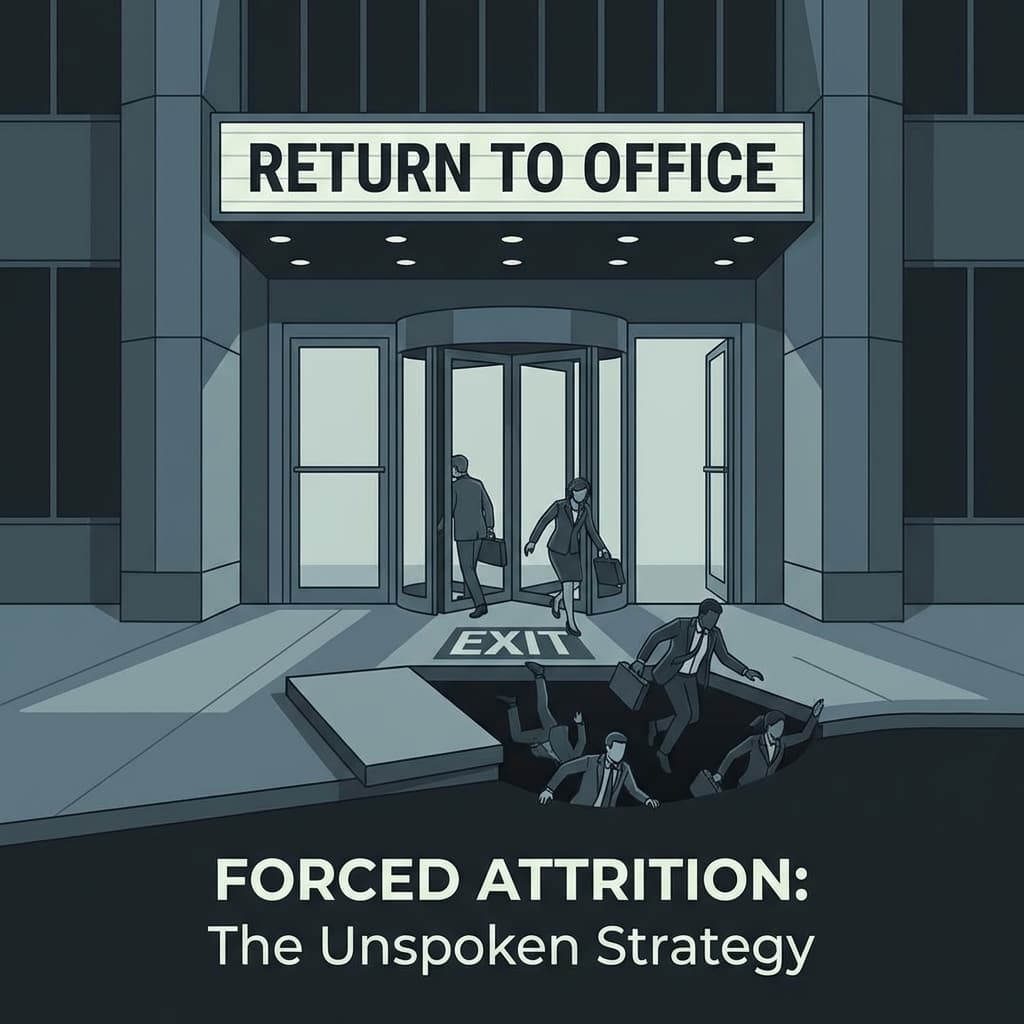
Every time I see a "Return to Office" (RTO) memo from a Big Tech CEO, I translate the corporate speak.
CEO Says: "We believe in the power of serendipity and hallway conversations. We innovate better when we are together."
CEO Means: "We overhired during the pandemic. We need to reduce headcount by 15%. If I do a layoff, the stock drops and I have to pay severance. If I mandate 5 days in the office, 15% of people will quit voluntarily. Problem solved."
It is called a "Constructive Dismissal" via policy. It is a Stealth Layoff.
But there is a fatal flaw in this strategy: It kills the wrong people.
The "Adverse Selection" of RTO
When you offer a "Quit or Commute" ultimatum, who quits?
1. The High Performers.
Your Senior Staff Engineer. Your best Architect. Your 10x Developer.
Why? Because they have options. Recruiters are in their DMs every day. They can quit on Tuesday and have a higher-paying remote job by Thursday. They know their worth, and they value their autonomy.
2. The Low Performers.
Who stays? The people who can't get another job easily. The "Coasting" middle layer. They will grumble, buy a train ticket, and come in. They will badge in at 9:00, sit on Zoom calls all day (with headphones on), and leave at 5:00.
The Result: You have reduced headcount (Success?), but you have drastically reduced Talent Density (Failure). You kept the mediocre compliance-oriented employees and lost the innovative outcome-oriented leaders.
Section 1: The "Commute" is Unpaid Labor
Let's do the math on the Commute.
If an employee commutes 1 hour each way (common in SF/NYC), that is 2 hours a day. 10 hours a week.
If they work a 40 hour week, that is a 25% tax on their time.
By mandating RTO without a 25% raise, you are effectively cutting their hourly wage by 25%.
The "Deep Work" Tax:
Remote work allowed for "Deep Work" blocks. No distractions. Efficient coding.
Office work (Open Plan Offices) is a factory for interruptions. "Hey, got a sec?" "Happy Birthday in the kitchen!"
Studies show that in-office employees are interrupted every 11 minutes. It takes 23 minutes to recover focus. Do the math. No real work happens in the office. Real work happens at home at night after the commute, because the office was too loud.
Section 2: The Location Arbitrage is Over
For 5 years, people moved. They bought houses in suburbs or cheaper states.
Now, you are asking them to:
- Sell their house (at a loss, given interest rates).
- Move back to a high-cost city.
- Pay triple the rent for a shoebox apartment.
...For the privilege of sitting on the same Zoom calls they were taking from their home office.
This breeds Resentment. An employee who feels "forced" to be there is not an engaged employee. They are a prisoner.
Section 3: The "Serendipity" Myth
CEOs love the word "Serendipity." The magic hallway idea.
I have looked at the data. I have tracked code commits and innovation metrics.
Innovation doesn't come from watercoolers. It comes from Intentional Collaboration.
A structured "One Pager" written asynchronously and reviewed by 5 experts produces more value than 50 random conversations.
Furthermore, in a global company, your team is distributed anyway. If your Backend Dev is in New York and your Frontend Dev is in London, going to the office doesn't help. You are just commuting to a cubicle to video chat with London.
Section 4: The Hybrid "Worst of Both Worlds"
Most companies compromise on "Hybrid" (3 days in, 2 days home).
This is often worse than full RTO.
- Reason 1: You still have to live near the office (High Cost of Living).
- Reason 2: You still have the commute stress.
- Reason 3: The office is 60% empty, so it feels like a ghost town.
- Reason 4: You spend half the day on Zoom anyway because one person on the team is at home (or sick).
The "Anchor Days" Strategy:
If you must meet, do it intentionally. Meet once a quarter for a "Offsite." Fly everyone in. Brainstorm for 3 days. Bond. Drink beer. Then go home and execute for 90 days.
That is high-value face time. Sitting in traffic on a Tuesday is low-value face time.
Section 5: How Smart Companies Win (The Remote Moat)
While Amazon and Google force RTO, smart startups are doing the opposite.
Recruiting Advantage:
When I post a job description that says "100% Remote / Async," I get 500 applications. I get the Principal Engineer from Google who quit because of RTO. I get the Mom who needs flexibility. I get the guy living in Wyoming who is a genius but doesn't want to live in SF.
I have access to the Global Talent Pool. RTO companies are fishing in a local pond.
Cost Advantage:
I don't pay for a $50,000/month office in SoMa. I invest that money in offsites and salaries.
Conclusion
RTO is not about productivity. It is about Control and Real Estate (Sunk Cost Fallacy).
If you are a leader, don't fall for the RTO peer pressure. Use Remote Work as a weapon to steal the best talent from the giants who are forcing them back to the cubicle.
Written by XQA Team
Our team of experts delivers insights on technology, business, and design. We are dedicated to helping you build better products and scale your business.