The Research That Opened My Eyes
Last quarter, I conducted an informal audit. I analyzed the pricing strategies of 50 B2B SaaS companies—some public (where I could see financials), some private (where I had insider knowledge through friends or investment relationships).
The question I wanted to answer: How much of a SaaS company's revenue actually comes from the pricing shown on their website?
The answer shocked me.
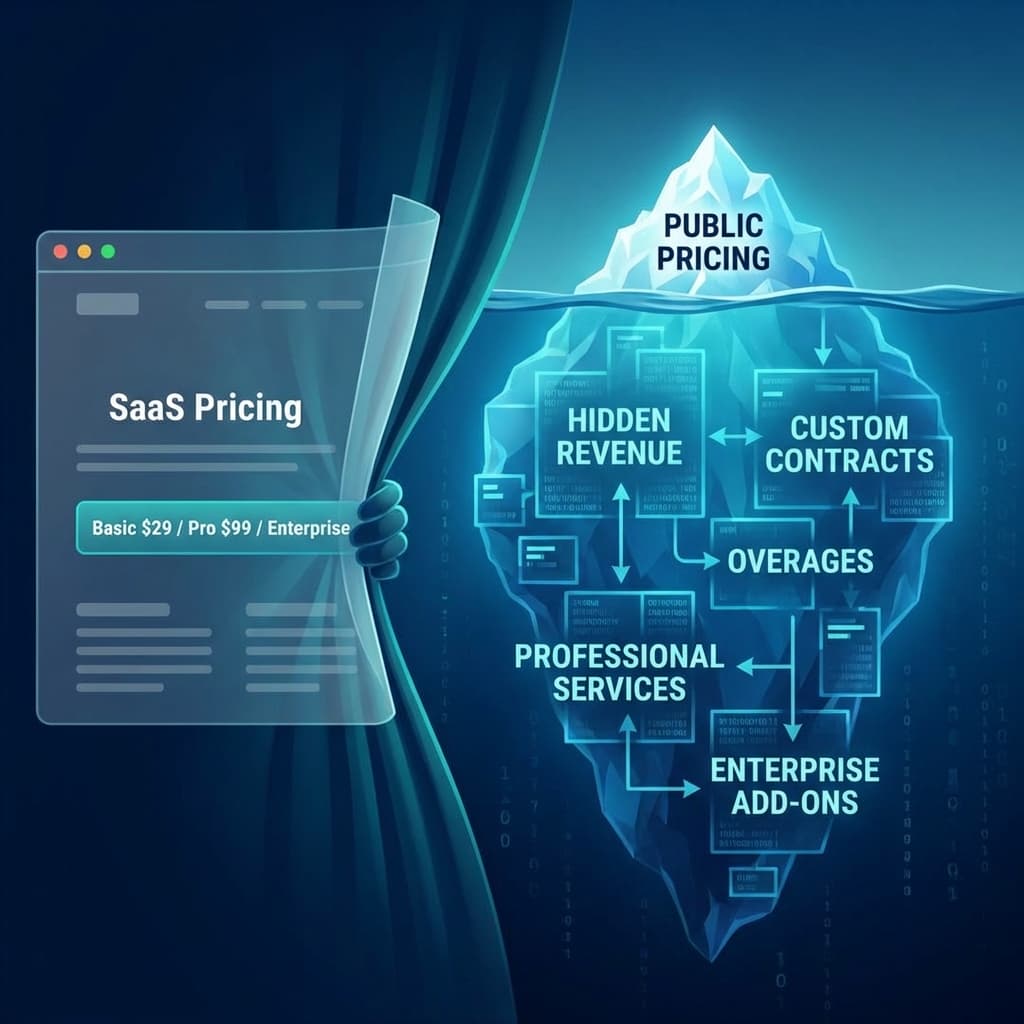
On average, the public pricing page—those neat "Basic / Pro / Enterprise" tiers you see on every SaaS website—accounted for less than 30% of total revenue. Sometimes as low as 15%.
The other 70%+ comes from pricing structures that never appear on any public page. Custom enterprise deals. Usage overages. Professional services. Add-on fees. API access charges. Data licensing.
This isn't deception. It's strategy. And if you're building or running a SaaS company, understanding this "hidden" revenue layer is the difference between a venture-scale business and a lifestyle business.
Let me pull back the curtain.
Section 1: The Pricing Page Illusion
First, let's understand what a SaaS pricing page actually is—and what it isn't.
The Pricing Page as Marketing Collateral
A pricing page is not a financial instrument. It's a marketing artifact.
Its job is not to accurately represent how the company makes money. Its job is to:
- Anchor expectations: "Our product costs roughly $X-Y/month."
- Qualify leads: "If $99/month is too expensive for you, you're not our target customer."
- Enable self-service: "Small customers who can sign up without talking to sales."
- Signal value: "We have an 'Enterprise' tier, so we're serious."
Notice what's missing from this list: maximizing revenue. The public pricing page optimizes for conversion and simplicity, not for extracting maximum value from each customer.
The Dirty Secret: Public Pricing is "Loss Leader" Pricing
Here's what most people don't realize: for many SaaS companies, the public pricing page describes the lowest margin, least profitable segment of the business.
Why? Because public pricing has constraints:
- It must be simple. You can't show 47 line items on a landing page.
- It must be competitive. Prospects compare you to alternatives.
- It must be self-service. No sales rep is there to explain nuance.
Simplicity, competitiveness, and self-service all push prices downward. Public pricing is optimized for volume, not margin.
The high-margin, high-value customers? They never touch the public pricing page. They talk to sales. They negotiate custom deals. They pay 5x the "Enterprise" list price—because their needs are complex, their budgets are large, and value-based pricing applies.
The Two-Tier Economy
Think of SaaS economics as two parallel businesses:
Tier 1: Self-Serve (Public Pricing)
- Customers: SMBs, startups, individual users
- ACV: $500 - $10,000
- Sales motion: None (or light-touch)
- Margin: Moderate (high volume, low price)
Tier 2: Enterprise (Hidden Pricing)
- Customers: Large companies, regulated industries, custom needs
- ACV: $50,000 - $1,000,000+
- Sales motion: Account executives, custom contracts
- Margin: Very high (low volume, high price)
The public pricing page describes Tier 1. Tier 2 is never shown publicly—because showing it would undermine Tier 1. If an SMB saw that enterprises pay $200,000/year, they'd feel ripped off at $99/month. So the company hides the enterprise economics.
Section 2: The 4 Hidden Revenue Streams in Modern SaaS
Now let's get specific. Where does the "hidden" 70% of revenue actually come from? In my analysis, I identified four major streams.
Stream 1: Usage Overages (The Metered Tax)
Many SaaS products advertise "unlimited" usage—but with fine print. The limits are buried in terms of service or only enforced at scale.
Common overage triggers:
- API calls beyond a threshold
- Storage beyond a limit
- Seats beyond the plan tier
- Events, messages, or transactions beyond a cap
Example: Segment. Segment's public pricing shows tiers based on "monthly tracked users." But at enterprise scale, customers pay per event—and the per-event pricing can result in bills 10-20x higher than the stated tier price would suggest.
Example: Twilio. Twilio's pricing page shows per-message and per-minute rates. Simple, right? But at high volume, the real conversation becomes about committed usage discounts, overage penalties, and reserved capacity—none of which appears on the public page.
Overages are powerful because they align price with value (customers who use more, pay more) while keeping the public pricing simple and competitive.
Stream 2: Professional Services (The Hidden 30%)
Enterprise software sales rarely end at the software license. They include:
- Implementation: Setting up the software in the customer's environment.
- Integration: Connecting to the customer's existing systems.
- Training: Teaching the customer's team to use the product.
- Customization: Building features specific to the customer's needs.
For many enterprise SaaS companies, professional services represent 20-40% of the total contract value. This revenue is never shown on pricing pages.
Example: Salesforce. Salesforce's public pricing shows per-seat costs. But a large Salesforce implementation typically involves $500,000+ in professional services—consulting, customization, and integration—delivered by Salesforce or partners. This can equal or exceed the software cost.
Example: Snowflake. Snowflake's public pricing is usage-based (compute and storage). But complex deployments require significant professional services for data modeling, migration, and optimization. These services are often bundled into enterprise deals.
Stream 3: Negotiated "Premiums" (The Reverse Discount)
This one surprises people. In enterprise sales, the public pricing is often a floor, not a ceiling.
Here's how it works: The public "Enterprise" tier might list at $999/month. A sales team uses this as an anchor—"Our public pricing is $999/month, but given your scale and requirements, your custom solution would be $4,500/month."
The customer negotiates a "discount" to $3,500/month and feels like they won. But $3,500 is still 3.5x the public price. The public pricing was a strategically low anchor.
Why this works: Enterprise buyers expect to negotiate. They distrust public pricing. By starting with a low public price and "customizing" upward, sales teams capture more value while making customers feel smart.
I've seen companies where the average Enterprise deal is 5x the listed Enterprise price. The public number is theater.
Stream 4: Platform Taxes and Ecosystem Revenue
Some SaaS companies build marketplaces or platforms on top of their core product. This creates additional revenue streams:
- Marketplace Fees: Taking a cut of third-party app sales (like Shopify's app store).
- Partner Revenue Shares: Charging integration partners for access to customers.
- Data Licensing: Aggregating anonymized data and selling insights.
- API Access: Charging developers for programmatic access to features.
Example: HubSpot. HubSpot's public pricing shows CRM and marketing tiers. But HubSpot also runs an app marketplace where partners pay 20% of revenue to be listed. This platform tax is invisible to end customers.
Example: Stripe. Stripe's public pricing is 2.9% + $0.30 per transaction. But Stripe also offers Stripe Atlas, Stripe Treasury, Stripe Issuing, and other products that create additional revenue streams entirely separate from the public rate.
Section 3: Case Study—60% of Revenue From an Invisible Feature
Let me walk through a specific (anonymized) example that illustrates how "hidden" revenue works in practice.
The Company
A B2B analytics company. They help e-commerce businesses understand customer behavior. Their public pricing:
- Starter: $29/month (1,000 events/day)
- Growth: $99/month (10,000 events/day)
- Pro: $299/month (100,000 events/day)
- Enterprise: "Contact Us"
Clean, simple, understandable. A prospect can estimate their cost in 30 seconds.
The Hidden Revenue
But when I looked at their revenue breakdown, a different picture emerged:
- Starter + Growth + Pro (public tiers): 25% of MRR
- Enterprise (custom deals): 75% of MRR
Okay, that's expected. Enterprise is where the money is. But within Enterprise, there was another split:
- Base platform fee: 40% of Enterprise revenue
- "Data Export API" add-on: 60% of Enterprise revenue
Wait—what's the "Data Export API"?
The $5,000/Month Add-On That Prints Money
The Data Export API is a feature that allows enterprise customers to programmatically export their analytics data to their own data warehouse (Snowflake, BigQuery, etc.).
This feature is not on the public pricing page. It's not even mentioned on the website. It's only presented during enterprise sales calls, positioned as a premium capability for "data-mature" organizations.
The price: $5,000/month. On top of the base Enterprise fee (which averages $15,000/month).
And nearly every enterprise customer buys it. Why? Because enterprise customers need their data in their warehouse. It's not optional for them. The analytics platform is useful, but the data is essential.
This single add-on—invisible to the public—generates 45% of the company's total revenue.
Why It's Not on the Pricing Page
I asked the founder why they don't advertise the Data Export API publicly. The answer was strategic:
- Anchoring: If SMBs saw "$5,000/month for data export," they'd assume the whole product is overpriced. The public pricing needs to feel accessible.
- Qualification: If someone asks about data export on a sales call, they're a serious enterprise buyer. It's a qualifying question.
- Value-Based Pricing: The value of data export varies by customer. A $10M e-commerce brand might pay $5k; a $500M retailer might pay $25k. Putting a public price limits flexibility.
The hidden pricing isn't deception—it's segmentation. Different customers, different prices, different conversations.
Section 4: Designing Your Own "Hidden Revenue" Strategy
If you're building a SaaS product, how do you design for hidden revenue from the start? Here's a framework.
Step 1: Separate Acquisition Pricing from Value Pricing
Think of your pricing in two layers:
Acquisition Pricing (Public): What gets customers in the door. Optimized for simplicity, competitiveness, and self-service conversion. This is your "loss leader" tier.
Value Pricing (Hidden): What captures value as customers grow and deepen their usage. Optimized for margin, not conversion. This is where you make money.
The key: Don't try to maximize revenue on the pricing page. Use the pricing page to acquire customers. Maximize revenue through the sales process, usage growth, and add-ons.
Step 2: Identify Your "Platform Tax" Features
Look for features that have three characteristics:
- High value to enterprise customers
- Low (or confusing) value to SMBs
- Relatively low marginal cost to deliver
These are your hidden revenue candidates. Examples:
- Data export / API access
- SSO / advanced security
- Custom integrations
- White-labeling
- Dedicated support / SLAs
- Historical data retention
Keep these off the public pricing page. Present them during sales conversations, when you understand the customer's needs and budget.
Step 3: Build Usage-Based "Growth Triggers"
Design your product so that successful customers naturally grow into higher usage tiers. Then align pricing with usage:
- API calls
- Data storage
- Team seats
- Messages / events / transactions
The public pricing shows conservative limits. As customers succeed, they exceed those limits and pay more. This feels fair—they're paying for value they're receiving.
Step 4: The Warning—Hidden, Not Deceptive
There's an ethical line here that matters.
Hidden pricing is fine: Not publicly listing every possible configuration, add-on, or enterprise feature. This is normal and expected.
Deceptive pricing is not fine: Advertising "unlimited," then hitting customers with surprise bills. Burying critical limits in page-45 of the ToS. Changing prices without notice after customers are locked in.
The test: When a customer discovers the hidden pricing, do they feel tricked—or do they feel that it's reasonable for their situation?
The best hidden revenue models feel fair once you understand them. Enterprise customers expect to pay more for enterprise features. They expect to negotiate custom deals. They're not surprised—they're satisfied that they got a solution tailored to their needs.
Closing Thought
Your pricing page is a marketing artifact—a carefully constructed illusion designed to attract and qualify customers.
Your revenue model is a strategic weapon—a complex, multi-layered system designed to capture value from different customer segments in different ways.
Treat them differently.
The companies that understand this distinction build venture-scale businesses. The companies that try to maximize revenue on the pricing page stay small.
Your SaaS pricing page is a lie. And that's exactly how it should be.
Appendix: Quick Audit for Your Own Pricing
Ask yourself these questions:
- What percentage of our revenue comes from customers on public pricing vs. custom deals?
- What features do enterprise customers ask for that aren't on our pricing page?
- Is our public pricing optimized for conversion or for margin? (It should be conversion.)
- Do we have clear "growth triggers" that naturally push successful customers into higher tiers?
- Can our sales team articulate the value of add-ons in terms of customer ROI?
If you can't answer these clearly, you're leaving money on the table.
Written by XQA Team
Our team of experts delivers insights on technology, business, and design. We are dedicated to helping you build better products and scale your business.