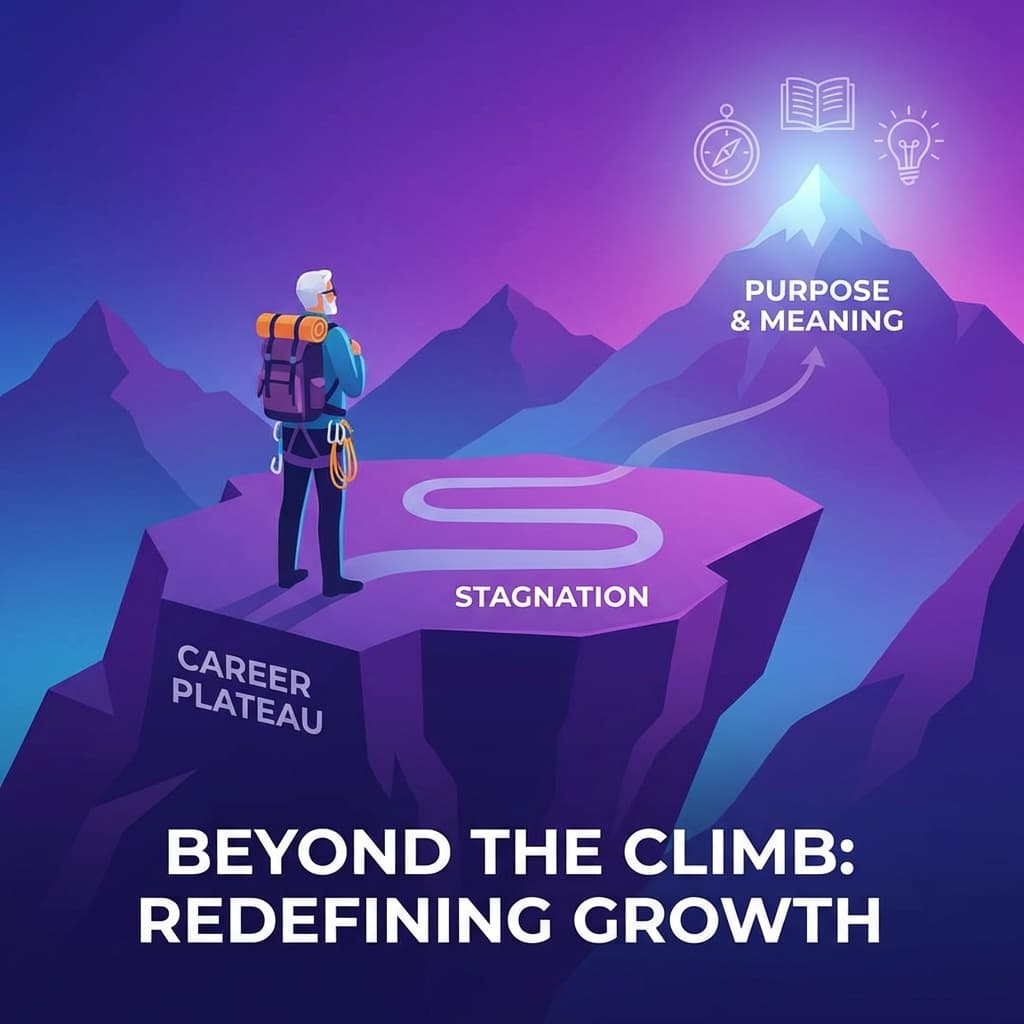
The Climb vs. The View
The first five years of your career are a vertical climb. Every day is new. "How do I center a div?" "What is a closure?" "How does Docker work?" You consume information like a black hole. The dopamine hits are frequent and intense. You struggle, you learn, you triumph.
Then, one day, you wake up. You are a "Senior Software Engineer." You can build anything you are asked to build. The fear of "can I do this?" is gone, replaced by the drudgery of "do I want to do this?"
This is the Plateau. And it is where many careers go to die.
The Symptoms of the Plateau
It manifests differently for everyone, but the signs are consistent:
- Boredom with Tech: New frameworks look like old frameworks with different syntax. React, Svelte, Solid—it's just state and DOM updates. You don't care anymore.
- Cynicism: When a junior engineer suggests a new tool, your first instinct is to explain why it will fail, rather than explore why it might work.
- The "Maintenance" Trap: You are so good at fixings things that you become the "fixer." You spend 80% of your time reviewing PRs, putting out fires, and attending meetings, and 0% writing code.
The Three Paths Forward
When you hit the Plateau, you have three choices. Most people drift into one; you need to choose consciously.
Path 1: The Specialist (The Monk)
You stop caring about "breadth" and go terrifyingly deep into one thing. You don't just "know Postgres"; you understand the vacuum process source code. You don't just "use Webrtc"; you contribute to the spec.
Is this for you? Only if you truly love the machine more than the product. This path requires solitude and obsession.
Path 2: The Multiplier (The Staff Engineer)
This is the most common advice, but the hardest to execute. You accept that your code output will drop. Your value shifts from "I write better code" to "I make 10 other people write better code."
This requires a fundamentally different skillset: Writing, persuasion, and architectural empathy. You are no longer building features; you are building the environment in which features are built.
Value = (Your Output) + (Team Output * Your Influence)If your influence is 0.1, you are barely helping. If it's 1.5, you are a Staff Engineer.
Path 3: The Product Engineer (The Founder)
You stop seeing code as the goal and start seeing it as a lever. You dive into the "Why." You talk to customers. You look at retention metrics. You use your technical superpower to prototype solutions to business problems faster than anyone else creates tickets.
This is where I found my exit from the plateau. I realized that the elegance of my code didn't matter if nobody used the feature.
Re-finding the Magic
If you are stuck, try this: Build something useless.
The Plateau often comes from professionalization. We only code for money. We only code to ship. Go build a game. Build a synthesizer. Build a generative art bot. Remember what it felt like to be a wizard, creating something from nothing just because you could.
The Trap of Management
Many seniors jump to Engineering Management (EM) effectively fleeing the plateau. Do not do this unless you want to change careers. Management is not a promotion; it is a different job. Using management to escape boredom is a disservice to the people you will manage.
Conclusion: The Plateau is a Feature, Not a Bug
The Plateau tells you that you have mastered the basics. It is an invitation to look up. The vertical climb is over; now you have to choose a direction across the landscape. It is scary because there is no longer a clear "next step" on the ladder. You have to build your own ladder.
So, take a deep breath. Look at the view. You earned it. Now, pick a direction and start walking.
Written by XQA Team
Our team of experts delivers insights on technology, business, and design. We are dedicated to helping you build better products and scale your business.