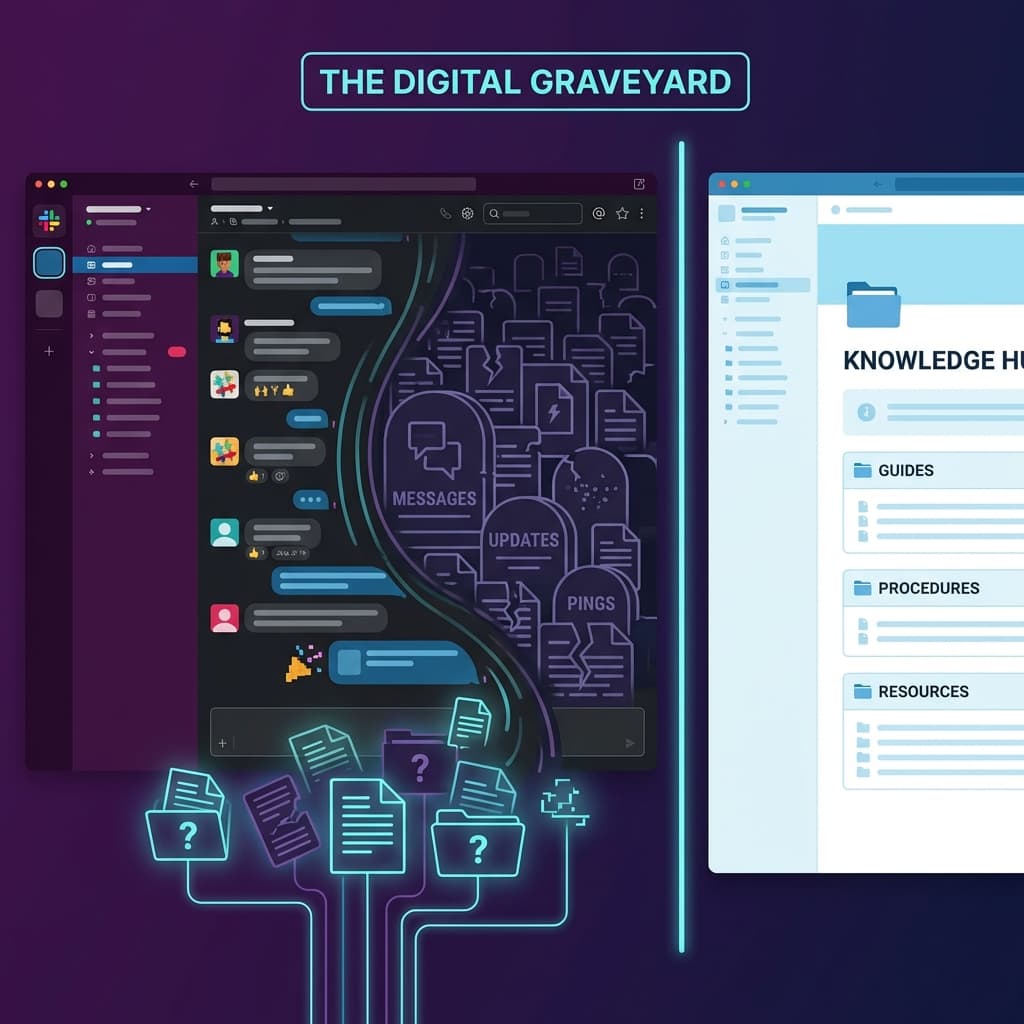
The Search That Broke Me
On my third day at a new company, I needed to deploy a change to the staging environment. Simple enough. I asked in the engineering channel: "How do I deploy to staging?"
The response: "It's in Slack somewhere. Search for 'staging deploy.'"
I searched. 47 results.
The first thread (6 months old) described a three-step process. The second thread (4 months old) contradicted the first—apparently the process had changed. The third thread (2 months old) mentioned a new tool that had been introduced. The fourth thread (3 weeks old) complained that the new tool was buggy and suggested a workaround.
None of these threads had been marked as the "canonical" answer. None had been updated when processes changed. They were just... conversations. Frozen in time. Scattered across hundreds of messages.
Two hours later, I had pieced together what I thought was the correct process. I was wrong. My deploy failed. I spent another hour debugging.
That's when I realized: Slack isn't documentation. It's a graveyard where knowledge goes to die.
Section 1: The Slack Paradox—More Communication, Less Knowledge
We've conflated communication with knowledge management. They're not the same thing.
The Illusion of Documentation
"It's in Slack somewhere" has become the de facto documentation strategy for many companies. And it feels like documentation—after all, the information was written down, right?
But Slack messages are fundamentally different from documentation:
- Ephemeral context: Messages are written for a specific moment, with assumptions about what readers already know.
- No update mechanism: When processes change, old messages don't get updated. They become landmines—technically present but dangerously outdated.
- Buried by volume: At 12,000 messages/day, even good information drowns in noise.
- Fragmented answers: The full answer to any question is usually spread across 5-10 messages with side conversations, jokes, and tangents in between.
This isn't documentation. It's a searchable archive of conversations. Those are not the same thing.
Why Chat is Anti-Knowledge
Chat as a medium has properties that actively work against knowledge retention:
- Real-time pressure: People write quickly to keep up with the conversation. Quick writing produces incomplete, context-dependent answers.
- Conversational format: Information is mixed with "thanks!", "lol", clarifying questions, and off-topic tangents.
- Recency bias: Search prioritizes recent messages, but recent doesn't mean correct.
- Threading chaos: Some answers are in threads, some are in the main channel, some are in DMs that other people can't see.
The medium itself is hostile to knowledge preservation.
The Organizational Cost
This isn't just an annoyance. It has measurable costs:
- Onboarding time 2x: New hires spend weeks learning things that should take days, because they're reconstructing knowledge from chat fragments.
- Repeated questions: The same questions get asked every month because no one can find the previous answers.
- Decision re-litigation: Decisions that were made and discussed get re-debated because the reasoning wasn't documented anywhere permanent.
- Expert bottlenecks: Senior people become walking documentation. Only they "remember" how things work. They become single points of failure.
I've seen estimates that poor knowledge management costs organizations 20-30% of productivity. After my Slack archaeology experience, I believe it.
The 72-Hour Window
Here's a useful mental model: the average Slack message is useful for about 72 hours. After that, the context has shifted, the participants have moved on, and the message becomes noise rather than signal.
If information needs to persist beyond 72 hours, it doesn't belong in Slack. Period.
Section 2: What "Documentation-First" Actually Means
Let me be clear about what I'm proposing—and what I'm not.
Not "Write More Docs"
The naive solution to bad Slack documentation is: "Let's write more docs!"
This creates a different graveyard. Now you have a Confluence space with 500 pages that are all outdated, unsearchable, and ignored. You've moved the problem; you haven't solved it.
More documentation is not the answer. Better documentation systems are the answer.
The Core Principle: Write Once, Reference Forever
Documentation-first means: conversations happen in real-time; decisions get documented in permanent form.
The workflow looks like this:
- Discussion happens in Slack (or meeting, or wherever)
- A decision is made
- One person documents the decision in the canonical location (wiki, docs, README)
- The Slack thread links to the documentation
- Future questions are answered by linking to the doc, not by re-explaining in Slack
The documentation becomes the source of truth. Slack becomes ephemeral coordination. They work together, but they have different purposes.
The 4 Pillars of Documentation-First Culture
Pillar 1: Decisions > Discussions
Discussions are useful, but decisions are what matter. Document the decision, not the full discussion. Include enough context to understand the "why," but don't transcribe the entire debate.
Pillar 2: Canonical Sources > Tribal Knowledge
For every major topic (deployment, architecture, onboarding, processes), there should be ONE canonical source. Not three wiki pages with slightly different information. One page that is kept up to date.
Pillar 3: Searchable > Chattable
Documentation should be written to be found. Use clear titles, section headers, and consistent terminology. If someone searches "how to deploy staging," the right page should appear.
Pillar 4: Maintained > Created-and-Abandoned
Documentation is alive. It needs maintenance. Build documentation review into your processes. When processes change, documentation changes. Assign owners to key pages.
The Anti-Pattern: "Living Docs in Slack"
Some people respond to these ideas with: "But our Slack IS alive! Docs get stale!"
This misunderstands the problem. Slack isn't "alive"—it's a constant stream of new messages that bury old ones. A wiki page that gets updated quarterly is more "alive" than a Slack message from 6 months ago that no one can find.
Living documentation means: updated regularly, with version history, by designated owners. That's a wiki or doc system. That's not chat.
Section 3: Case Study—70% Reduction in Onboarding Time
Let me tell you about a company that made this transition. I'll anonymize the details, but the story is real.
The Before State
A 200-person company with a "Slack-first" culture. Engineering prided itself on being "async." But in practice:
- Onboarding took 6 weeks before new hires were productive
- 20% of engineering time was spent answering (and re-answering) questions
- The wiki had 300 pages, but it hadn't been updated in 18 months
- "Ask in #engineering" was the default answer to everything
They had a Slack problem, but they thought they had an "information organization" problem. They tried Slack channels, threads, saved messages, and search improvements. Nothing worked.
The Mandate
New engineering director comes in. First month, they issue a mandate: "If it's not in the wiki, it doesn't exist."
The rules:
- Every process must have a wiki page. If there's no page, create one before asking questions.
- Answers in Slack must link to docs. "The answer is in the wiki: [link]" is acceptable. Explaining in Slack without a link is not.
- Questions that should be in docs trigger doc creation. "That's a great question. Can you create the doc and I'll review it?"
- Pages have owners. Every doc page has an assigned owner who is responsible for keeping it current.
The Resistance
Initial resistance was fierce:
- "Docs slow us down! We move fast!"
- "Writing is not my job!"
- "This is bureaucracy!"
The director held firm. They made documentation part of the definition of "done." A feature wasn't complete until the docs were updated. They praised good documentation publicly in all-hands meetings.
The Results (6 Months Later)
- Onboarding time: Dropped from 6 weeks to 2 weeks. New hires could read the docs and be productive without constant hand-holding.
- Repeated questions: Dropped by 70%. When someone asked a question, the answer was "see wiki page X." Questions only came when the docs were genuinely missing.
- Decision re-litigation: Mostly eliminated. "We discussed this—the decision and reasoning are documented here."
- Support tickets: Dropped 40%. Customers could find answers in documentation instead of filing tickets.
The "slow down" that people feared never materialized. Writing docs takes time upfront but saves 10x that time in repeated explanations.
The Cultural Shift
The most interesting outcome was cultural. Engineers who wrote great documentation got praised and promoted. "Clear technical writing" became a valued skill, not just coding speed.
People started taking pride in their documentation. "Look how clean this onboarding guide is" became a thing. The wiki went from a graveyard to a living resource.
Section 4: How to Shift Your Organization
If you're convinced documentation-first is the right approach, here's how to make it happen.
Start Small: Pick One High-Pain Topic
Don't try to document everything at once. Pick the topic that causes the most repeated questions or onboarding pain.
Common starting points:
- Deployment processes
- Local development setup
- On-call procedures
- Architecture decisions
Create excellent documentation for that one topic. Use it as the model. Then expand.
Tooling Matters (But Not as Much as Culture)
Pick a documentation tool and standardize on it:
- Notion: Good for flexibility and rich content
- Confluence: Good for enterprise with heavy Atlassian usage
- GitBook: Good for external-facing docs
- Docs-as-code (Markdown in repos): Good for developer-heavy teams
The specific tool matters less than consistency. Multiple documentation systems = no documentation system. Pick one and enforce it.
Incentives: Make It Part of Performance
If documentation isn't part of how people are evaluated, it won't happen consistently.
- Include "documentation quality" in performance reviews
- Praise good docs publicly
- Require docs updates as part of feature completion
- Make doc ownership part of senior engineer expectations
What gets measured gets done. What gets praised gets repeated.
Kill the Escape Hatch
The hardest part: when someone asks a question in Slack, resist the urge to just answer it.
Instead:
- If there's a doc, link to it: "Great question! See [link]."
- If there's no doc, create one (or assign someone to create it): "That should be documented. Can you create a doc and I'll review?"
Every time you answer in Slack without creating or linking documentation, you're reinforcing the "Slack-is-docs" anti-pattern.
The Broken Window Theory of Documentation
If one doc is outdated, people assume all docs are outdated. If the wiki feels abandoned, people stop contributing.
Keep the most-visited pages impeccable. Review them monthly. Kill pages that are beyond saving. It's better to have 50 excellent pages than 500 neglected ones.
Closing Thought
Chat is for coordination. Docs are for knowledge. Stop confusing them.
Slack is wonderful for real-time coordination, quick questions, and team bonding. It's terrible for knowledge preservation. Use it for what it's good at.
Documentation is boring. Writing takes time. Maintaining takes discipline. But the alternative—organization-wide knowledge loss, repeated questions, slow onboarding, expert bottlenecks—is far more expensive.
I spent 2 hours searching Slack for deployment instructions that should have been a 2-minute doc lookup. Multiply that by every employee, every question, every week. That's the cost of "Slack as documentation."
Document it once. Reference it forever. Your future selves will thank you.
Appendix: Documentation Health Check
Score your organization 1-5 on each dimension:
- Findability: Can a new hire find the answer to common questions by searching docs (not Slack)?
- Freshness: Are your most-viewed docs updated within the last 3 months?
- Ownership: Does every critical doc have a designated owner?
- Linkability: When questions are asked in Slack, are they answered with doc links?
- Completeness: Are major processes (deploy, onboarding, incident response) fully documented?
If you score below 3 on any dimension, that's where to focus first.
Written by XQA Team
Our team of experts delivers insights on technology, business, and design. We are dedicated to helping you build better products and scale your business.