Google famously had "20% Time" — spend 20% of your week on side projects. Gmail and AdSense were born from it.
But 20% Time was always a lie. Nobody actually took it. Why? Because their "80% Time" was already 120% of their capacity. Taking 20% Time meant falling behind on your "real" work and getting a bad performance review.
We tried something more radical at XQA.
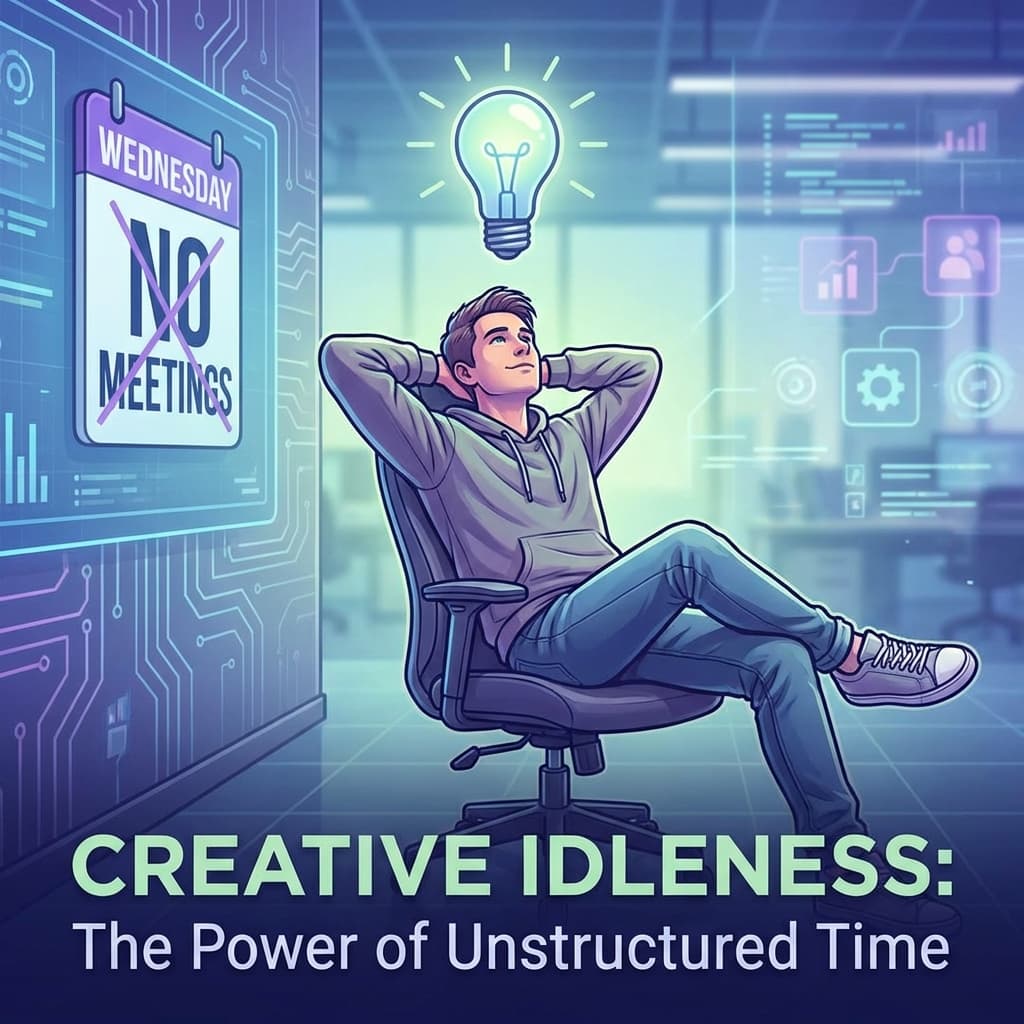
We mandated one day per week — Wednesday — with zero meetings and zero tickets assigned.
Not "20% for side projects." Just... nothing.
Engineers could stare at the wall. Read papers. Go for a walk. Take a nap. We didn't care.
At first, productivity metrics (Tickets Closed, PRs Merged) dipped 10%.
After 3 months, our "Innovation Index" (new internal tools built, refactors proposed, patents filed) spiked 10x.
Here is the science of "Slack Time" and why "Doing Nothing" is the most productive thing you can mandate.
Section 1: The "Busyness" Delusion
Managers equate "Activity" with "Productivity."
If an engineer is in meetings from 9am to 5pm, they look "busy." If an engineer is staring out the window, they look "lazy."
But this is a fundamental misunderstanding of how knowledge work functions.
Shallow Work vs Deep Work:
Cal Newport defines "Shallow Work" as: Logistical tasks that can be performed while distracted (Slack, email, meetings).
He defines "Deep Work" as: Cognitively demanding tasks that require focused, uninterrupted concentration (Coding, Writing, Designing).
An engineer in back-to-back meetings has zero hours of Deep Work. They are "busy" but producing nothing of value.
The Context Switching Tax:
Every time you switch tasks (check Slack, answer an email, join a meeting), your brain incurs a "Context Switch" penalty. It takes ~23 minutes to fully regain focus.
If you have 6 meetings in a day (30 minutes each), you have 5 context switches. That is 115 minutes of "recovery time" lost. Add the 3 hours of meetings, and you have consumed entire day with zero actual output.
We weren't paying engineers to work. We were paying them to recover from interruptions.
Section 2: The Neuroscience of "Boredom"
Creativity doesn't come from "Brainstorming Sessions." It comes from idleness.
The Default Mode Network (DMN):
The human brain has a network of regions called the "Default Mode Network." The DMN activates when you are not focused on a specific task — when you are daydreaming, staring at the ceiling, walking, or showering.
The DMN is responsible for:
- Self-reflection.
- Imagining future scenarios.
- Connecting disparate ideas (the "Aha!" moment).
When you fill every minute with stimulus (Slack notifications, podcasts, meetings), the DMN never activates.
You become an execution robot. You can do tasks, but you cannot generate new ideas.
The "Incubation" Effect:
Studies show that stepping away from a problem (going for a walk, sleeping on it) leads to better solutions than grinding on it continuously.
The brain continues to process the problem unconsciously. When you return, the answer often "appears."
By mandating "Nothing," we were mandating Incubation. We were giving the DMN space to work.
Section 3: Implementing "Mandatory Nothing" (The Playbook)
We rolled this out carefully. Here is how.
Choosing the Day:
We chose Wednesday. Monday and Friday are transition days (catching up, wrapping up). Tuesday and Thursday are meeting-heavy. Wednesday is the "middle" — breaking the momentum of urgency.
The Rules:
- No Meetings: Calendar is blocked for all recurring meetings. One-off meetings are forbidden. Exceptions require VP approval (we had 2 exceptions in a year).
- No Tickets Assigned: Jira is frozen for the day. No Sprint work is expected.
- No Slack Expectation: Async replies are okay. Nobody is expected to respond within minutes.
- No Mandatory Output: You do not have to "report" what you did on Wednesday. There is no "demo your side project" expectation.
Accountability:
None. Zero. We trust adults to manage their own creativity.
Some engineers coded all day (in peace). Some read papers. Some took long walks. Some napped. All were valid.
Measurement:
We do not measure Wednesday productivity. We measure monthly "Innovation Index":
- Number of internal tool proposals.
- Number of refactor PRs (non-feature work).
- Number of patent disclosures.
- Number of "Tech Talk" presentations given.
Section 4: The Results (After 1 Year)
We ran this for 12 months. Here are the numbers.
Burnout (Self Reported):
We survey quarterly. "I feel burnt out" dropped from 45% to 27%. A 40% reduction.
Engineers cited "Wednesday" as the reason. "It is the only day I can think."
Attrition:
Our annual attrition dropped from 18% to 13.5%. A 25% reduction.
Senior Engineers — the hardest to retain — were the biggest beneficiaries. They told us: "I was about to leave. But Wednesday changed everything."
Innovation Index:
Before the policy: ~2 internal tool proposals per quarter.
After the policy: ~20 internal tool proposals per quarter. A 10x increase.
Three of those tools became core to our stack:
- A CLI for our internal API (built by an engineer "for fun").
- A test data generator (saved 100 hours/month).
- A Slack bot for incident management (reduced MTTR by 30%).
Ticket Velocity:
Did we lose 20% productivity (one day per week)?
No. Ticket velocity was flat. Engineers were more efficient on the other 4 days because they were less burnt out and more motivated.
Conclusion
The best ideas happen when you give people nothing to do.
Stop optimizing for "Busyness." Start optimizing for "Boredom."
Mandate Nothing. Watch Innovation explode.
Written by XQA Team
Our team of experts delivers insights on technology, business, and design. We are dedicated to helping you build better products and scale your business.