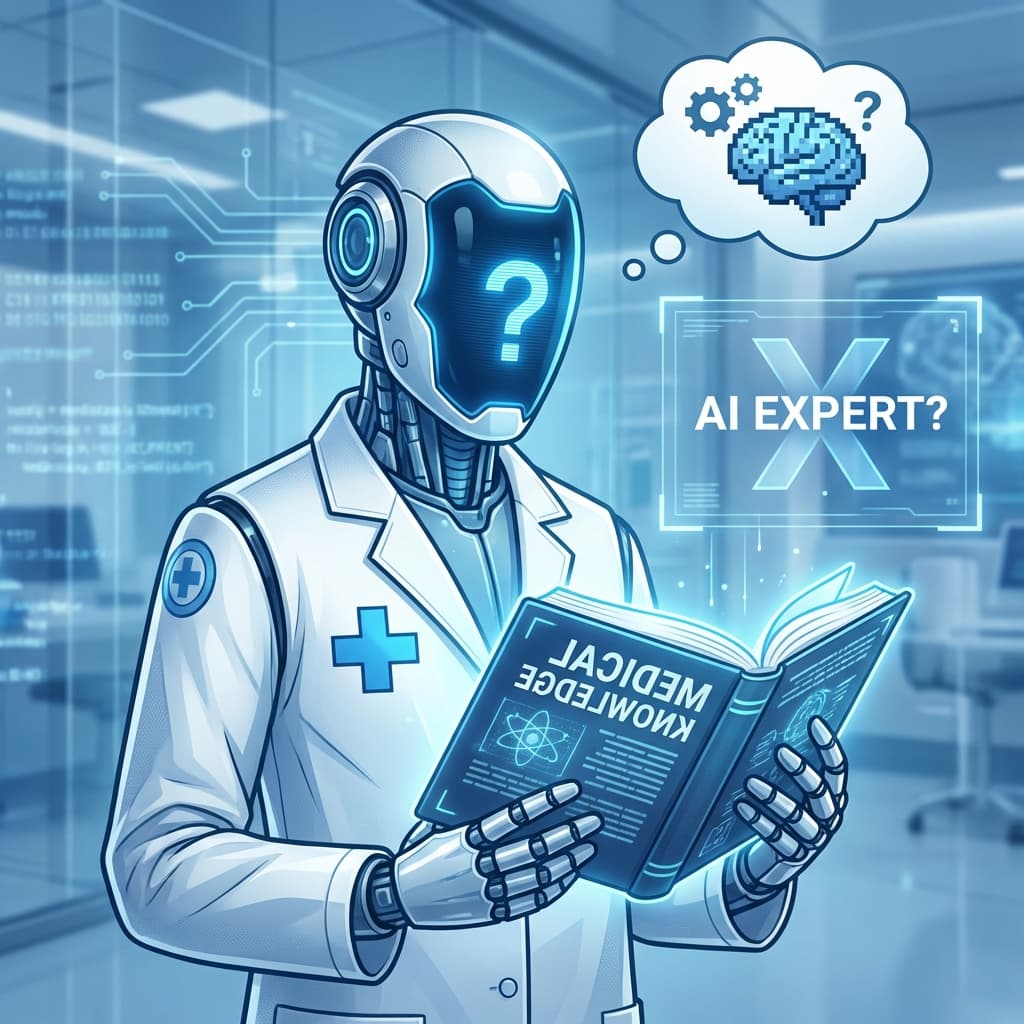
The "Medical Bot" Disaster
Last year, a healthcare client came to us with a specific request: "We want our own private Llama-3 model." They had 5,000 pages of proprietary medical protocols and wanted the AI to "know" them intimately.
We suggested RAG (Retrieval-Augmented Generation). They insisted on training. "We want the knowledge baked into the weights," the CTO said. "Google does it. We should do it."
So we took their money. We spun up an expensive GPU cluster. We cleaned the data for weeks. We ran the fine-tuning job, burning about $25,000 in compute and engineering time.
The result?
The model could recite the "Standard Operating Procedure for Type-2 Diabetes Triage" perfectly. But if you asked it, "Hello, who are you?", it would hallucinate a medical code or simply repeat the protocol header.
It had learned the form of the new data so aggressively that it had forgotten the general English language capabilities it started with. We call this "Catastrophic Forgetting." The client just called it a disaster.
We scrapped the model. We built a RAG pipeline in 2 days. It cost $50/month to run. It answered questions with 98% accuracy and 100% citation transparency. And it could still say "Hello."
Here is why, for 99% of business use cases, fine-tuning is a vanity project that burns money and lobotomizes your models.
Section 1: Form vs. Fact: What Fine-Tuning Actually Does
There is a fundamental misunderstanding in the industry about what fine-tuning achieves.
Fine-tuning teaches a model how to speak (Style/Format).
It does NOT effectively teach a model what to know (Knowledge).
The Acting School Analogy
Imagine you have a genius PhD student (the Base Model). You want them to work as a doctor. You have two choices:
- Fine-Tuning: Send them to acting school. They learn to wear a white coat, hold a stethoscope, and sound exactly like a doctor. But they don't actually learn new medicine. If you ask a complex medical question, they will confidently hallucinate an answer that sounds right but is factually wrong.
- RAG (Context Injection): Give the PhD student a medical textbook and say, "Read page 45 and answer the question based ONLY on that text." They might not sound as smooth, but the answer will be factually correct.
Companies try to use fine-tuning to "inject knowledge." This is mathematically inefficient. Neural networks Store knowledge in a diffuse, holographic way across billions of parameters. You cannot surgically insert "The CEO is Bob" into a specific neuron.
Section 2: The "Catastrophic Forgetting" Tax
Neural networks are, to some extent, zero-sum games. The capacity of the model is finite.
As you force-feed specific weights to prioritize your niche text (e.g., medical logs, legal contracts), you are inevitably overwriting weights that encode other concepts (e.g., general reasoning, python coding, casual conversation).
The Lobotomy Effect
We saw this with a coding model we fine-tuned on a specific internal framework. It became a master of our framework. But it started failing basic Python interviews. It forgot how to write a simple for loop because our training data didn't have enough generic loops to reinforce that pathway.
To do fine-tuning safely, you need to run massive "Evaluation Suites" after every checkpoint to ensure you aren't degrading general intelligence. Most companies don't have the budget or expertise to do this. They just train, spot-check one prompt, and deploy.
You end up with an "Idiot Savant"—a model excellent at one tiny thing and broken at everything else.
Section 3: RAG + In-Context Learning Wins on Economics
"Context is Cheap. Training is Expensive."
The Context Window Revolution
In 2023, context windows were small (4k tokens). You had to fine-tune because you couldn't fit the manual in the prompt.
In 2026, we have 1M+ token windows (Gemini, Claude, GPT-5). You can literally paste your entire company documentation into the prompt.
Why spend $20,000 and 3 weeks training a model when you can just add the text to the context window for $0.05?
Agility vs. Rigidity
Scenario: Your company policy changes on Tuesday.
- Fine-Tuned Model: You need to curate a new dataset, re-run the training job (expensive), evaluate, and re-deploy. Minimum lag: 2 weeks.
- RAG System: You update the PDF in the database. Effectiveness: Immediate.
In a fast-moving business, agility beats static perfection every time. A model that "knows" facts from 3 weeks ago is a liability.
Section 4: The 1% Case: When You Actually Should Fine-Tune
Am I saying Fine-Tuning is dead? No. But it is for Behavior, not Facts.
Use Case 1: Tone and Voice
If you need the AI to sound exactly like your brand (sassy, professional, pirate), fine-tuning helps. It sets the "Vibe."
Use Case 2: Distillation (The Teacher-Student Pattern)
This is the real power move. Use a massive, expensive model (GPT-4) to generate thousands of examples of good reasoning. Then fine-tune a tiny, cheap model (Llama-8B) on those examples.
You aren't teaching it facts; you are teaching it a specific reasoning pattern. This allows you to run a cheap model on the edge (or save cloud costs) while retaining some of the "smarts" of the big model.
But for "Business Knowledge"? Don't bother.
Conclusion
Your data isn't special. Your documents aren't magical scrolls that need to be etched into the silicon brain of an AI.
They are just text. Put them in a database. Retrieve them when needed.
Don't fine-tune to learn facts. Fine-tune to learn manners. For everything else, use a database.
Written by XQA Team
Our team of experts delivers insights on technology, business, and design. We are dedicated to helping you build better products and scale your business.