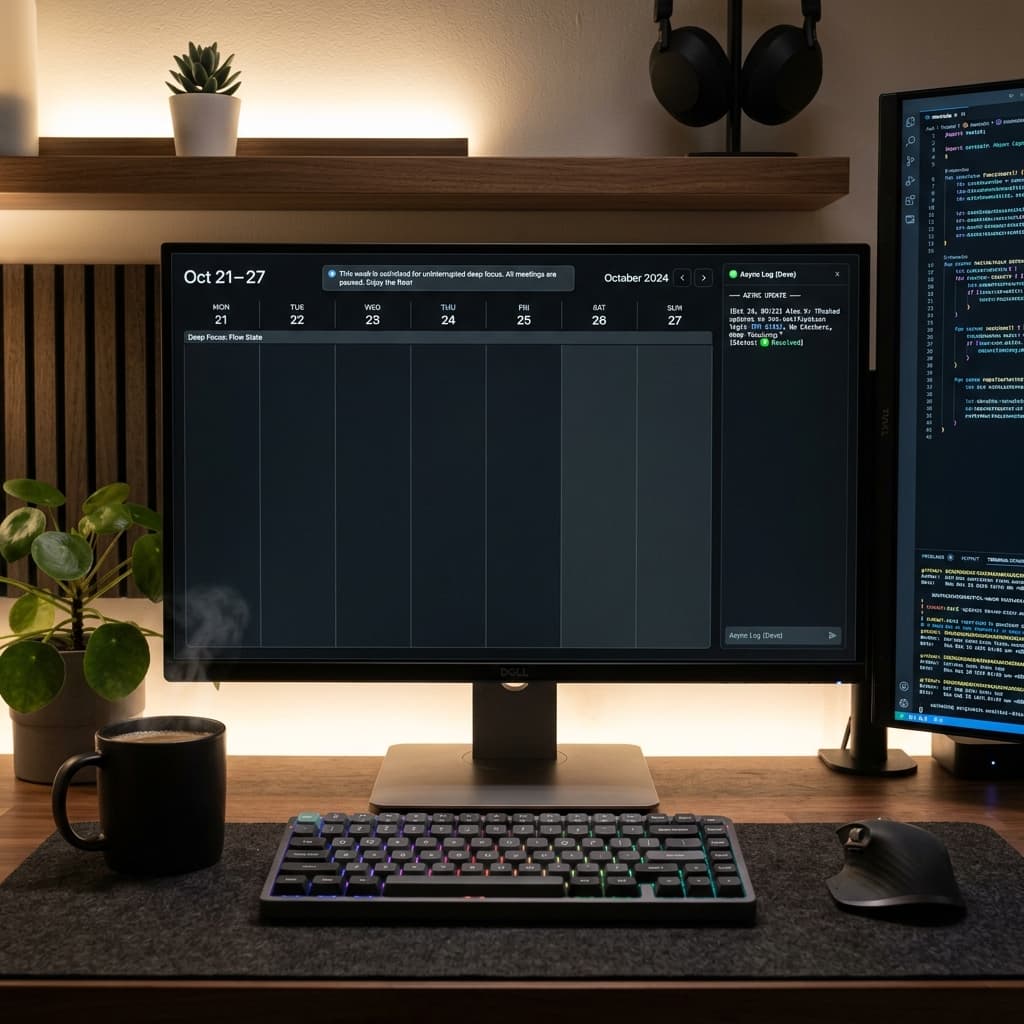
If there is one untouchable, sacred cow in modern engineering management, it is the weekly 1-on-1. Every management book, every HR consultant, and every Silicon Valley thought leader insists that a 30-minute weekly meeting between an employee and their manager is the bedrock of organizational health. You cancel a 1-on-1 at your own peril. You are told it shows you don't care.
Last year, we did the unthinkable. We canceled all of them. Entirely.
We replaced the rigid, calendared weekly 1-on-1 with a system of structured asynchronous updates and on-demand office hours. The result was not chaos or a collapse of morale. The result was dramatically increased deep work time, more honest communication, and the elimination of the most dreaded phenomenon in corporate life: the meeting where two people sit across from each other desperately searching for something to talk about.
The Myth of the 1-on-1
The theoretical premise of the 1-on-1 is brilliant. It is a dedicated space for coaching, career development, addressing blockers, and building rapport. The engineering manager provides sage wisdom, unblocks complex technical architectural problems, and guides the engineer toward their long-term career aspirations.
The reality of the 1-on-1 is vastly different.
They devolve into status updates. Despite every manager swearing they won't let it happen, 80% of 1-on-1s eventually devolve into a verbal recounting of a Jira board. "What did you work on yesterday? How is that ticket coming? Will it be done by sprint end?" Paying two highly compensated professionals to verbally recite text that is already written down in a project management tool is a staggering waste of capital.
They force artificial conversation. Not every week requires a deep, soul-searching conversation about career trajectory. Sometimes, an engineer just wants to put their headphones on, write Rust for five days straight, and be left alone. Forcing a conversation when there is nothing organic to discuss leads to awkward silences, manufactured problems ("Well, I guess one minor annoyance is..."), and mutual resentment of the calendar block.
They create context switching. A 30-minute meeting on a Tuesday at 2:00 PM does not cost 30 minutes. It costs the hour of deep focus before the meeting as the engineer anticipates the interruption, the 30 minutes of the meeting itself, and the 45 minutes of recovery time required to rebuild the mental context of the code they were writing. A completely clear day is an engineer's most valuable asset; dotting that day with 30-minute management check-ins shatters it.
The Asynchronous Replacement
When we killed the weekly meeting, we didn't stop communicating. We simply changed the medium. We instituted a highly structured, asynchronous weekly update format.
Every Friday afternoon, every engineer writes a short update in a dedicated Slack channel (or Notion document). It has four required sections:
- Progress: What was definitively shipped or completed this week. (Keep it brief, link to pull requests).
- Stuck/Blockers: What technical or organizational issues are preventing progress. Where do you need management intervention?
- Focus for Next Week: What is the primary objective for the coming week.
- Morale/Vibe Check: A low-friction, color-coded (Green/Yellow/Red) indicator of how they are feeling, with optional context.
This update takes 10 minutes to write. The manager reads the updates asynchronously on Friday evening or Monday morning. This solves the status update problem instantly. The manager has full visibility into the work, the blockers, and the engineer's workload without a single word being spoken.
The "On-Demand" Conversation
Of course, actual human conversation is occasionally required. Career paths need to be discussed. Interpersonal conflicts need to be resolved. Complex architectural disagreements must be debated.
For these conversations, we shifted to an "On-Demand" model accompanied by Manager Office Hours.
Manager Office Hours: Every manager blocks out two consecutive hours on Wednesday mornings. During this time, they are in an open Google Meet (or physical office cubicle). Any engineer can drop in, completely unannounced, for 5 minutes or 45 minutes. If an engineer is blocked, wants to discuss a promotion, or just wants to chat about a new framework, they drop in. If no one drops in, the manager does their own deep work.
On-Demand Scheduling: If an issue arises outside of office hours that cannot be resolved asynchronously, anyone—the manager or the engineer—can instantly schedule a targeted meeting. But the meeting must have a specific, actionable agenda. "Quick chat about the database migration latency" is a valid meeting. "Weekly sync" is forbidden.
By removing the default weekly meeting, we ensured that when two people do get on a call, it is because there is a genuine, pressing, and identified need to communicate dynamically.
The Results After One Year
The pushback to this policy change was initially fierce. Junior engineers worried they wouldn't get enough face time with leadership. Managers worried they would lose the "pulse" of their team and that psychological safety would erode.
One year later, the metrics and the sentiment surveys tell a different story.
- Velocity Increased: Story points delivered per engineer increased by 18%. The elimination of context-switching allowed for significantly longer periods of uninterrupted flow state.
- Blockers Resolved Faster: In the old system, an engineer who hit a minor political blocker on Thursday would often say, "I'll just wait and bring it up in my 1-on-1 on Tuesday." In the async system, they raise it immediately in a thread, and it gets unblocked within hours.
- Higher Quality Conversations: When on-demand meetings are scheduled, they are highly potent. Because both parties know the meeting was called for a specific reason, they come prepared, focus intensely on the issue, and leave with immediate action items.
- Introvert Supremacy: 60% of our engineering team identifies as deeply introverted. For them, written communication is primary. They are far more articulate, thoughtful, and honest when writing an asynchronous update than they are when put on the spot in a spontaneous video call.
What About the "Human Element"?
The most common criticism of this approach is that it is clinical. "How do you build trust? How do you ask about their weekend? How do you know if someone is secretly burning out?"
Trust is not built by forcing someone to turn on their webcam every Tuesday at 10 AM to discuss their weekend. Trust is built by delivering on promises. Trust is built when an engineer says "I am blocked by the platform team," and the manager resolves the blocker within an hour. Trust is built by respecting an engineer's time and autonomy.
As for burnout, managers are trained to look closely at the asynchronous data. If an engineer who meticulously writes detailed updates suddenly starts posting one-sentence replies, if their pull request volume drops, or if their Vibe Check stays "Yellow" for three weeks, the manager intervenes. They schedule an immediate on-demand sync. We did not stop caring about our developers; we simply stopped assuming that a rigid calendar invite was the only way to express that care.
Conclusion
The weekly 1-on-1 is an artifact of the factory floor, adapted poorly for the digital age. It assumes that management requires continuous visual inspection and auditory reporting. It assumes that communication cannot happen unless two people occupy the same digital room simultaneously.
We are knowledge workers. Our work is asynchronous. Our planning is asynchronous. Our code reviews are asynchronous. It makes zero sense that our management relationships must remain tightly bound to the synchronized ticking of a clock.
Free your calendar. Trust your engineers to write down their problems. Speak when speech is required, and embrace silence when the work demands focus. The best managerial intervention is often getting entirely out of the way.
Written by XQA Team
Our team of experts delivers insights on technology, business, and design. We are dedicated to helping you build better products and scale your business.