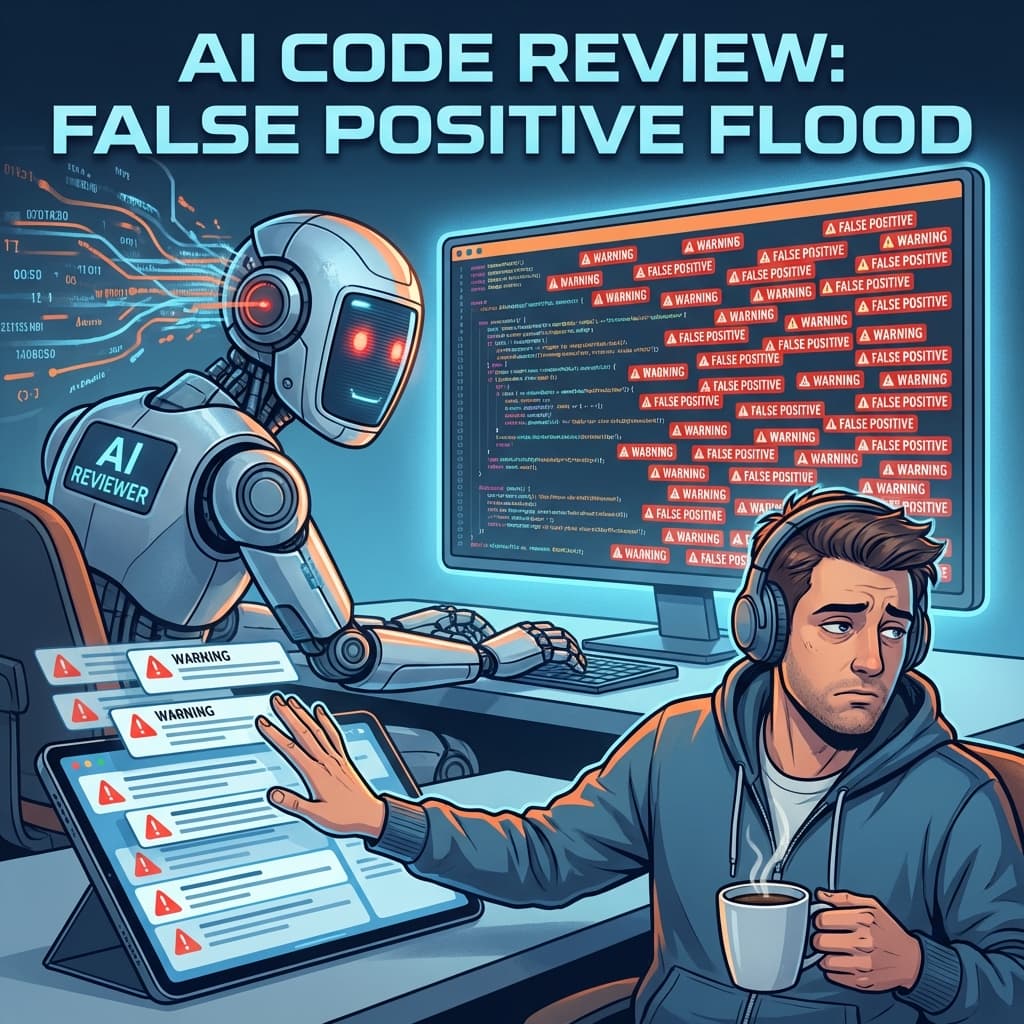
We integrated an AI code review tool. It automatically flagged potential issues on every pull request. The promise: catch bugs before human reviewers spend time on them.
The first week, engineers loved it. "It's catching bugs before review!"
By week 4, engineers ignored it entirely.
The tool flagged too much. 30% of its suggestions were wrong or irrelevant. Style nitpicks presented as bugs. False positives everywhere.
Engineers stopped reading its comments. When it finally caught a real bug — a genuine security issue — nobody noticed. The comment sat there unread for 3 days.
We turned it off. The boy who cried wolf had destroyed its own credibility.
Here's when AI code review helps — and when it creates noise that drowns out signal.
Section 1: The Promise of AI Code Review
AI code review sounds perfect on paper.
Catch Bugs Before Human Review:
Instead of senior engineers spending time on obvious issues, AI catches them first. By the time a human reviews the code, the easy stuff is already fixed.
This should save time. Human reviewers focus on architecture, logic, and design. AI handles syntax, common patterns, and basic errors.
Consistent Standards:
AI doesn't have bad days. It applies the same rules to every PR. No more "this reviewer is strict about X but lenient about Y."
Codebase consistency improves. New engineers learn the patterns faster because they're explicitly called out.
Free Up Senior Engineers:
Senior engineers are expensive. If AI can handle the first pass of review, seniors can focus on higher-value work: mentoring, architecture, complex problem-solving.
This should increase team velocity without increasing headcount.
The Vision:
Faster reviews. Fewer bugs. More consistent code. Less burden on senior engineers. Sounds like the perfect productivity multiplier.
We bought in completely.
Section 2: The False Positive Problem
Reality was different.
30% Wrong or Irrelevant:
We tracked it. Of every 10 AI suggestions, 3 were one of:
- Factually wrong (suggesting changes that would break the code)
- Stylistically nitpicky (flagging valid personal preferences as "issues")
- Irrelevant (commenting on patterns that were intentional and documented)
That's a 30% false positive rate. In any other context, we'd call that unacceptable.
The Cry Wolf Effect:
When 1 in 3 suggestions is wrong, engineers learn to distrust all suggestions.
It's rational. If reviewing an AI comment takes 30 seconds and 30% are worthless, that's 10 seconds wasted per comment. Multiply by 10 comments per PR. Multiply by 5 PRs per day. Engineers started skipping them entirely.
The tragedy: the 70% of suggestions that were valid also got ignored. Including the one security issue that slipped through.
Real Issues Buried in Noise:
When the AI flagged a genuine SQL injection vulnerability, the comment was one of 12 on the PR. Eleven were noise. The engineer glanced at the list, saw mostly nitpicks, and approved the PR.
The bug made it to production. We caught it in a later security audit. But AI code review had the job of catching it — and technically, it did. The engineer just didn't see it.
Worse Than No Tool:
Without the AI tool, human reviewers would have reviewed the code themselves. They'd have caught the security issue. The AI tool created a false sense of coverage while actually reducing attention.
The tool made code review worse, not better.
Section 3: Why AI Code Review Often Fails
Our experience isn't unique. AI code review has structural problems.
Code Context Is Hard:
AI sees lines. It doesn't understand architecture.
A pattern that's wrong in one context is right in another. AI doesn't know that this particular function is intentionally duplicated because of a dependency isolation requirement. It just sees "duplication" and flags it.
Human reviewers understand why code is the way it is. AI sees what code is without the why.
Style vs. Substance:
AI is good at style. "This line is too long." "This variable name doesn't match your convention." "You're missing a docstring."
AI is bad at substance. "This logic has a race condition." "This algorithm won't scale." "This abstraction is wrong for your use case."
The easy things (style) are also the least important. The hard things (logic, architecture) are where bugs hide. AI focuses on the former while missing the latter.
Lack of Codebase Knowledge:
AI doesn't know your codebase. It doesn't know your team's decisions, your tech debt, your intentional deviations from best practices.
It applies generic rules to a specific context. Context matters enormously in code review.
When It Might Work:
AI code review can work in narrow, constrained contexts:
- Massive open-source projects with many contributors and no shared context
- Specific, deterministic checks (security scanning for known vulnerability patterns)
- Style enforcement (but linters already do this, without AI)
For most engineering teams, these conditions don't apply.
Section 4: What We Use Instead
After turning off AI review, we revisited our code review process.
Human Reviewers with Domain Knowledge:
We assign reviewers based on expertise, not availability. Someone who knows the subsystem reviews code in that subsystem.
This costs more reviewer time. But the reviews are meaningful. Bugs get caught. Architecture decisions get discussed. Knowledge transfers.
Linters and Static Analysis (No AI Guessing):
For deterministic checks — formatting, linting, type errors — we use traditional tools. ESLint. Prettier. TypeScript's type checker.
These tools have ~0% false positive rates for the rules they check. Engineers trust them completely. When they flag something, it's real.
No AI guessing. No probabilistic suggestions. Just deterministic rules.
AI for Specific, Constrained Tasks:
We do use AI for security scanning. Tools that look for known vulnerability patterns (SQL injection, XSS, etc.) with high precision.
These are narrow tasks with well-defined right answers. AI can be trained to high accuracy on them.
General code review is too broad. Security scanning is narrow enough to be reliable.
Conclusion
AI code review sounds like the future. In practice, it's often counterproductive.
The false positive problem isn't a bug to be fixed. It's a fundamental limitation of applying probabilistic models to contexts that require near-perfect precision.
One wrong suggestion is forgivable. Ten wrong suggestions per day is exhausting. And once engineers stop trusting the tool, even the good suggestions get ignored.
Tools must be trusted to be useful. False positives destroy trust.
Written by XQA Team
Our team of experts delivers insights on technology, business, and design. We are dedicated to helping you build better products and scale your business.