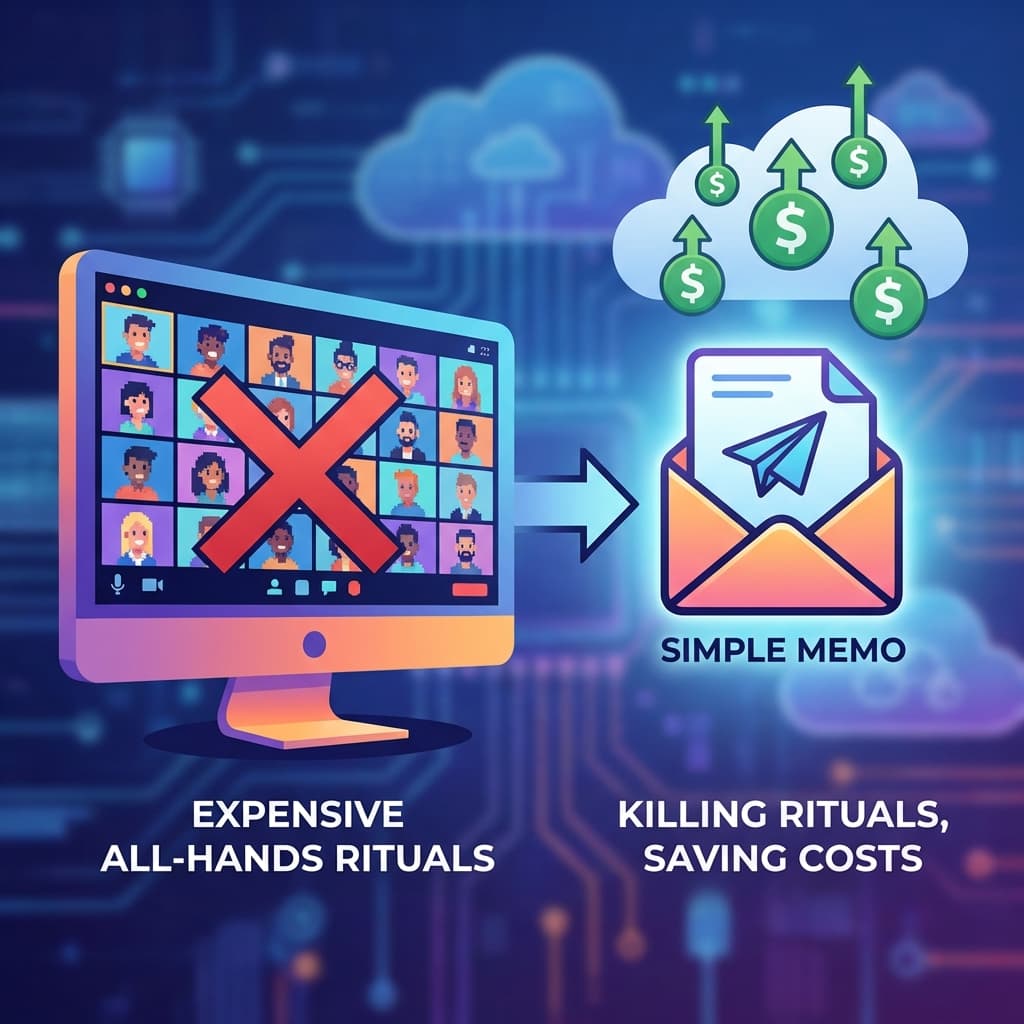
Every month, we'd pull the entire company into a 90-minute All-Hands meeting. 200 people. One Zoom call. Leadership would present slides. Someone would ask a softball question. Everyone would applaud.
I did the math one day.
200 people × 1.5 hours × $75/hour average = $22,500 per meeting.
Our All-Hands cost $270,000 per year. For what?
I surveyed the team: 80% said they'd rather get an email summary. 15% said they "tolerated" it. Only 5% found it genuinely valuable.
We killed the All-Hands. Replaced it with written updates and optional Q&A.
Engagement with company updates actually increased. Here's why synchronous rituals are often expensive theater.
Section 1: The Ritual Nobody Questions
All-Hands meetings are one of those corporate traditions that nobody questions. "This is how companies communicate."
But why?
The Historical Context:
All-Hands meetings made sense in a pre-digital era. You couldn't email 200 people. You couldn't post a video. The only way to reach everyone simultaneously was to gather them physically.
That context no longer exists. We have email. We have Slack. We have Loom. We have a dozen ways to broadcast information that don't require 200 people to stop what they're doing simultaneously.
But the ritual persists. Traditions outlive their justifications.
The Format Problem:
All-Hands meetings are broadcasts, not discussions.
One person (or a small group) talks. 99% of attendees listen. There's no back-and-forth. There's no collaboration. It's a one-way information transfer.
If you need to broadcast information, you don't need a meeting. You need a memo.
The meeting format is optimized for discussion. All-Hands aren't discussions. They're presentations with a captive audience.
The Illusion of Alignment:
Leaders often justify All-Hands as creating "alignment." Everyone hears the same message at the same time. Everyone is on the same page.
But are they?
In a 90-minute meeting, attention wanders. People multitask (despite admonitions not to). Key messages get buried in slide decks. By the next day, most attendees remember fragments, if anything.
A written memo, which people can read at their own pace and refer back to, creates more alignment than a meeting that becomes a blur of slides.
Scaling Problems:
All-Hands don't scale. At 20 people, they're intimate and interactive. At 200 people, they're performances.
As companies grow, the All-Hands format degrades. The CEO becomes a distant figure on a screen. Questions become performative ("Great question, Jennifer!"). The human connection that justified the format disappears.
What remains is ritual — expensive, time-consuming ritual.
Section 2: The True Cost of Synchronous Rituals
Let's be explicit about what All-Hands costs.
Time Cost:
200 people × 1.5 hours = 300 human-hours.
That's almost 8 full-time work weeks consumed in a single meeting. Every month.
Those hours have value. Engineers could be shipping features. Salespeople could be closing deals. Customer Success could be helping customers.
The All-Hands pre-empts all of that.
Opportunity Cost:
What could the company accomplish with 300 hours of focused work?
- A significant feature shipped
- Dozens of sales calls made
- Hundreds of support tickets resolved
The opportunity cost is invisible but real. Every All-Hands is a trade-off against productive work.
Attention Cost:
Let's be honest: most people aren't fully present in All-Hands meetings.
They're checking Slack. Responding to emails. Getting things done while the CEO talks about Q3 results.
The meeting claims 90 minutes but captures perhaps 20 minutes of actual attention. The rest is theater — pretending to pay attention while doing other things.
Why maintain a fiction that wastes everyone's time?
Energy Cost:
Fake enthusiasm is exhausting.
The pressure to look engaged, to clap at the right moments, to unmute and say "Great update, thanks for sharing!" — this is emotional labor.
After an All-Hands, people are drained. They need time to recover before returning to focused work. The meeting's impact extends beyond its scheduled time.
Section 3: What People Actually Want
Before killing the All-Hands, I surveyed the company. The results were clarifying.
Survey Results:
- 80% said they'd prefer a written summary they could read on their own time
- 15% said they "tolerated" All-Hands but didn't find them valuable
- 5% said they genuinely valued the synchronous format
We were running a $270k/year meeting for 5% of the company.
What People Want Is Information:
People don't want All-Hands meetings. They want to know what's happening in the company.
The meeting is a means to an end. But it's a clumsy means. A memo serves the same end more efficiently.
They Want Relevance:
A 90-minute All-Hands covers many topics. Most are irrelevant to any given attendee.
Engineers don't need 20 minutes on sales pipeline. Sales doesn't need a deep-dive on the technical roadmap. But everyone sits through everything.
Written updates can be skimmed. People can dive deep on what matters to them and skip what doesn't.
They Want Psychological Safety:
The All-Hands Q&A is theater. Nobody asks the hard questions in front of 200 colleagues.
"Any questions about the restructuring?" Silence.
People have questions. They don't feel safe asking them publicly. The forum suppresses the conversation it claims to enable.
Anonymous questions or smaller forums create space for real dialogue. All-Hands doesn't.
Section 4: Our Replacement System
When we killed the All-Hands, we didn't eliminate company communication. We improved it.
Monthly CEO Memo:
Every month, the CEO writes a detailed company update. 2,000-3,000 words covering:
- Key metrics and what they mean
- Strategic updates and context
- Team highlights and wins
- Challenges and how we're addressing them
- What's coming next
The memo is emailed to everyone and posted in Notion. People read it at their own pace — at their desk, on the subway, whenever suits them.
Reading engagement is 85% (we track opens). Much higher than actual attention during All-Hands.
Optional Live Q&A:
For those who want synchronous interaction, we offer a 30-minute optional Q&A.
Typically 15-20 people attend. The questions are better because self-selection means attendees are genuinely curious, not just obligated to be there.
The Q&A is recorded and shared, so those who can't attend live can catch up.
Team-Specific Updates:
Instead of making everyone sit through everything, teams get targeted updates.
Engineering gets technical roadmap details. Sales gets pipeline context. Support gets customer feedback trends.
Relevant information to relevant people. No more forcing the whole company to listen to everything.
Results:
- Engagement with company updates: Up 40%
- Meeting time reclaimed: 300 hours/month
- Quality of questions in Q&A: Dramatically improved
- Employee satisfaction with company communication: Up 25%
Killing the All-Hands didn't reduce communication. It improved it.
Conclusion
All-Hands meetings are a legacy ritual from an era when broadcasting required gathering. That era is over.
Today, we have better tools for information sharing. Written updates are more efficient, more accessible, and more respectful of people's time.
The companies that cling to All-Hands are paying a huge tax in hours and attention for a format that no longer serves its purpose.
Kill the ritual. Communicate for effectiveness, not for tradition.
Your team doesn't need a performance. They need information.
Written by XQA Team
Our team of experts delivers insights on technology, business, and design. We are dedicated to helping you build better products and scale your business.