"Offer annual plans at a discount! Better cash flow! Lower churn!" Standard SaaS wisdom.
We followed the playbook. 20% off for annual billing. Two months free, essentially.
60% of customers took it. We celebrated the "predictable revenue."
Then I ran the numbers over 3 years. What I found made me sick.
The annual customers churned at the same rate — just delayed until the end of their term. Meanwhile, we'd given away 20% of their lifetime value upfront.
The monthly customers who stayed? They became our most valuable segment. And we were charging them full price while discounting the churners.
Our "cash flow optimization" had cost us an estimated 35% of potential revenue from our most loyal customers.
We killed the annual discount. Here's the math they don't teach you.
Section 1: The Annual Billing Myth
SaaS orthodoxy says annual billing is better. The logic seems airtight.
The Pitch:
- Better cash flow: Get 12 months of revenue upfront instead of waiting month by month
- Lower churn: Customers locked in for a year can't churn monthly
- Lower payment processing costs: One transaction instead of 12
- Higher LTV: Annual customers commit, so they stay longer
The math seems obvious: Monthly price × 12 - 20% = more cash now. Win-win.
What the Math Ignores:
The annual discount math makes a hidden assumption: that the customers taking annual would have churned at the same rate if they'd stayed monthly.
This assumption is wrong.
Annual and monthly customers are different populations. The annual customers are often the ones who:
- Have budget to spend upfront
- Are confident they'll use the product long-term
- Would have stayed anyway
By offering an annual discount, you're giving 20% off to your most loyal, most committed customers. The ones who would have paid full price for years.
The Hidden Transfer:
Annual discounts are a wealth transfer from loyal customers to your cash flow.
You're taking money that customers would have paid you over time and accepting less of it upfront. The "better cash flow" comes at the cost of total revenue.
For healthy SaaS companies that don't desperately need cash today, this is a bad trade.
Section 2: Our Data — What Actually Happened
Let me show you our actual numbers.
Annual Customers:
- 20% discount locked in at signup
- Average tenure before churn: 18 months (so 1.5 annual renewals)
- Churn rate: 35% at first renewal, 25% at second
Monthly Customers:
- Full price
- Average tenure before churn: 24 months
- Higher early-stage churn (month 1-3) but lower long-term churn
The Surprise:
Annual customers didn't have lower churn. They had *delayed* churn.
A customer who was going to quit at month 3 couldn't — they'd paid for the year. So they quit at month 12 instead. We didn't save them. We just postponed their departure.
Meanwhile, customers who genuinely loved the product and would have stayed for 36+ months were paying 20% less than they could have.
The Revenue Impact:
We modeled two scenarios:
Scenario A (What we did):
- 60% annual customers at 20% discount
- 40% monthly customers at full price
- Total 3-year revenue: $X
Scenario B (What would have happened):
- All customers at full monthly price
- Higher early churn (monthly churners leave faster)
- But no discount to loyalists
- Total 3-year revenue: $X × 1.35
We'd left 35% of potential revenue on the table by discounting our best customers.
Section 3: When Annual Plans Make Sense
Annual billing isn't always wrong. There are contexts where it genuinely helps.
High CAC Businesses:
If your customer acquisition cost is high relative to monthly revenue, you need upfront cash to fund growth.
A company spending $1,000 to acquire a customer paying $50/month needs 20 months to break even. Getting a year upfront dramatically improves cash flow and growth velocity.
But if your CAC is low (product-led growth, word of mouth), the cash flow pressure doesn't exist. The annual discount is unnecessary.
Long Adoption Curves:
Some products take months to deliver value. Enterprise software with complex implementations. Products that require behavior change.
Annual contracts give customers time to see the value before they can churn. The commitment creates space for adoption.
But for products that deliver value quickly (most modern SaaS), this doesn't apply.
Enterprise Procurement:
Enterprise buyers often require annual contracts. Their procurement systems, budget cycles, and processes are built around annual purchasing.
If you're selling to enterprise, annual makes sense for operational reasons, not discount reasons.
But for SMB and self-serve SaaS, enterprise procurement constraints don't apply.
Our Situation:
We were a product-led SaaS with low CAC, quick time-to-value, and mostly SMB customers. None of the annual plan justifications applied to us.
We were discounting for no reason.
Section 4: What We Changed
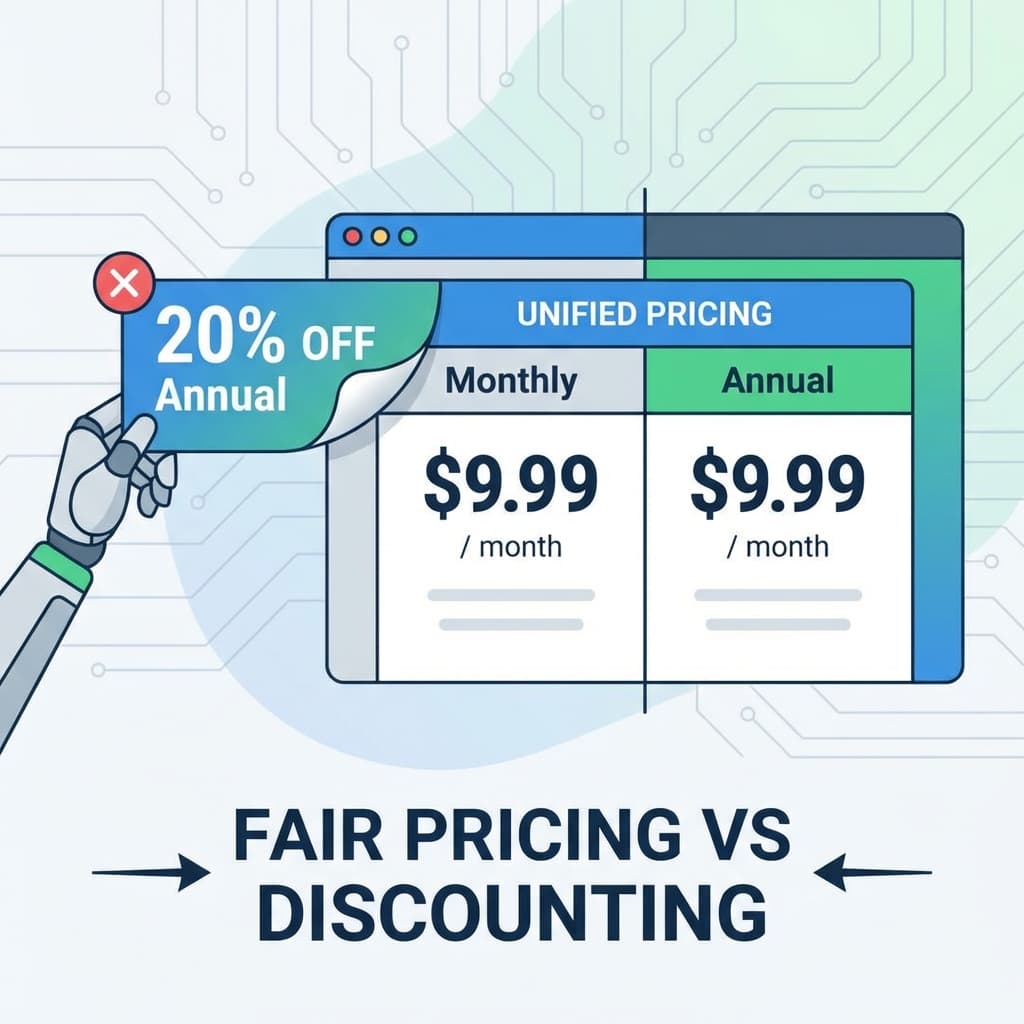
We made a simple but counterintuitive change: annual and monthly now cost the same.
Same Price, Different Convenience:
Annual plan: Pay once, don't think about it for 12 months.
Monthly plan: Pay as you go, cancel anytime.
The annual plan is positioned as a convenience, not a discount. Some customers prefer the simplicity of one payment per year. They're not expecting a discount for it.
Removing the Discount Conversation:
When we offered annual discounts, every customer asked for them. Even customers who preferred monthly felt like they were leaving money on the table.
Without the discount, there's no negotiation. Pricing is clear. The sales cycle is shorter.
Results:
- Annual adoption: Dropped from 60% to 25%
- Revenue per customer: Increased 15% on average
- Churn visibility: Improved (we see problems at month 3, not month 12)
- Total revenue: Up 12% year-over-year (partially attributable to this change)
Loyal Customers Pay Full Value:
Our best customers — the ones who stay for 3+ years — now pay full price. We're not leaving money on the table with the people who love us most.
Churners Churn Faster:
This is actually good. Customers who aren't getting value now leave in month 2 instead of month 12.
That means: we learn about problems faster, we can try to save them sooner, and we don't have upset customers languishing in contracts they don't want.
Early churn is information. Delayed churn is hiding problems.
Conclusion
Annual billing discounts are one of those "best practices" that isn't.
The logic sounds good: cash flow, predictability, lower churn. The reality is different: you're giving discounts to your best customers while providing false signals about your actual retention.
For many SaaS businesses — especially product-led, SMB-focused ones — annual discounts are pure revenue destruction.
Price your products fairly. Let customers choose their billing frequency for convenience, not for a discount they don't actually need.
Don't discount your way to lower revenue.
Written by XQA Team
Our team of experts delivers insights on technology, business, and design. We are dedicated to helping you build better products and scale your business.