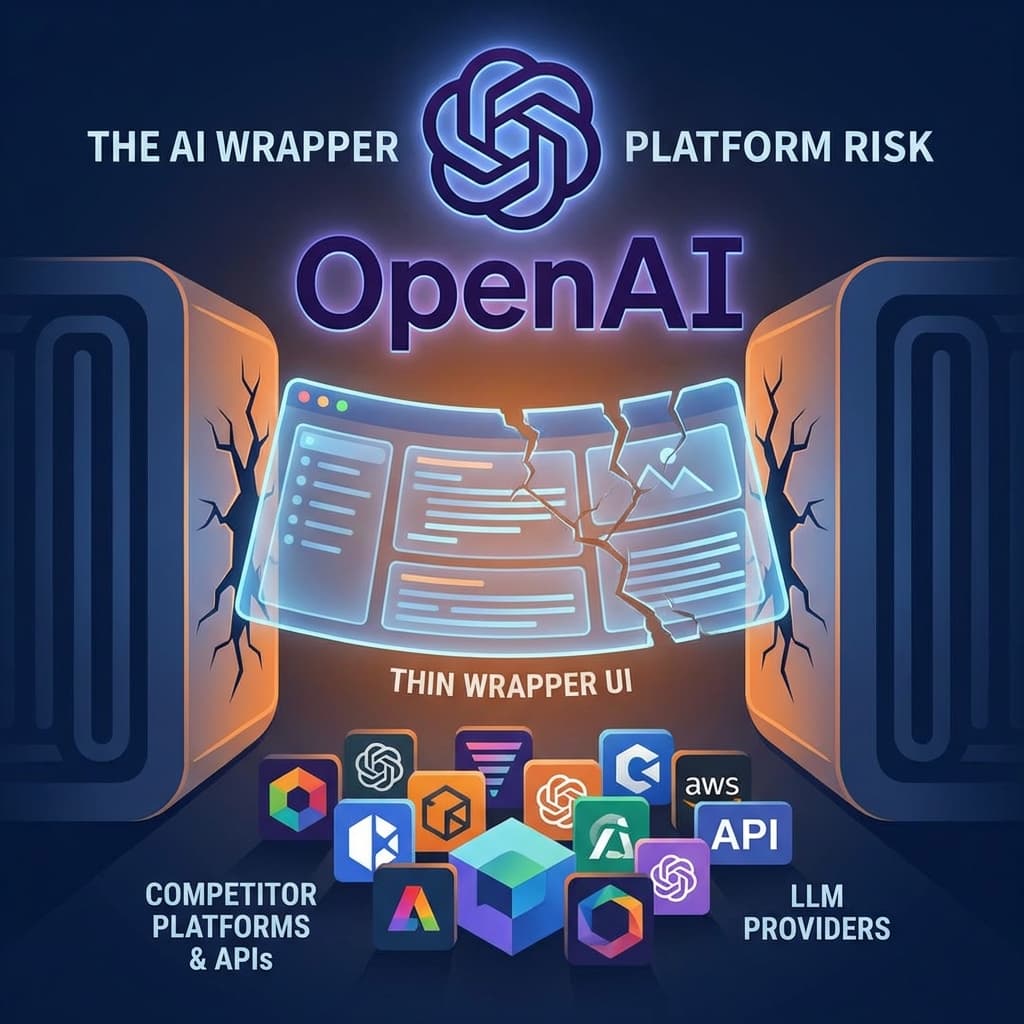
I invested in 3 AI startups in 2024. All three wrapped OpenAI's API with a nice UI and charged $29/month. "We're GPT for [industry]!"
All three are dead.
When OpenAI released features that replicated their core value prop, their differentiation vanished overnight. GPT-4 got better at legal questions. Copilot added chat. Every platform integrated AI support.
They had no moat. They had a thin UI layer over someone else's intelligence.
Wrapper businesses look like real businesses — until the platform expands. Then you discover you were renting your entire value proposition from your biggest competitive threat.
Here's what the survivors built instead — and why "just add AI" was never a strategy.
Section 1: The Wrapper Illusion
In 2023-2024, "GPT for X" became the default startup pitch.
The Appeal:
Wrappers are easy to build. OpenAI provides the intelligence. You provide the interface. Stripe handles payments. Launch in a weekend.
They're quick to market. While others are training models, you're shipping products. First-mover advantage (supposedly).
They look like product-market fit. Users pay! Revenue grows! Metrics are green!
VCs funded them. Customers bought them. For a moment, it looked like a gold rush.
The Reality:
You're renting your entire value proposition from OpenAI. Or Anthropic. Or Google.
Your product is: their model + your UI + your niche positioning.
If they improve the model to serve your niche directly... what's left? Your UI?
UIs are commodities. ChatGPT's interface is good enough. Claude's is good enough. The wrapper UI isn't defensible.
Platform Risk: 100%:
When you build on a platform, you accept platform risk. The platform can:
- Raise prices (OpenAI has done this)
- Change terms (they've done this too)
- Build your feature (constantly happening)
- Cut you off entirely (ask Twitter API developers)
For AI wrappers, platform risk approaches 100%. Your entire product is the platform with minor modifications. If the platform moves, you're dead.
This isn't theoretical. I watched it happen three times.
Section 2: How the 3 Startups Died
Let me tell you about my portfolio's AI graveyard.
Startup 1: "GPT for Legal Q&A"
The pitch: "Lawyers ask questions, get accurate legal research summaries. $99/month per seat."
They had early traction. Law firms loved it. 500 paying customers in 6 months.
Then GPT-4's legal knowledge improved dramatically. ChatGPT Plus, at $20/month, answered legal questions almost as well. The $79 premium for the wrapper became hard to justify.
Then ChatGPT added file uploads. Lawyers could drop in case files. The wrapper's document parsing feature was no longer differentiating.
Churn spiked. Growth stalled. They couldn't raise a Series A. Dead within 18 months.
Startup 2: "GPT for Code Explanation"
The pitch: "Paste code, get plain-English explanations. Perfect for junior developers."
Clever positioning. Great for onboarding. Growing nicely.
Then GitHub launched Copilot Chat. Integrated directly in the IDE. Explains code in context. Free with Copilot subscription.
Why would anyone use a separate tool when the IDE does it natively?
User acquisition cost skyrocketed. Existing users churned. Dead within 12 months.
Startup 3: "GPT for Customer Support"
The pitch: "Automated first-line support that sounds human. Integrates with Zendesk."
Great idea. Real pain point. Good early traction.
Then Zendesk added AI. Intercom added AI. Freshdesk added AI. Every support platform integrated LLMs natively.
The wrapper's value was integration with support tools. When support tools added their own AI, the wrapper was redundant.
Couldn't compete on distribution. Dead within 18 months.
Common Thread:
All three had zero proprietary value. Their "product" was someone else's intelligence with a skin on top. When the intelligence itself became accessible in other ways, the skin wasn't worth paying for.
Section 3: What Defensible AI Companies Look Like
Not all AI startups are wrappers. The survivors have different characteristics.
Proprietary Data:
The most defensible AI companies have training data that competitors can't access.
- Healthcare companies with patient data (under proper consent/privacy frameworks)
- Enterprise tools that learn from customer usage
- Vertical solutions with domain-specific datasets they've built over years
The model is commodity. The data isn't. If you have data moats, you can fine-tune and customize in ways that generic models can't match.
Domain Integration:
Defensible AI companies are embedded in workflows, not floating as chat windows.
Cursor doesn't just answer questions about code. It edits your codebase. It's in the IDE. The switching cost is high because the integration is deep.
Harvey (legal AI) isn't just a chat interface. It integrates with legal workflows, document management, billing systems. Ripping it out is painful.
Integration creates switching costs. Switching costs create defensibility.
Vertical Depth:
Defensible AI companies solve 100% of a narrow problem, not 10% of everything.
General chat interfaces (ChatGPT, Claude) are good at everything but perfect at nothing. Vertical AI tools can be perfect at one thing.
If you can make a radiologist never want to use anything else for reading scans, you have a business. Generic AI can't match that depth.
The Pattern:
Data + Integration + Vertical Depth = Defensibility.
UI + Generic Model + Horizontal Positioning = Wrapper Death.
Section 4: The Lesson for Founders
If you're building an AI startup, here's what I've learned from my losses.
AI Is Infrastructure, Not Product:
Think of LLMs like databases. You don't sell "Postgres with a nice UI." You build applications that use Postgres as infrastructure.
The same applies to AI. The model is infrastructure. Your product is the outcome the model enables, not the model itself.
Your Moat Must Exist Independent of the Model:
Ask yourself: If OpenAI/Anthropic/Google copied my core feature tomorrow, would I still have a business?
If the answer is no, you don't have a moat. You have a feature that will be absorbed.
Your defensibility must come from something they can't copy: your data, your integrations, your domain expertise, your customer relationships.
Platform Expansion Is Inevitable:
OpenAI will build every obvious feature. The features that seem like opportunities today are features OpenAI hasn't gotten around to yet.
Don't bet on their roadmap gaps. Bet on things they structurally can't or won't build.
They won't build deep vertical solutions. They're horizontal by design. Go vertical.
They won't integrate with your customers' specific workflows. Do that.
They won't collect your domain data. Build that asset.
Conclusion
AI wrappers were the gold rush scam of 2023-2024. Easy to build, easy to sell, impossible to defend.
The survivors aren't the ones who wrapped the fastest. They're the ones who built moats that exist independent of the underlying model.
If you're building an AI company, make sure you can answer: "What do we have that OpenAI can never have?"
If the answer is "nothing except our UI," you're building a wrapper. And wrappers die.
The AI is not your product. The AI-enabled outcome is your product.
Written by XQA Team
Our team of experts delivers insights on technology, business, and design. We are dedicated to helping you build better products and scale your business.