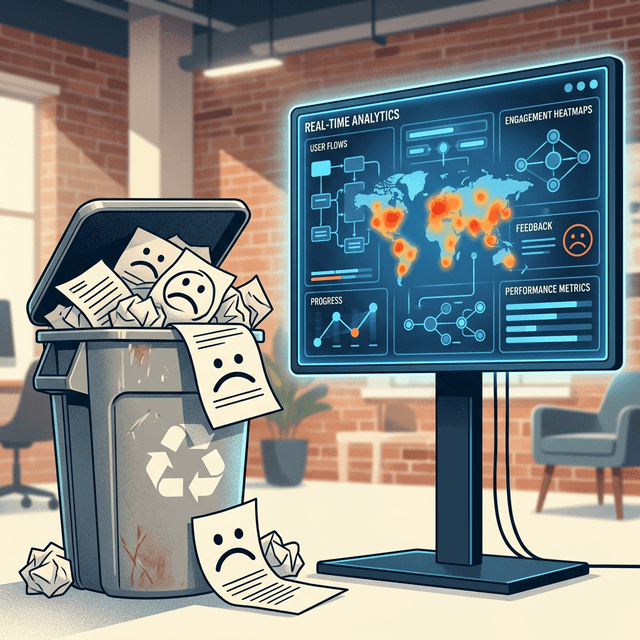
Every quarter, we sent a customer satisfaction survey. It had 15 questions. It took 10 minutes to complete. We incentivized responses with Amazon gift cards. We had a dedicated analyst who compiled the results into a 40-slide PowerPoint deck.
Our response rate was 6%.
Of that 6%, the responses split into two categories: people who were so angry they wanted to vent, and people who loved us so much they wanted to help. The silent majority — the 94% who were "fine" — never responded.
We were making product decisions based on the opinions of 6% of our customers, heavily biased toward extremes. We were building features for the loudest voices, not the most common needs.
We stopped sending surveys. We built a behavioral analytics pipeline instead. And for the first time, we understood what our customers actually wanted — not what they said they wanted.
The Survey Response Bias
Survey methodology has a fundamental problem: self-selection bias. The people who respond to surveys are systematically different from the people who don't.
Who responds to surveys?
- The Angry: People with a grievance are highly motivated to tell you about it. They want change. They want acknowledgment. The survey is their complaint box.
- The Delighted: People who love your product and want to help you succeed. They are your superfans. They would fill out a survey every day if you asked.
- The Incentivized: People who want the gift card. They click through the survey as fast as possible, selecting random answers. Their data is noise.
Who doesn't respond?
- The Satisfied-but-Busy: The largest group. They find your product adequate. They have no strong feelings. They certainly don't have 10 minutes to tell you about their neutral experience.
- The Quietly Churning: Users who are slowly disengaging. They've already decided to leave. They're not going to spend time helping you improve a product they're abandoning.
This means your survey data over-represents extremes and under-represents the mainstream. It is like predicting an election by polling only people at political rallies.
The "Say vs Do" Gap
Even when people respond honestly to surveys, there is a well-documented gap between what people say and what they do.
Example 1: In our survey, 72% of respondents said they wanted a "dark mode." We built it. After launch, 8% of users enabled it. The 72% who "wanted" it were expressing a preference in the abstract. In reality, most of them didn't care enough to click one button.
Example 2: 45% of respondents said "reporting" was their most important feature. We invested a quarter in building advanced reports. Usage data showed that only 12% of users ever opened the reporting section. The feature they called "most important" was one of our least used.
Example 3: Only 5% of respondents mentioned "page load speed" as a concern. But our analytics showed that users who experienced load times over 3 seconds had 40% higher churn rates. Speed was the most impactful factor in retention, but customers didn't think to mention it because they didn't consciously notice it.
Surveys capture stated preferences. Analytics capture revealed preferences. These are fundamentally different things.
What We Built Instead
We replaced surveys with a three-layer analytics system.
Layer 1: Product Analytics (What They Do)
We implemented comprehensive event tracking using Mixpanel. Every button click, page view, feature interaction, and workflow completion is tracked.
This gives us objective data about behavior. We can see:
- Which features are used daily, weekly, monthly, or never.
- Where users drop off in workflows (funnel analysis).
- Which features correlate with retention (feature stickiness).
- How usage patterns differ between customer segments.
Layer 2: Session Recordings (How They Do It)
We use FullStory to record user sessions. When analytics shows that users are dropping off at step 3 of a workflow, we watch sessions to understand why.
Session recordings revealed insights surveys never could:
- Users were clicking the wrong button because the UI was ambiguous. They didn't report this as a "bug" in surveys — they just assumed they were doing it wrong.
- Users were using features in ways we never intended. One customer was using our "notes" field to track entire project timelines because we didn't have a timeline feature.
- Users were rage-clicking on elements that looked clickable but weren't. The frustration was invisible in surveys but obvious in recordings.
Layer 3: Behavioral Cohort Analysis (Why They Leave)
We built cohort analyses to understand which behaviors predict retention and churn.
The results were surprising:
- Users who used the "export" feature in their first week had 3x higher retention. This feature was not mentioned in any survey as important.
- Users who invited a teammate within 48 hours had 5x higher retention. The collaboration aspect was the strongest predictor, but solo users who churned never mentioned "collaboration" as a need in surveys.
- Users who customized their dashboard in the first session had 2x higher retention. Personalization was a leading indicator, invisible to traditional surveys.
The Feature Prioritization Revolution
With analytics replacing surveys, our feature prioritization changed dramatically.
Before (Survey-Driven):
"72% of respondents want dark mode. Let's build dark mode." (Result: 8% adoption.)
After (Data-Driven):
"Users who export data in week 1 retain at 3x. Let's make the export feature more discoverable and powerful." (Result: 15% increase in first-week exports, measurable retention improvement.)
We went from building features people asked for to building features that data proved would drive outcomes. The distinction seems subtle but is transformative.
Survey-driven roadmaps are reactive. You wait for complaints, then fix them. Analytics-driven roadmaps are proactive. You find patterns, then optimize for them.
The Qualitative Gap
Critics will say: "Analytics tells you what, but surveys tell you why."
This is partially true. But we found better ways to get qualitative insights than mass surveys:
1. Targeted Micro-Surveys:
Instead of quarterly 15-question surveys sent to everyone, we trigger one-question surveys at specific moments:
- After a user completes a workflow: "Was this easy? (thumbs up/down)"
- After a user hits an error: "What were you trying to do?"
- After a user cancels: "What's the primary reason you're leaving?"
These micro-surveys have 30-40% response rates (vs 6% for quarterly surveys) because they are contextual. The user just experienced the thing you are asking about. The answer is fresh and specific.
2. Customer Interviews:
We conduct 10 customer interviews per month, targeted at specific segments identified by analytics. "Users who activated feature X but stopped using it after 2 weeks" — why? That question, asked to 10 specific people, yields more insight than 15 questions asked to 1,000 random people.
3. Support Ticket Analysis:
Support tickets are unsolicited qualitative data. Users write to support when they have real problems, not hypothetical preferences. We categorize and analyze support tickets to identify pain points that analytics confirms are widespread.
Conclusion
Customer surveys were invented in an era when we couldn't observe behavior directly. You couldn't watch users interact with a physical product, so you asked them about it afterward.
In software, we can observe everything. Every click, every scroll, every hesitation, every rage-quit. We have more behavioral data than we can analyze.
Asking users what they want when you can see what they do is like asking someone what they ate for lunch when you have a video of them eating. The video is more reliable.
Stop asking. Start observing. Your customers are telling you everything you need to know through their behavior. You just have to watch.
Written by XQA Team
Our team of experts delivers insights on technology, business, and design. We are dedicated to helping you build better products and scale your business.