Every quarter, without fail, the ritual would begin. The emails went out: "Hackathon Week is coming!" We ordered pizza from four different places to accommodate every dietary restriction. We stocked the fridge with Red Bull, LaCroix, and cold brew. We cleared the engineering roadmap. We decorated the office with "Innovate!" posters.
For 48 glorious hours, the office energy transformed. Engineers who normally left at 6 PM stayed until midnight. People who rarely talked to each other were suddenly teammates. The Slack channel exploded with ideas. "What if we built a VR onboarding experience?" "What if we rewrote the entire backend in Rust?" "What if we added AI-powered everything?"
Friday afternoon arrived: Demo Day. Teams presented their creations. Some were genuinely impressive—a week's worth of engineering crammed into 48 sleepless hours. Management clapped. Prizes were awarded: gift cards, extra PTO days, "Innovator of the Quarter" trophies.
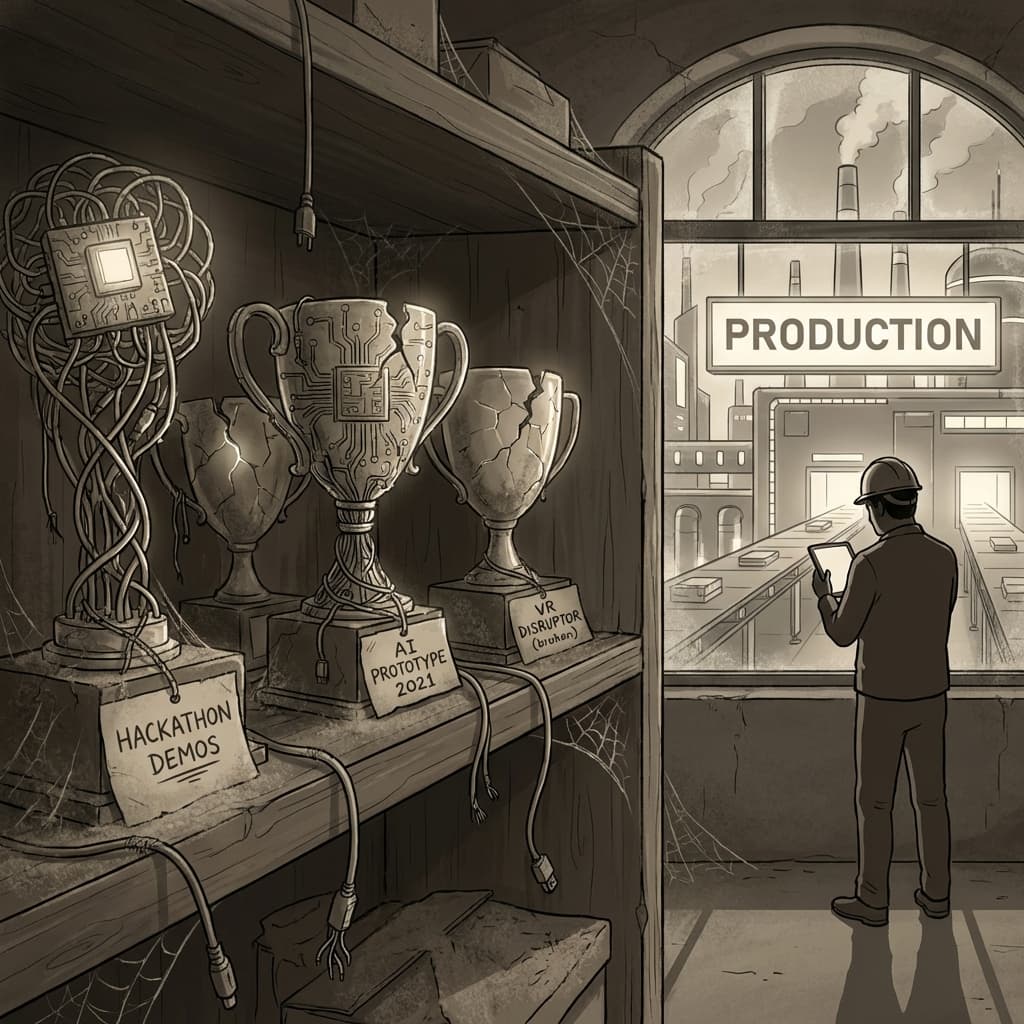
Then Monday came. Everyone went back to the roadmap. The hackathon projects sat in private repos, slowly decaying.
After three years of quarterly hackathons, I finally did the analysis I should have done from the start. Over 36 months, we had conducted 12 hackathons. Each involved approximately 40 engineers for 48 hours. We produced roughly 60 "demo-able projects"—around 5 per hackathon.
Number of hackathon projects that made it into our production product: Zero.
Not one. Not a single feature. Not even a library. Not a useful internal tool. Nothing.
We had invested approximately 23,000 engineer-hours (40 engineers × 48 hours × 12 hackathons) into producing... nothing of lasting value. At an average fully-loaded cost of $120/hour, that's $2.76 million of engineering time spent on demos that died on the vine.
We weren't innovating. We were LARPing innovation—acting out the theater of creativity while producing no actual outcomes.
We killed the hackathon program and replaced it with "Polish Week." Here's the full breakdown of why hackathons are often organizational waste masquerading as culture.
Section 1: The "Demo Driven" Trap—Flash Over Substance
Hackathons operate on a simple feedback loop: you have 48 hours, then you must demo something impressive. This constraint shapes every decision.
Optimizing for "Wow" Over Value
To win the demo, you need spectacle. You need something visual. You need that "Wow" moment when you reveal what you built. Demos are performances, and performances need drama.
You know what doesn't wow a demo audience?
- "I refactored the authentication service to be 200ms faster and fixed a rare race condition"
- "I fixed 50 accessibility bugs that were preventing screen reader users from navigating our app"
- "I wrote comprehensive documentation for our internal API that nobody understands"
- "I improved our CI pipeline to reduce build times from 45 minutes to 8 minutes"
These are high-value engineering achievements. They would make our product better. Our customers would benefit. Our developers would be happier.
But they're boring in a demo. "Watch as I... run a test suite... 5x faster!" No applause.
So engineers build flashy, fragile toys instead. A VR demo with hard-coded data that only works on one specific device. An AI chatbot that falls apart with any unexpected input. A "futuristic" interface that looks amazing but violates every UX principle we've established.
The demo wows. The code is garbage. Happy paths only. No error handling. No tests. No security considerations. No accessibility. No internationalization. Written at 2 AM on Red Bull by sleep-deprived engineers who just wanted to finish something cool.
Teaching the Wrong Definition of "Innovation"
Over time, hackathons teach engineers a dangerous mental model: "Innovation = building new shiny things without constraints. Engineering = boring maintenance work on the roadmap."
This is backwards. Real innovation is disciplined improvement. It's making things better, more reliable, faster, more accessible, more maintainable. Real innovation takes years, not 48 hours.
But hackathons celebrate the shortcut. They celebrate "move fast and break things" when our actual development culture emphasizes "move deliberately and build things that last."
We were sending contradictory signals. Roadmap work: follow best practices, write tests, document everything, think carefully. Hackathon work: ignore all that, just make something flashy by Friday. Which message would engineers internalize?
Section 2: The Maintenance Hangover—When "Too Good To Throw Away" Became a Nightmare
Occasionally, a hackathon project would be genuinely compelling. The demo would land perfectly. Management would get excited. "This should be a real feature! Let's ship it!"
And then the hangover would begin.
The "Just Deploy It" Fallacy
One hackathon team built a "smart search" feature for our documentation. It used semantic embeddings and returned surprisingly relevant results. The demo was impressive. Leadership said: "Add this to the product. Users will love it!"
The team estimated 2 weeks to integrate it. It took 3 months.
Why? Because hackathon code is demo code, not production code:
- It had no tests (that's 2 weeks right there—writing retroactive tests for code is harder than writing tests alongside code)
- It violated our authentication model (another week to refactor)
- It didn't handle any error cases (the demo used perfect input data)
- The embeddings were generated locally on the demo machine (scaling that to production required an entirely different architecture)
- It couldn't handle multilingual content (we have users in 40 countries)
- It had no rate limiting, caching, or observability
The "2 week" project became a 3-month slog that demoralized the team. They had thought they were almost done—the demo worked! But "demo works" is about 10% of "production ready."
Worse, stakeholders didn't understand the delay. "It was working at the demo! Why has it been 3 months? Just deploy what you showed us!"
Hackathons create a massive gap between perceived progress (it demos!) and actual engineering reality (it's a prototype that needs to be essentially rewritten). This gap breeds frustration on all sides.
The Orphan Problem
Even when a hackathon project does ship, it immediately becomes an orphan. The hackathon team was assembled for 48 hours. They don't own this code long-term. They have roadmap work to return to.
So the "smart search" feature ships... and then bugs come in. Who fixes them? The original team is gone. Some new engineer inherits code they didn't write, has no documentation, and was built under time pressure with shortcuts everywhere.
We had a 70% chance that a shipped hackathon project would be tech-debt-deprecated within 18 months because nobody wanted to maintain it.
Section 3: Cultural Damage—The Message We Were Actually Sending
The most insidious problem with hackathons wasn't the wasted time or the bad code. It was the cultural message.
Two Classes of Work
Hackathons implicitly told our team that there are two kinds of work:
- "Real work": The boring features on the roadmap that someone tells you to build. Sprint planning. Jira tickets. Code reviews. Documentation. Testing.
- "Fun work": Hacking together garbage code without constraints, rules, or accountability. Caffeine-fueled creativity. Recognition and prizes!
We gave prizes for the fun work. We literally gave trophies to people for writing code without tests. We celebrated the hack and ignored the craft.
The best engineers—the ones we most wanted to retain—were often the ones least excited about hackathons. They found joy in disciplined, high-quality craft. They enjoyed making things work well, not just work. Hackathons celebrated the opposite of their values.
Innovation Theater vs. Actual Innovation
Hackathons let leadership feel like they were "investing in innovation" without actually changing anything about how we worked day-to-day. It was performative. We could put photos in the company newsletter. "Look at our innovative culture!"
But real innovation doesn't happen in 48-hour bursts. Real innovation happens when you give teams time to experiment within their normal work. When you create slack in the schedule for exploration. When you reward engineers for fixing the unglamorous problems that actually matter.
The hackathon was innovation theater that let us avoid doing the hard work of building an actually innovative culture.
Section 4: The Replacement—Polish Week
We cancelled the quarterly hackathon. We replaced it with "Polish Week."
Same cadence: once a quarter. Same structure: we pause the roadmap for a week. Same budget: pizza, snacks, flexible hours.
One critical difference:
The Rule: You can work on anything you want, as long as it improves the existing product.
What Counted
- Fix that bug that's been bugging you for a year (but never makes it to sprint priority)
- Smooth out that janky animation that's always annoyed you
- Refactor that messy class that everyone complains about
- Update the documentation that's 18 months out of date
- Improve the CI/CD pipeline to make everyone faster
- Fix accessibility issues that keep failing audits
- Reduce page load time on the slowest screens
- Clean up the test suite—remove flaky tests, add missing coverage
What Didn't Count
- Building new features (that's roadmap work)
- Prototyping "what if" ideas that wouldn't ship for months
- Rewriting things in trendy new technologies for the sake of trendiness
The Results
First Polish Week, engineers were hesitant. "So... we just fix bugs and do maintenance? That's allowed?"
After the week, the reaction was uniformly positive. Engineers said things like:
- "I finally had time to fix the thing that's been annoying me for a year"
- "I felt productive because I actually shipped improvements"
- "This was less stressful than hackathons—no pressure to demo"
Users noticed too. After Polish Week, our NPS scores would bump up. The product felt faster, smoother, more polished. Small annoyances that users had complained about for months suddenly disappeared.
And here's the key metric: 100% of Polish Week work went to production. Not 0%, like hackathons. 100%. Every fix shipped. Every improvement landed. Every documentation update went live.
Because it was real engineering, not demo-ware.
Conclusion: Real Innovation Is Boring
Innovation doesn't happen in 48-hour bursts of caffeine-fueled mania. That's not innovation—that's spectacle.
Real innovation happens in the slow, steady improvement of a product over years. It happens when you give engineers time to do things right. When you fix the broken windows. When you pay down the tech debt. When you make the invisible infrastructure better.
Hackathons are fun. They're great for team bonding. If you want to do them as a social event, go for it. But don't confuse them with product strategy. Don't expect them to produce useful features. And definitely don't use them as a substitute for building an engineering culture that values quality.
If you want a better product, stop hacking and start polishing.
Code that doesn't ship isn't innovation. It's inventory. And inventory is a cost, not an asset.
Written by XQA Team
Our team of experts delivers insights on technology, business, and design. We are dedicated to helping you build better products and scale your business.