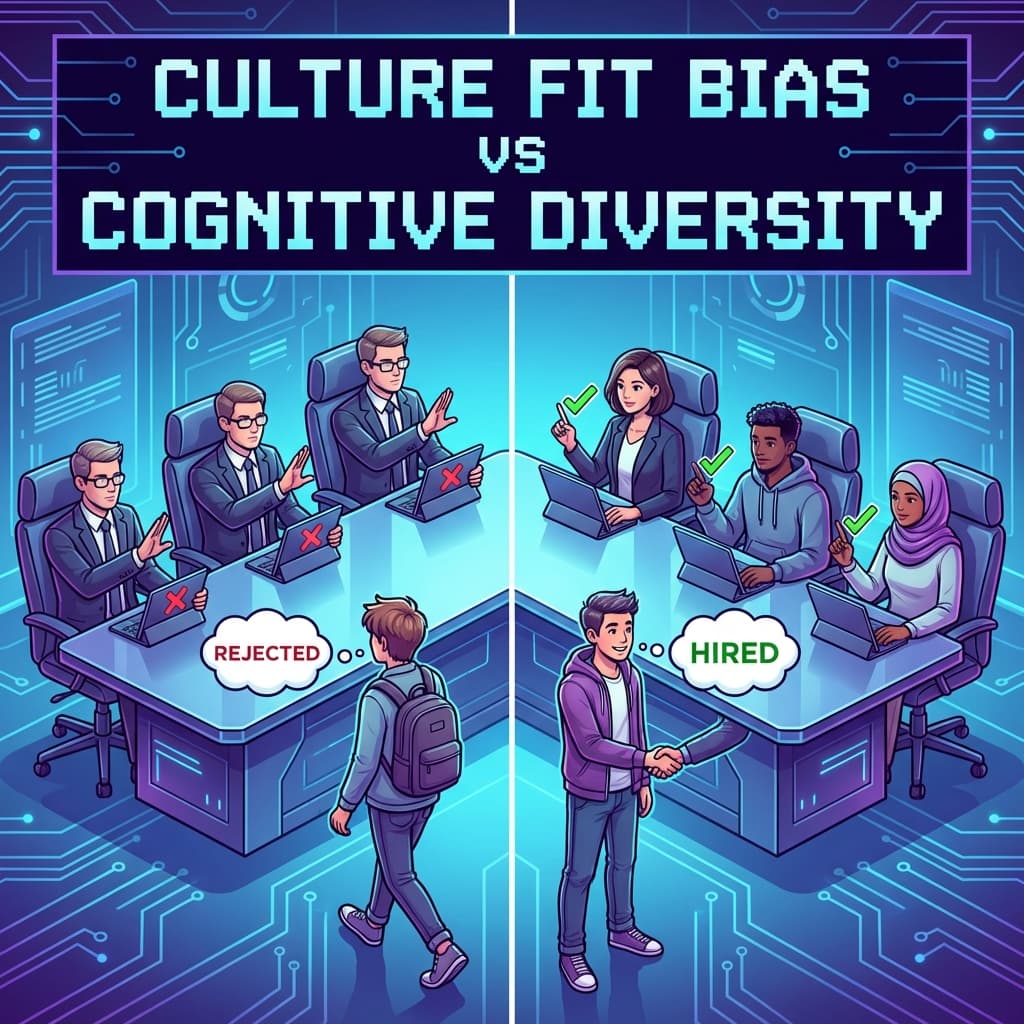
I was proud of our hiring bar. "Culture fit is critical!" Every new hire felt like a natural member of the team. Conversations flowed. Nobody disagreed. Onboarding was smooth.
Then I looked at the team photo.
We'd hired the same person fifteen times. Same educational backgrounds. Same career paths. Same communication styles. Same opinions.
When a crisis hit requiring a perspective none of us had — we floundered. We couldn't see the problem because we all had the same blind spots. The "culture fit" that felt so comfortable was actually suffocating us.
Our "culture fit" filter was actually a "people like us" filter. It felt like values. It was bias.
We replaced it with "values alignment + cognitive diversity." The team got more uncomfortable. And it got dramatically better.
Here's how "culture fit" is killing your team — and what to do instead.
Section 1: How "Culture Fit" Became Code
Culture fit started as a legitimate concept. It devolved into something uglier.
The Original Intent:
The idea was reasonable: Hire people who share the company's values and can work well with the existing team.
- Do they value collaboration? (If we're a collaborative culture)
- Do they work with integrity? (Presumably a universal value)
- Can they communicate effectively with the team?
These are legitimate hiring considerations. Unfortunately, "culture fit" rarely stays this pure.
The Devolution:
In practice, "culture fit" interviews became: "Would I enjoy getting a beer with this person?"
Interviewers assessed comfort, not values. They evaluated familiarity, not competence. The question shifted from "Can they do the job well?" to "Do they feel like one of us?"
This is how bias sneaks in. People feel comfortable with people who are similar to them. Same schools. Same hobbies. Same cultural references. Same socioeconomic background.
The Implicit Bias:
"Culture fit" became a socially acceptable way to reject candidates who were different.
- "Not sure about culture fit" = "They're different from us in ways I can't articulate legally."
- "Great qualifications but not a culture match" = "They didn't laugh at our inside jokes."
- "Didn't click with the team" = "We prefer people who remind us of ourselves."
This isn't hypothetical. Research consistently shows that "culture fit" assessments correlate with demographic similarity, not with job performance or actual values alignment.
The Legal Risk:
Using undefined "culture fit" criteria exposes companies to discrimination claims. When selection criteria are subjective and correlated with protected characteristics, you're in dangerous territory.
Several companies have faced lawsuits over "culture fit" hiring that disproportionately excluded certain demographics. It's not just ethically problematic — it's legally risky.
Section 2: The Homogeneity Tax
Teams that look and think alike pay a hidden tax. We paid it.
Problems Don't Surface:
When everyone has the same perspective, problems that would be obvious to outsiders remain invisible.
We built a feature that made perfect sense to our all-male engineering team. When it launched, female users immediately identified usability issues we'd never considered. We had no women in the room when we designed it.
Homogeneous teams have shared blind spots. What you can't see, you can't fix.
Groupthink Accelerates:
In homogeneous teams, disagreement feels socially costly. Everyone nods. Nobody challenges. Bad ideas survive because challenging them would disrupt the comfortable consensus.
We made a major strategic decision that, in retrospect, was obviously wrong. Nobody objected in the meeting. Later, I asked why. "It felt like everyone agreed, so I assumed I was missing something."
Everyone assumed the group was right. The group was wrong. Groupthink nearly sank us.
Innovation Stalls:
Novel ideas come from combining different experiences. If everyone has the same background, the combinatorial space of ideas is tiny.
We noticed our product innovation slowing. Features were incremental. Nothing surprised us. That's because nothing could surprise us — we'd hired people who thought exactly like us.
The Crisis That Exposed Us:
We faced a market shift that required understanding a customer segment none of us belonged to. We guessed. We guessed wrong. We lost a year of progress.
If we'd had one person on the team from that demographic, they'd have seen it immediately. We didn't, because "culture fit" had filtered them out.
Section 3: Values Alignment vs. Culture Fit
The solution isn't to ignore fit entirely. It's to separate legitimate criteria from bias.
Values Alignment (Legitimate):
Do they share our core principles?
- Integrity: Will they do the right thing even when it's hard?
- Customer focus: Do they genuinely care about user outcomes?
- Growth mindset: Are they open to learning and feedback?
- Collaboration: Can they work productively with others?
These are observable behaviors, not identity characteristics. They can be assessed through structured questions with rubrics.
Culture Fit (Usually Bias):
Do they seem like us?
- Same hobbies
- Same communication style
- Same educational background
- Same sense of humor
- "Clicks" with existing team
These are identity characteristics dressed as qualifications. They're not predictive of job performance. They're predictive of homogeneity.
How to Assess Values (Without Assessing Conformity):
- Use structured behavioral interviews: "Tell me about a time when you faced an ethical dilemma at work."
- Apply consistent rubrics: Rate responses against defined criteria, not gut feel.
- Remove unstructured "culture" discussions: These are where bias creeps in.
- Train interviewers to recognize affinity bias: "I like them" ≠ "They're qualified."
Section 4: Building Cognitive Diversity
After recognizing our problem, we rebuilt our hiring approach.
Actively Hire for Difference:
We made cognitive diversity an explicit goal. Not just demographic diversity (though that too), but diversity of thought:
- Different educational backgrounds (not just CS from top-10 schools)
- Different industry experiences (not just ex-FAANG)
- Different thinking styles (not just extroverted consensus-builders)
- Different life experiences (not just urban, upper-middle-class)
We actively sought candidates who weren't like us. This felt uncomfortable at first. That was the point.
Make Disagreement Expected:
We rewrote our team norms. "Disagreement is part of how we work."
We explicitly told new hires: "We hired you for a different perspective. We expect you to challenge us. Silence isn't golden here — it's a failure mode."
This gave diverse hires permission to actually be diverse, not just look diverse while conforming.
Train Interviewers:
Every interviewer went through bias training. Not the generic corporate kind. Specific training on:
- Affinity bias: "I like them" usually means "They're like me."
- Halo effect: Don't let one good signal override other data.
- Structured evaluation: Rate against rubrics before discussing with other interviewers.
We also removed "culture fit" from our interview scorecard entirely. It was replaced with "values alignment" assessed through specific behavioral questions.
Results:
- Decision quality improved: More perspectives meant more problems caught early.
- Innovation increased: Novel combinations of ideas emerged from diverse backgrounds.
- Resilience improved: When crises hit, someone on the team usually had relevant experience.
- Meetings got harder: More disagreement. More debate. This was a feature, not a bug.
Conclusion
"Culture fit" is a trap. It sounds like a value ("We care about culture!") but functions as bias ("We prefer people like us.").
Healthy teams share values, not identities. They align on principles, not personalities. They hire for difference, not sameness.
If your team agrees on everything, you have a problem. If every new hire "clicks" immediately, you're probably just hiring clones.
The discomfort of working with people different from you is the discomfort of growth.
Hire for values. Embrace difference in everything else.
Written by XQA Team
Our team of experts delivers insights on technology, business, and design. We are dedicated to helping you build better products and scale your business.