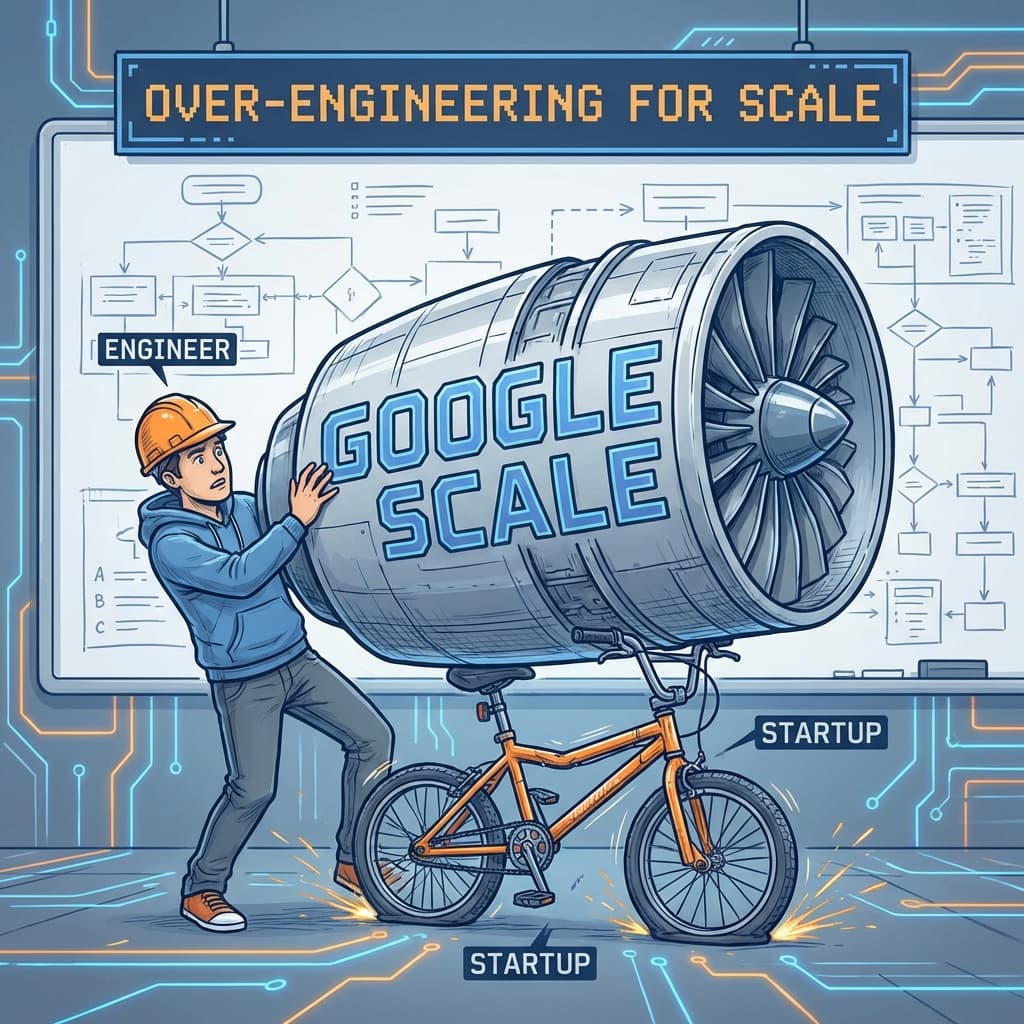
We hired ex-Google and Meta engineers. Their resumes were impeccable. Stanford degrees. Worked on systems serving billions of users. Brilliant technical minds.
They also failed miserably at our 50-person startup.
They wanted custom tooling for everything ("At Google, we used Blaze"). They over-engineered simple features for "scale" we didn't have ("What if we hit 100M QPS?"). They couldn't function without a specialized support infrastructure (SREs, QA, DevTools teams).
It wasn't their fault. They had been trained for a different sport. They were NFL linebackers trying to play rugby.
We stopped hiring them. Here's what we look for instead.
Section 1: The 'Google Scale' Mindset
Big Tech engineering is a specific discipline. It's about:
- Consistency at massive scale
- Preventing catastrophic failure
- Optimizing 0.1% efficiency gains
- Navigating complex internal bureaucracy
At Google, if you verify a change for 3 weeks before shipping, you're prudent. At a startup, you're dead.
The Tooling Trap:
FAANG engineers are used to the world's best internal tooling. Build systems that handle monorepos effortlessly. Deploy systems that are fully automated. Observability tools that are magic.
When they join a startup and see Jenkins scripts and console logs, they freeze.
First instinct: "We need to build better tooling."
They spend 3 months building a custom deployment framework instead of shipping the product feature we hired them for.
Section 2: Over-Engineering for Imaginary Scale
A startup problem: "We need to store user preferences."
Startup Solution: Add a column to the Postgres `users` table.
FAANG Solution: "Postgres won't scale if we hit 1 billion users. We should build a dedicated microservice backed by Cassandra with a Redis write-through cache and an async queue for consistency."
They aren't technically wrong. If we had 1 billion users, the Postgres column would fail.
But we have 5,000 users. And if we spend 6 weeks building the microservice instead of 1 hour adding the column, we'll run out of cash before we ever get to 10,000 users.
They optimize for problems we might have in 5 years, ignoring the problem we do have today (survival).
Section 3: The Specialized Infrastructure Dependency
At Meta, you don't rack servers. You don't manage DB backups. You don't write your own QA frameworks.
There are teams for that.
At a startup, you are the SRE. You are the QA. You are the DB admin.
Our ex-FAANG hires struggled with this breadth. "Who handles the load balancer config?" "You do." "Is there a team to write the integration tests?" "You are the team."
This "learned helplessness" regarding infrastructure paralyzed them. They were used to being pure code-writers in a highly supported environment.
Section 4: The 'Startup Native' We Hire Now
We pivoted our hiring strategy. We stop optimizing for prestige brands.
We look for:
1. The "Zero to One" Builder:
Engineers who have built side projects. Freelancers. Founders of failed startups. People who have had to ship code to survive.
2. Pragmatists over Purists:
We ask: "How would you build X?" If they start with Kubernetes and Kafka, we pass. If they say "Django on Heroku until it breaks," we hire them.
3. Generalists:
People who know a little bit about everything (database, frontend, CSS, deployment). Full stack is a lie at Google. It's a necessity at a startup.
Conclusion
Hiring from FAANG feels like a safe bet. "Nobody gets fired for hiring an ex-Googler."
But context matters. A Formula 1 driver is a great driver, but they'll struggle to drive a rally car through the mud.
Startups are mud. You don't need drivers who need a pit crew of 20 to change a tire. You need drivers who can fix the engine with duct tape while driving 80mph.
Hire for the stage you're in, not the stage you hope to be.
Written by XQA Team
Our team of experts delivers insights on technology, business, and design. We are dedicated to helping you build better products and scale your business.