The Decision That Seemed Smart
In early 2024, we made a decision that seemed logical at the time: stop hiring junior developers entirely.
The reasoning was compelling:
- AI tools had made our senior engineers roughly 2x more productive
- Junior engineers still needed months of hand-holding before becoming net-positive contributors
- Senior + Copilot could do the work of two seniors from the previous year
- Junior + Copilot was still a junior—productive but requiring significant oversight
The math seemed obvious: hire seniors exclusively, arm them with AI, and stop paying the "junior training tax."
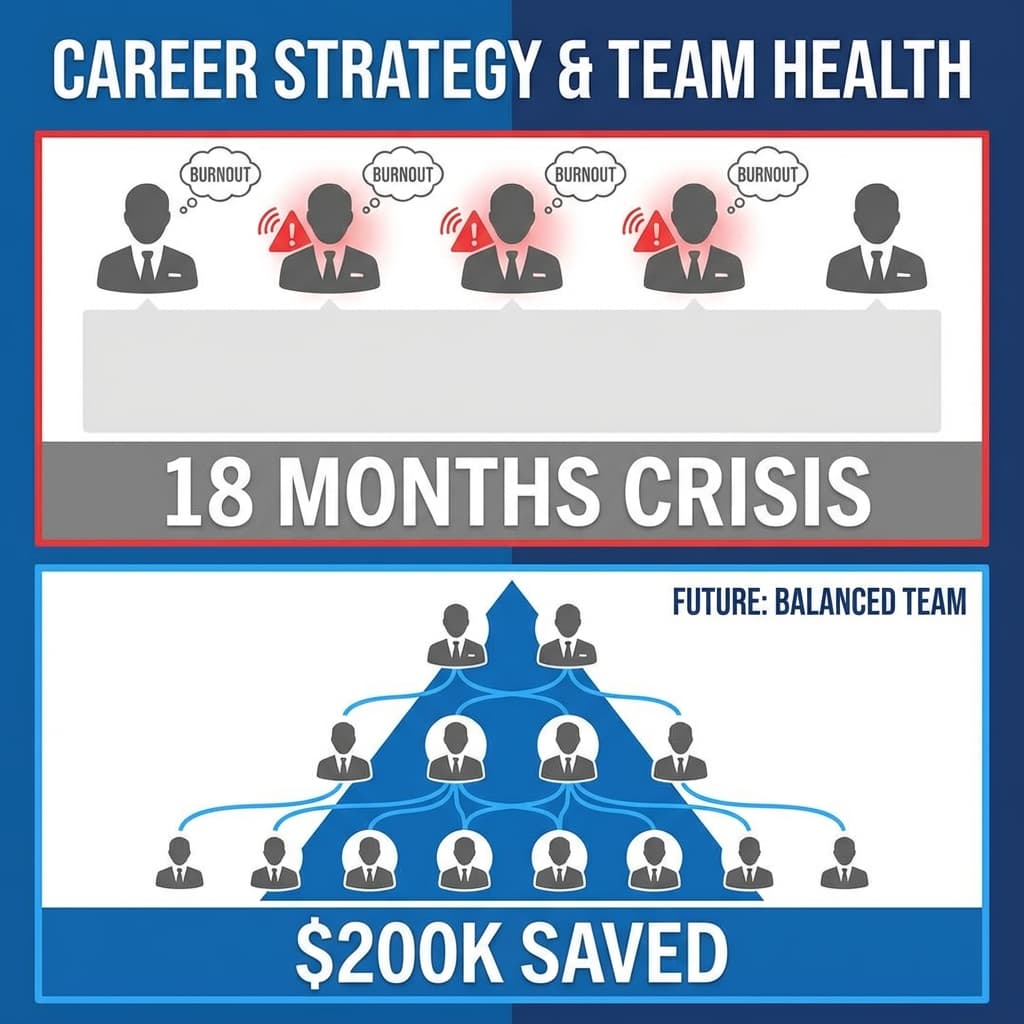
We saved approximately $200,000 in junior developer salaries over the following year. We felt efficient. We felt modern. We felt like we had cracked the code on AI-era team building.
18 months later, I'm writing this post because we're now desperately hiring juniors. Our seniors are burned out. Our bus factor is one person for three critical systems. We have no one to promote into mid-level roles. Our engineering culture has calcified.
The "AI replaces juniors" narrative was a trap. Here's what actually happened.
Section 1: The Narrative That Seduced Us
We weren't alone in our thinking. The entire tech industry was having the same conversation in 2024.
The Logic Chain
The argument went like this:
- AI coding tools make everyone more productive
- But seniors benefit more than juniors (they can guide and correct AI output better)
- Therefore, the productivity gap between seniors and juniors has widened
- Therefore, juniors are relatively less valuable than before
- Therefore, hire only seniors and let AI handle the "junior work"
This logic is seductive because each step seems reasonable in isolation. The problem is the conclusion ignores everything juniors provide besides immediate productivity.
Industry Signals Reinforced the Narrative
We weren't acting in a vacuum. Everywhere we looked, the market was sending the same signal:
- Big tech layoffs: Junior engineers were disproportionately affected. FAANG companies cut new grad hiring dramatically.
- Bootcamp closures: Several prominent coding bootcamps shut down or pivoted. The "junior pipeline" seemed to be drying up industry-wide.
- Entry-level job postings: Collapsed by 50%+ according to various job board analyses. Even "junior" roles started requiring 2+ years of experience.
- Pundit consensus: Influential tech voices on Twitter and podcasts declared that junior roles were being "AI'd away."
It felt like we were front-running an obvious trend. Everyone was realizing juniors weren't worth the investment anymore.
What We Saw Initially
For the first 6 months, the strategy seemed to work:
- Higher immediate velocity (seniors ship faster than juniors, obviously)
- Less management overhead (no onboarding, no mentorship)
- Fewer "basic" bugs (seniors make different mistakes than juniors, but fewer of them)
- Lower payroll costs (not hiring juniors saved money directly)
We congratulated ourselves. We had optimized the team.
Then the problems started.
Section 2: The 18-Month Reckoning
By month 12, cracks were showing. By month 18, we were in a crisis. Here's what happened.
The Burnout Epidemic
Without juniors to handle routine tasks, seniors did everything.
Previously, juniors handled:
- Simple bug fixes and maintenance tickets
- Documentation updates
- Test writing for existing features
- Basic on-call triage
- Initial investigation of customer-reported issues
These tasks aren't glamorous, but they're necessary. When juniors were gone, seniors absorbed them. "AI will help," we said. And AI did help—but seniors still had to do the work. They just did it slightly faster.
The result: our senior engineers spent 30-40% of their time on tasks they considered "beneath them." Not because they were arrogant, but because they were hired to architect systems and solve hard problems—not write documentation and fix typos. Morale tanked.
By month 15, two of our best seniors quit. "I didn't sign up to be a senior-and-also-junior," one said in the exit interview. "There's no growth here—just more of the same, forever."
The Bus Factor Crisis
We had 4 senior engineers covering multiple systems. With no juniors learning the codebase, all knowledge concentrated at the senior level.
When Senior #3 quit, 25% of our institutional knowledge walked out the door. Their systems became "legacy code" overnight—not because the code was old, but because no one else understood it.
We tried to hire a replacement. Experienced engineers don't want to join a team with bus factor problems—they know they'll be stuck maintaining mystery code. Our hiring pipeline suffered because of the very problem we'd created.
The Leadership Vacuum
Here's something we didn't anticipate: mid-level engineers come from juniors.
When it came time to promote someone to Tech Lead, we had no internal candidates. All our seniors were already at the senior level. We had no one "on deck" who had grown into the organization over 2-3 years.
We were forced to external-hire a Tech Lead. They had the skills, but they didn't have the context. They made decisions based on general best practices, not our specific codebase's quirks. It took them 6 months to be truly effective—the same onboarding time we thought we were saving by not hiring juniors.
Culture Calcification
The most insidious cost was cultural.
Juniors ask "why?" a lot. Why is the code structured this way? Why do we use this tool? Why does this process exist? This is annoying in the moment but valuable in aggregate—it forces teams to justify their decisions and sometimes realize those decisions were wrong.
Without juniors, no one asked "why?" Everyone was experienced enough to assume there must be a good reason. Legacy decisions went unquestioned. Technical debt accumulated because no one with fresh eyes pointed at it and said "this seems weird."
We became insular. We stopped learning because no one was pushing us to explain things. The learning culture atrophied.
Section 3: The Hidden Value of Juniors
After this experience, I now understand what juniors actually provide—and it's not just "cheap labor that can be replaced by AI."
Juniors Create Learning Culture
When you have to explain your codebase to someone new, you understand it better yourself. When a junior asks "why is this done this way?" you sometimes realize there's no good answer.
Documentation improves because juniors need it. Processes improve because juniors struggle with bad ones. Onboarding improves because juniors experience it.
Without juniors, no one uses the onboarding docs. They rot. Then when you finally do hire a junior (like we're doing now), you have Untitled no onboarding infrastructure left.
Juniors Provide Diversity of Thought
Seniors have learned "the way things are done." They've internalized industry conventions, team norms, and technical orthodoxies. This makes them efficient but also conformist.
Juniors haven't learned the rules yet. They try things that "shouldn't work" and sometimes discover they do work. They question assumptions because they don't know they're assumptions.
One of our best architectural improvements came from a junior who asked "why don't we just...?" The seniors had never considered it because it violated a convention that turned out to be obsolete.
Mentorship Makes Seniors Better
Teaching forces you to articulate tacit knowledge. When you explain why something works, you understand it more deeply yourself.
Seniors who mentor juniors become better engineers. They develop communication skills, empathy, and the ability to decompose complex problems. These are leadership skills.
Without juniors to mentor, our seniors stopped developing these skills. They became deeper individual contributors but poorer collaborators.
Juniors Become Your Best Seniors
A senior engineer hired externally has skills but lacks context. A senior engineer grown internally has both.
Internal-growth seniors understand your codebase's history, your customers' quirks, your team's dynamics. They don't need to learn what external hires spend 6 months learning. They're also more loyal—they grew up in your org and feel attached to it.
By not hiring juniors, we forfeited this long-term investment. We optimized for immediate productivity and destroyed our future leadership pipeline.
AI Actually Accelerates Junior Development
Here's the irony: AI tools don't make juniors obsolete—they make juniors faster to train.
Juniors with Copilot can write working code earlier. They can get unstuck faster. They can experiment more safely. The AI doesn't replace the junior; it accelerates the junior's learning curve.
If anything, the case for hiring juniors has strengthened. You can bring them to productivity faster than ever before. The "training cost" we were trying to avoid has actually shrunk.
Section 4: How to Hire Juniors in the AI Era
We're now rebuilding our junior program. Here's what we've learned about doing it right in 2025/2026.
The New Junior Profile
The skills that matter for juniors have shifted:
Less important:
- Syntax memorization (AI handles this)
- Boilerplate code writing (AI handles this)
- Looking up documentation (AI handles this)
More important:
- Systems thinking: understanding how components interact
- Curiosity: asking "why" and investigating deeply
- Judgment: knowing when AI output is wrong or suboptimal
- Communication: explaining problems clearly, asking good questions
- Learning agility: picking up new tools and concepts quickly
We've updated our interview process to screen for these attributes rather than testing syntax knowledge.
AI-Augmented Onboarding
We now use AI tools as onboarding accelerators:
- Codebase Q&A bots that answer "what does this function do?" questions
- AI-generated documentation summaries for complex systems
- Pair programming with AI for the first few tasks, supervised by a senior
- AI-based code review feedback as a first pass before human review
This has cut our junior onboarding time from 3 months to 6 weeks. The training cost we feared has shrunk dramatically.
The Leveling Investment
We now explicitly budget senior time for mentorship: 3-4 hours per week per junior for the first 6 months.
This isn't free. But it's an investment with clear returns:
- Junior reaches productivity faster
- Senior develops leadership skills
- Knowledge transfer happens naturally
- Culture stays healthy
We track this like any other investment, and the ROI is positive within 12 months.
The Healthy Ratio
Based on our experience, the ideal team composition is roughly:
- 3 seniors
- 2 mid-levels
- 1-2 juniors
Too top-heavy (all seniors) creates the problems we experienced. Too bottom-heavy (many juniors, few seniors) creates a different problem—not enough mentorship capacity.
The mid-levels are crucial. They're experienced enough to work independently but junior enough to remember what it's like to be new. They're your future seniors and your best junior mentors.
Closing Thought
The companies that stopped hiring juniors in 2024-2025 will face a leadership vacuum in 3-5 years. They'll have no internal-growth seniors, no mid-level pipeline, and a calcified culture that stopped questioning itself.
We almost became one of those companies. We're recovering now, but we lost 18 months and significant institutional knowledge.
Juniors aren't a cost center. They're an investment in your future. AI doesn't replace that investment—it actually makes it more efficient.
Stop listening to the pundits who say juniors are obsolete. Start building the team you'll need in 5 years, not just the team that ships the most tickets this quarter.
Appendix: Junior Hiring Red Flags and Green Flags
Green Flags (what to look for):
- Asks "why?" during the interview, not just "how?"
- Can explain a personal project in terms of trade-offs and decisions, not just technologies
- Admits what they don't know and describes how they'd learn it
- Shows curiosity about your codebase, not just excitement about the job
Red Flags (avoid these):
- Recites syntax but can't explain underlying concepts
- Has never worked on a project outside of coursework/tutorials
- Focuses entirely on what tools they've used, not what problems they've solved
- Can't describe a time they were wrong about something technical
Written by XQA Team
Our team of experts delivers insights on technology, business, and design. We are dedicated to helping you build better products and scale your business.