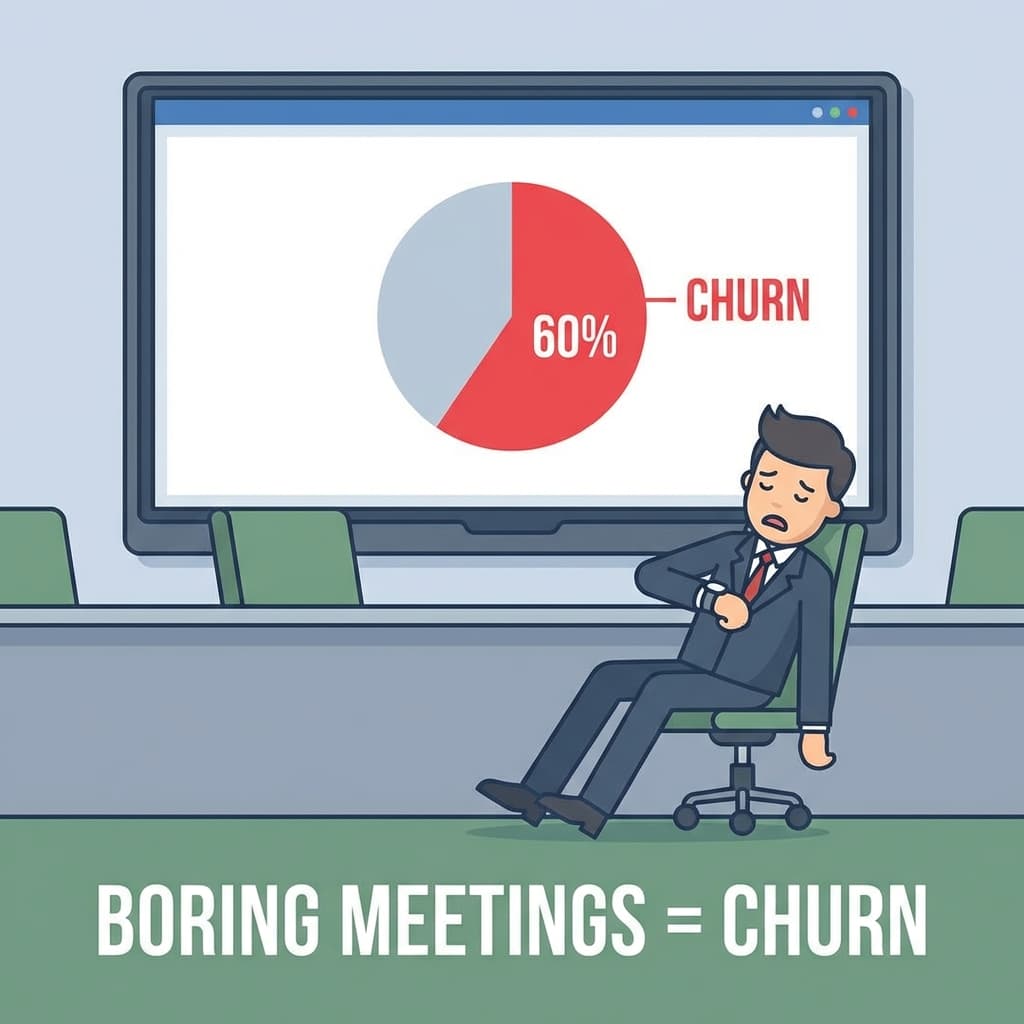
The Customer Success playbook is unanimous: "You must do Quarterly Business Reviews!" Every CS software vendor recommends them. Every customer success certification program teaches them. Every SaaS executive has been told that QBRs are essential for retention. The logic seems bulletproof: regularly demonstrate value to customers, reinforce the relationship, identify expansion opportunities, and secure the renewal.
We followed the playbook religiously. Every quarter, for every customer above $10k ARR, we scheduled a QBR. Our Customer Success Managers prepared 30+ slide decks full of usage statistics, roadmap previews, value calculations, and "partnership next steps." We blocked 60 minutes on busy executives' calendars. We invested heavily in making these presentations polished and professional.
For two years, we treated the QBR as sacred. It was the cornerstone of our retention strategy. The QBR was where we "proved value" and "deepened relationships."
Then our data scientist did an analysis that made my stomach drop.
She looked at churn patterns relative to customer touchpoints. The finding was counterintuitive and alarming:
Customers were 20% more likely to churn in the 30 days following a QBR than in any other 30-day period.
Our retention event was actually a churn trigger. The meeting designed to secure renewals was accelerating cancellations.
I didn't believe it at first. We re-ran the analysis controlling for every variable we could think of: customer size, tenure, industry, CSM assignment. The correlation held. QBRs were correlated with higher churn, not lower.
We immediately halted the QBR program and spent a month figuring out what was happening. What we learned transformed our entire approach to customer success.
Section 1: The "Wake Up the Sleeping Dog" Effect
Here's a dirty secret of B2B SaaS: many of your customers are "happily dissatisfied."
They're not thrilled with your product. It doesn't do everything they want. They have complaints. They'd switch to a competitor if switching were easy.
But switching isn't easy. It's a major project. It requires executive buy-in, migration planning, retraining, and risk. Most customers—especially mid-market—are too busy running their business to evaluate alternatives. Inertia is a powerful force.
These customers aren't promoters. They wouldn't recommend you enthusiastically. But they renew. Every year, autopilot renewal. Because canceling requires effort they don't have time for.
The QBR Wakes Them Up
The QBR forces these happily dissatisfied customers to stop and think about you. That's the problem.
You get the VP on the call. The VP hasn't actively thought about your tool in 3 months. They just know their team uses it and the auto-payment goes through.
Now you're presenting a 30-slide deck. "Let's review your usage metrics!" The VP looks at the numbers.
"Wait, usage is flat? We're paying $72,000 a year and usage hasn't grown? And we still don't have that reporting feature we asked about? And you're showing me a roadmap where our request is pushed to Q3 next year?"
You've just given them a reason to scrutinize the relationship. You've surfaced problems they had successfully compartmentalized. You've reminded them of every gap between their expectations and your delivery.
The QBR is supposed to be "value demonstration." But if you haven't delivered exceptional value, the QBR becomes "value prosecution." The customer is now actively evaluating whether you're worth it.
We Found This in Customer Conversations
We interviewed customers who churned post-QBR. The patterns were clear:
"The QBR made me realize how little we actually use it. I forwarded the usage report to my boss and he asked why we're paying so much for something nobody uses."
"I hadn't thought about canceling until you showed me the numbers. Then I started shopping alternatives."
"Your deck reminded me of 5 feature requests we made that went nowhere. It felt like you were showing off while ignoring our needs."
The QBR crystallized dissatisfaction that would have otherwise remained diffuse and inactive.
Section 2: PowerPoint Fatigue—Meetings Nobody Wants
Let's be honest about what a QBR actually is from the customer's perspective.
It's a meeting. Another meeting. In a calendar already overflowing with meetings.
And it's not even a meeting where they get value. It's a meeting where a vendor reads a slide deck at them. It's a vendor trying to justify their continued existence. It's fundamentally self-serving, wrapped in the language of partnership.
The Behavioral Evidence
Our QBRs had awful attendance dynamics:
- Rescheduled 3+ times: 45% of QBRs
- Key stakeholder absent: 30% of QBRs
- Customer cameras off: 60% of QBRs
- Customer multitasking (obvious typing sounds): 40% of QBRs
- "Can we end early today?": 35% of QBRs
Customers didn't want to be there. They were enduring the QBR out of politeness, not interest. They were appeasing us while resenting the time drain.
The Relationship Damage
If your "relationship building" meeting is a chore for the customer, you're not building relationship. You're burning social capital.
Every QBR reminded the customer that engaging with us was tedious. Every 60-minute deck reinforced that we talked too much and listened too little. The positive intention produced negative sentiment.
We were confusing activity (meetings! touchpoints! slides!) with value.
The Unhappy CSMs
Our Customer Success Managers weren't thriving either. They spent 30-40% of their time preparing and delivering QBRs. They dreaded the prep work. They hated the awkward calls where customers were clearly checked out.
When we surveyed CSM satisfaction, QBR prep was the #1 complaint. "I feel like I spend all my time making PowerPoints instead of actually helping customers."
The process was burning out our team while annoying our customers. Lose-lose.
Section 3: The Replacement—Async Value Reports
We killed the QBR meeting. We replaced it with something simpler and, it turns out, more effective: the Async Value Report.
The Format
Every quarter, each customer receives a single-page PDF (designed to render well in email):
Above the fold:
- Headline Metric: "Your team saved 380 hours this quarter using XQA." One big number. Easy to understand. Easy to forward to a boss.
- Comparison: "+12% vs last quarter." Trend is good.
Body:
- Usage Summary: "42 active users (up from 38). 1,247 tests run."
- Value Calculation: "At an average hourly rate of $75, you've saved approximately $28,500 this quarter."
Call to Action:
- Recommendation: "You're not using Parallel Test Execution. Teams similar to yours see 40% faster builds with this feature. Click here to enable it." One actionable suggestion.
That's it. No meeting. No 30 slides. One page. 2 minutes to read.
Why This Works
1. Respects Time: The customer can consume it in 2 minutes instead of blocking 60 minutes. They can read it when convenient—on the train, during lunch, between meetings.
2. Sharing-Optimized: A PDF is easy to forward. "Hey boss, look at the ROI we're getting from this tool." You can't forward a meeting. The value proof reaches decision-makers who would never join a QBR.
3. Pure Signal: No filler. No "agenda" slides. No "about our company" refresher. Just: here's what you got, here's how to get more.
4. Positive Framing: The headline is always a benefit: "hours saved," "bugs caught," "uptime achieved." The customer sees what they gained, not what they're missing.
Customer Response
We tracked email engagement on Value Reports:
- Open rate: 72% (much higher than typical B2B email)
- Click-through on recommendation: 34%
- Forward rate: 18% (tracked via unique links)
Customers told us they loved it:
"Finally, a vendor that respects my time. Just tell me the value and let me get back to work."
"I forwarded this to my CFO. She was impressed. Makes my job easier."
Section 4: Just-in-Time Conversations Instead of Calendar-Driven Rituals
We still talk to customers. Relationship matters. But we shifted from "calendar-driven" to "signal-driven" engagement.
The Old Model
"It's January, time for Q1 QBRs. Get everyone on the calendar."
Forced conversations whether there was something to talk about or not. Everyone went through the motions.
The New Model
Conversations happen when there's an actual reason to talk:
Negative Signals (Interventions):
- Signal: Usage drops 20% month-over-month. → Action: CSM calls to investigate. "Is everything okay? Can we help?"
- Signal: Champion changes jobs (detected via LinkedIn). → Action: CSM reaches out to new contact. "Congrats on the new role! Let's make sure the transition is smooth."
- Signal: Support ticket volume spikes. → Action: CSM offers training or consulting. "Looks like your team has questions. Want us to run a refresher session?"
Positive Signals (Opportunities):
- Signal: Customer hitting usage limits. → Action: Sales reaches out for upgrade discussion. Perfectly timed, not forced.
- Signal: Customer adopts new feature rapidly. → Action: CSM shares advanced tips and case studies. Help them go deeper.
- Signal: Customer mentions us positively online. → Action: Ask for case study or referral. They're already enthusiastic.
These are relevant, timely conversations. They happen when the customer needs them, not when the calendar says so. They feel like service, not obligation.
The Results
Within 6 months of killing QBRs:
- Net Revenue Retention: Up 8 points
- Gross Churn: Down 15%
- CSM Productivity: Each CSM now handles 30% more accounts
- CSM Satisfaction: Up 25 points (no more deck prep)
- Customer Satisfaction (post-renewal survey): Up 12 points
The QBRs hadn't been helping. They'd been actively hurting. Removing them improved everything.
Conclusion: Retention Comes from Value, Not Meetings
The QBR is a relic of the "Field Sales" era. It made sense when you flew to a customer site, took the executive team to a steak dinner, and built relationship over 6 hours of face time. The QBR was the remote-work version of the business dinner: forced relationship-building time on the calendar.
In the modern SaaS world, that model doesn't work. Your customers are overwhelmed with meetings. They don't want another hour with a vendor. They want the product to work and get out of their way.
Don't force your customers to watch you present a book report on why you're good. Be good. Send the proof. Let them forward it to their boss. And let them get back to work.
If your product delivers value, the data speaks for itself. If it doesn't, no PowerPoint will save you.
Retention comes from product value, not meeting volume. Stop scheduling proof. Start delivering it.
Written by XQA Team
Our team of experts delivers insights on technology, business, and design. We are dedicated to helping you build better products and scale your business.