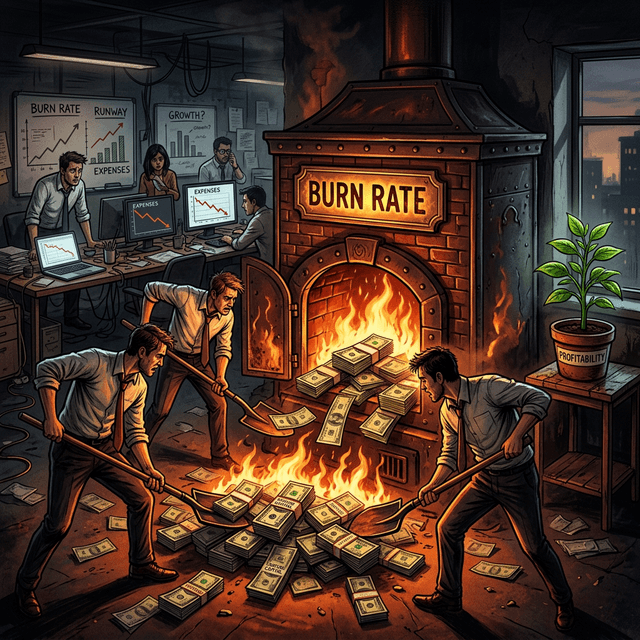
In 2021, we raised a 3 million dollar seed round. In 2022, we raised a 9 million dollar Series A. By 2023, we had 65 employees, a beautiful office, catered lunches, and a burn rate of 800,000 dollars per month.
We were "growing." Revenue was 2 million dollars annually and increasing 80% year-over-year. Our investors were happy. Our board praised our velocity. Every metric on our investor update looked green.
Except one: we were losing 7.6 million dollars per year. And nobody seemed to care.
This is the venture capital paradox. You raise money to grow. Growth requires spending more than you earn. Spending more than you earn requires raising more money. Each raise dilutes your ownership and increases your obligations. The cycle continues until either you achieve escape velocity (IPO or acquisition) or you run out of runway.
Most companies run out of runway. We almost did. Instead, we bought out our investors and rebuilt the company around profitability. It was the hardest and best decision we ever made.
How VC Money Distorts Your Company
It changes what you optimize for. Before raising, we optimized for customer satisfaction and revenue. After raising, we optimized for growth rate and market capture. These are different objectives with different strategies.
Customer satisfaction says: make the product better for existing customers. Growth rate says: acquire new customers even if the product isn't ready. Market capture says: expand into new segments even if you haven't mastered your current one.
Our investors explicitly told us: "Don't worry about profitability. Worry about growth. Profitability comes later." This advice is rational from a portfolio perspective — VCs need outlier returns, so each company should swing for the fences. But it's terrible advice for the company itself, because only 1 in 10 VC-backed companies achieve those outlier returns. The other 9 die or limp along.
It inflates your headcount. When you have 12 million in the bank and a mandate to grow fast, the natural inclination is to hire. We went from 15 people to 65 in 18 months. Many of those hires were unnecessary.
We hired a VP of Marketing before we had product-market fit. We hired a Director of Partnerships before we had partnerships to direct. We hired three senior engineers for a "platform team" that built internal tools nobody used.
Each unnecessary hire costs more than their salary. They create management overhead, communication complexity, meeting culture, and organizational politics. Going from 15 to 65 didn't make us 4x more productive. It made us 2x slower, because the coordination costs exceeded the productive capacity we added.
It creates a board you serve. Our board had two investors, each with their own thesis about what our company should become. One wanted us to go upmarket into enterprise. The other wanted us to go broad into SMB. We tried to do both. We executed neither well.
Board meetings consumed a week of leadership time each quarter. Not the meeting itself (2 hours) but the preparation: building the board deck, anticipating questions, rehearsing answers, updating models, and managing investor relationships. This was a week every quarter that could have been spent on customers and product.
The Buyout
In early 2024, with 18 months of runway remaining, we made the decision to buy out our investors. We offered them a modest return — 1.3x on their invested capital — funded by a combination of existing cash reserves and a small revenue-based financing facility.
Both investors accepted, though reluctantly. They had hoped for 10x or more. But the alternative was a company that might run out of money, and 1.3x is better than 0x.
The buyout cost us 15.6 million dollars. It nearly drained our reserves. But it gave us something priceless: control.
Restructuring for Profitability
With investors gone, we made changes that would have been impossible under VC governance:
Headcount: We reduced from 65 to 28 people. This was painful. We laid off good people, many of whom should never have been hired in the first place. The remaining 28 were the core team who understood our customers, our product, and our market.
Product focus: We killed three product lines and focused on our core offering. The three products we killed had been "growth initiatives" — attempts to expand our addressable market that diluted our engineering effort without generating meaningful revenue.
Pricing: We raised prices 40%. Under VC pressure, we had priced aggressively to capture market share. With profitability as the goal, we priced for value. We lost some price-sensitive customers and gained margin on everyone else.
Office: We closed our office and went fully remote. The office cost us 35,000 dollars per month including utilities, furniture, and catering. Remote work saved us 420,000 dollars per year.
Marketing: We cut our paid acquisition budget by 80% and invested in content marketing and customer referrals. Paid acquisition had been a growth lever, but the CAC (Customer Acquisition Cost) was never justified by the LTV at our old pricing. With higher prices and organic growth, unit economics finally worked.
The Financial Transformation
Within six months of the restructuring:
- Monthly burn rate: From negative 800,000 to positive 120,000 (profitable).
- Revenue: Dropped 15% initially (lost some customers to price increase), then grew 25% over the following year.
- Headcount efficiency: Revenue per employee went from 30,000 to 130,000.
- Customer satisfaction (NPS): Improved from 32 to 58, because we were focused on fewer customers and serving them better.
Our revenue was lower. Our headcount was lower. Our growth rate was lower. And yet, by every metric that actually matters, the company was healthier.
What Profitability Gives You
Time. A profitable company has infinite runway. You don't need to raise again. You don't live in fear of running out of money. You can make long-term decisions because you're not on a countdown.
Freedom. No board meetings. No investor updates. No fundraising roadshows. No pressure to pursue strategies that optimize for exit rather than sustainability. You build what your customers need, not what your investors want.
Resilience. When the market contracts (and it always does), profitable companies survive. VC-backed companies that depend on the next raise die. We watched three competitors fold in 2024 when the funding environment tightened. We were profitable. We didn't even notice.
Optionality. A profitable company can choose to stay private forever. It can choose to grow slowly. It can choose to sell whenever the terms are right, not whenever the runway demands it. Every option is available because none is forced.
When VC Makes Sense
Venture capital is the right tool for specific situations:
- Winner-take-all markets: If the market will consolidate to 1-2 players and speed determines the winner, VC-funded growth is rational.
- Capital-intensive businesses: If building the product requires millions in upfront investment before any revenue (hardware, biotech, infrastructure), VC provides necessary capital.
- Network effects: If the product's value increases with each user and early scale determines long-term dominance, aggressive growth spending is justified.
For most software companies, none of these apply. Most markets support multiple players. Most products don't require massive upfront capital. Most businesses don't have strong network effects. For these companies, bootstrapping or modest funding with a path to profitability is the superior strategy.
Conclusion
We raised 12 million dollars and used it to make our company worse. We hired too many people, built too many products, and optimized for the wrong metrics. The money gave us the illusion of progress while creating structural problems that nearly killed the company.
Profit is not a dirty word. It is the fundamental measure of whether your business creates more value than it consumes. If your company cannot be profitable, it is not a business. It is a charity funded by venture capitalists who expect a return they will probably never see.
Written by XQA Team
Our team of experts delivers insights on technology, business, and design. We are dedicated to helping you build better products and scale your business.