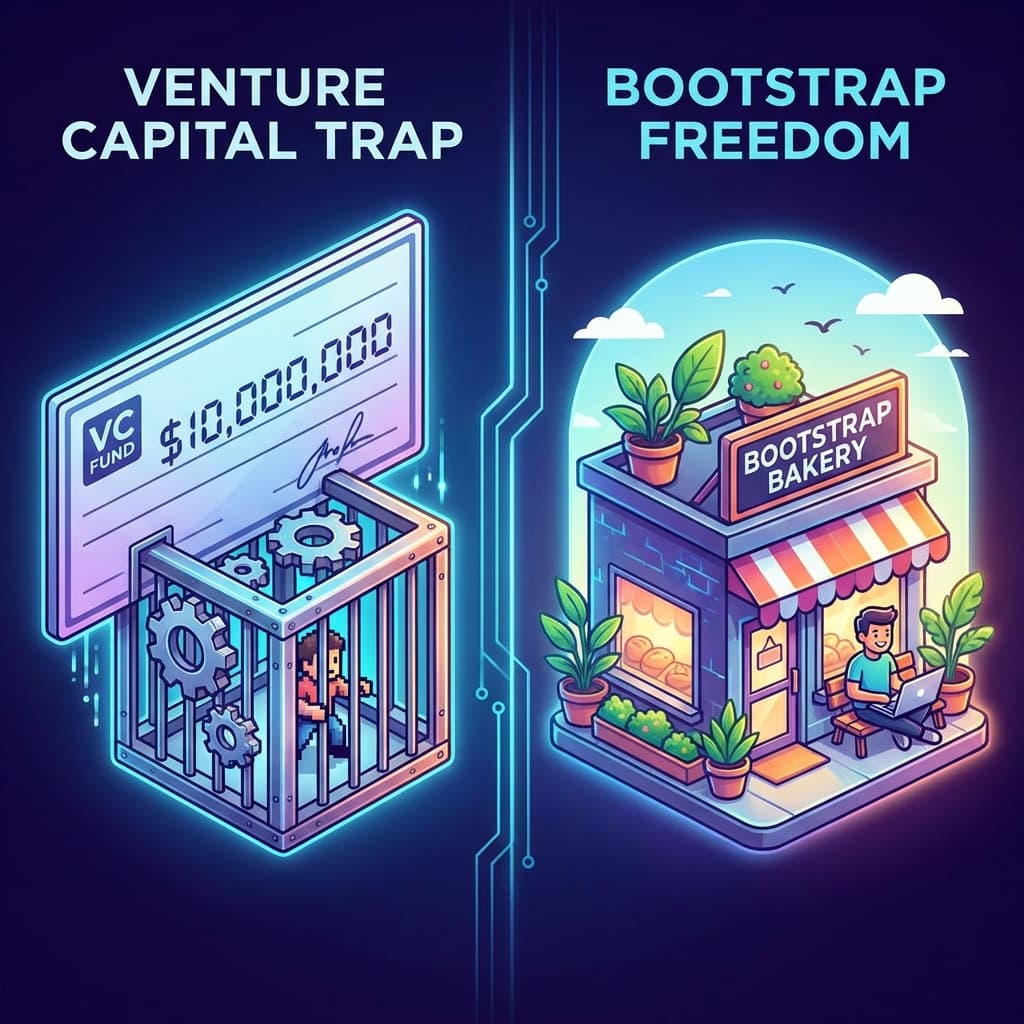
We had a $10M Series A term sheet on the table. Lead investor from a top-tier firm. "You'll be the market leader!"
I almost signed.
Then I ran the math on what "success" looked like under VC terms.
To return the fund (a basic expectation for any VC investment), we'd need a $500M+ exit.
Our total addressable market? $200M.
The "success" scenario was mathematically impossible. We'd have to capture 250% of the market. That's not how markets work.
The real outcome under VC: grow fast, burn cash, either get acquired at a mediocre multiple (where the VCs get their preferences and founders get scraps) or die trying.
We walked away. Bootstrapped instead. Slower growth. Full control. Profitable. Alive.
Here's when VC makes sense — and when it's a trap.
Section 1: The VC Success Myth
Venture capital has great marketing. "Smart money." "Strategic value-add." "Validation from the best."
The Narrative:
VC is positioned as an endorsement. "If Andreessen/Sequoia/Benchmark invested, you must be onto something big."
Founders feel validated. "We got funded!" becomes a milestone, a signal of success.
The ecosystem reinforces this: TechCrunch writes about fundings. Twitter celebrates raises. LinkedIn profiles highlight investments.
The Reality:
VC is a business model. It's not an endorsement of your company's quality. It's an expectation contract.
VCs need outlier returns. A $500M fund needs to return $1.5-2B. They need multiple 10-100x outcomes. They know most investments will fail.
When they invest in you, they're not saying "your business is good." They're saying "your business might be a 100x outcome, and if it isn't, we'll move on."
The Expectations Contract:
Taking VC means agreeing to swing for the fences.
- Modest success (building a $20M/year business) is failure in VC terms
- You must pursue the huge outcome, even if a smaller outcome is more likely and more profitable for you
- Growth must be prioritized over profitability, often indefinitely
- Exit must happen within the fund timeline (typically 10 years)
Many founders don't understand they're agreeing to this. They think they're getting money. They're getting obligations.
Section 2: The Math That Didn't Work
Let me walk through the specific math that made me walk away.
The Term Sheet:
- $10M investment at $40M pre-money valuation
- Post-money: $50M
- Investor owns: 20%
Looks reasonable. Standard early-stage terms.
The Return Requirements:
The fund was $300M. They need to return $900M+ to their LPs (3x return is baseline acceptable).
Their 20% stake needs to be worth $30M minimum (10% of the $300M fund) to matter to them. Preferably $60M+ (20% of the fund) to be a meaningful return.
For their stake to be worth $60M at exit, the company needs to exit at $300M (20% of $300M = $60M).
But VCs want better than "meaningful." They want fund-returning. For this investment to return the fund, they need a $1.5B exit (20% of $1.5B = $300M = their whole fund).
Our Market:
Our TAM (total addressable market) was $200M. All companies in our space competing for a $200M pie.
For us to exit at $300M (minimum "meaningful" return), we'd need to be worth more than the entire market. At $1.5B, we'd need to be worth 7.5x the market.
This is impossible. Markets don't work like this.
The Realistic Outcome:
If we captured 30% of our market (an incredible outcome), we'd have $60M in revenue.
At a 5x revenue multiple (generous for our space), that's a $300M company.
The VCs get their $60M. Founders, after preferences and dilution from future rounds, might get $20-30M on a $300M exit.
But here's the thing: to get to $60M revenue on VC timelines, we'd need to burn $30M+ (the $10M plus likely a Series B). The risk of death would be high.
The VC-backed path had a small chance of a modest founder outcome and a large chance of company death.
The bootstrapped path had a high chance of a smaller but still life-changing outcome and a small chance of death.
The expected value of bootstrapping was higher for us.
Section 3: When VC Actually Makes Sense
VC isn't always wrong. There are contexts where it's genuinely the right choice.
Winner-Take-All Markets:
In markets with strong network effects, the winner captures most of the value. Being first and fast matters more than being profitable.
Social networks, marketplaces, communication platforms — if you're not first to scale, you're dead. VC lets you scale before you're profitable.
Our market wasn't winner-take-all. There was room for multiple players. Speed wasn't existential.
Capital-Intensive Businesses:
Some businesses require huge upfront investment before they can generate revenue.
Hardware. Biotech. Deep tech. Infrastructure.
You can't bootstrap a chip fab. You need capital markets.
Our business was software. Marginal costs were near zero. We didn't need capital to build.
Founder Preferences:
Some founders want the high-risk, high-reward experience. They'd rather swing for a unicorn and fail than build a smaller but successful business.
That's a legitimate preference. VC is the right model for those founders.
I wanted to build something sustainable. I wanted to control my company. I wanted to be alive in 10 years. VC didn't align with my preferences.
Section 4: The Bootstrap Alternative
We walked away from the term sheet. Here's what happened instead.
The Hard Part:
Bootstrapping is harder than raising. Every dollar comes from customers, not investors.
We couldn't hire ahead of revenue. We couldn't subsidize growth with losses. We couldn't buy market share.
Growth was 40% year-over-year instead of 200%. Slower. Steadier.
The Payoff:
Profitable within 18 months. No existential fundraising pressure. No board to answer to.
We own 100% of the company. No preferences, no dilution, no liquidation waterfalls.
Every dollar of profit is ours. We reinvest what makes sense and distribute what doesn't.
The Comparison:
Many of our competitors took VC in 2024. Here's how they're doing:
- Company A: Raised $15M. Burned through it. Acqui-hired for $10M. Founders got ~$500k each after preferences.
- Company B: Raised $8M. Still alive but underwater. Needs to raise again or die. Founders are employees at this point.
- Company C: Raised $5M. Dead. Shut down after 18 months.
We're smaller than they were at peak. But we're profitable, growing, and own our company.
5 Years Later:
We're still running. Revenue grows every year. Team is stable. Stress is manageable.
We could have been a "TechCrunch startup." We chose to be a business instead.
Conclusion
Venture capital is a tool. Like any tool, it's good for some jobs and bad for others.
For winner-take-all markets, capital-intensive businesses, and founders who want moonshot risk, VC makes sense.
For niche markets, capital-efficient software, and founders who want control and sustainability, it often doesn't.
The hardest part is knowing which category you're in. The VC narrative says everyone should want to be a unicorn. But unicorns are rare for a reason. Most businesses are not unicorns. Most founders would be better served building profitable, sustainable companies.
Sometimes the best funding is no funding.
Written by XQA Team
Our team of experts delivers insights on technology, business, and design. We are dedicated to helping you build better products and scale your business.