"Start an affiliate program—it's basically free marketing!" Every SaaS growth playbook says this. Every growth consultant recommends it. Every podcast host with a side business runs one. The logic seems sound: pay a small commission for customers you wouldn't have found otherwise. Pure upside!
We launched ours with enthusiasm and what we thought was a generous offer: 30% recurring commission for the lifetime of any customer referred. If you sent us a customer paying $100/month, you'd get $30/month as long as they stayed. Beautiful alignment, we thought—you're incentivized to send us customers who stick around.
Within a month, we had 2,000 affiliates. YouTube channels were creating "XQA Review" videos. Blogs compiled "Best Software 2026" lists featuring us. Comparison sites ranked us against competitors. The traffic poured in.
Our signup graph went vertical. We celebrated. We hired more support staff to handle the volume. We started planning our next funding round based on the growth trajectory.
Three months later, two graphs had gone vertical: signups and churn. Our Net Revenue Retention plummeted. Our support team was overwhelmed with complaints. Our G2 reviews were increasingly negative. And our brand was buried under a wave of spam content we couldn't control.
We shut down the affiliate program entirely. It was one of the best business decisions we made that year.
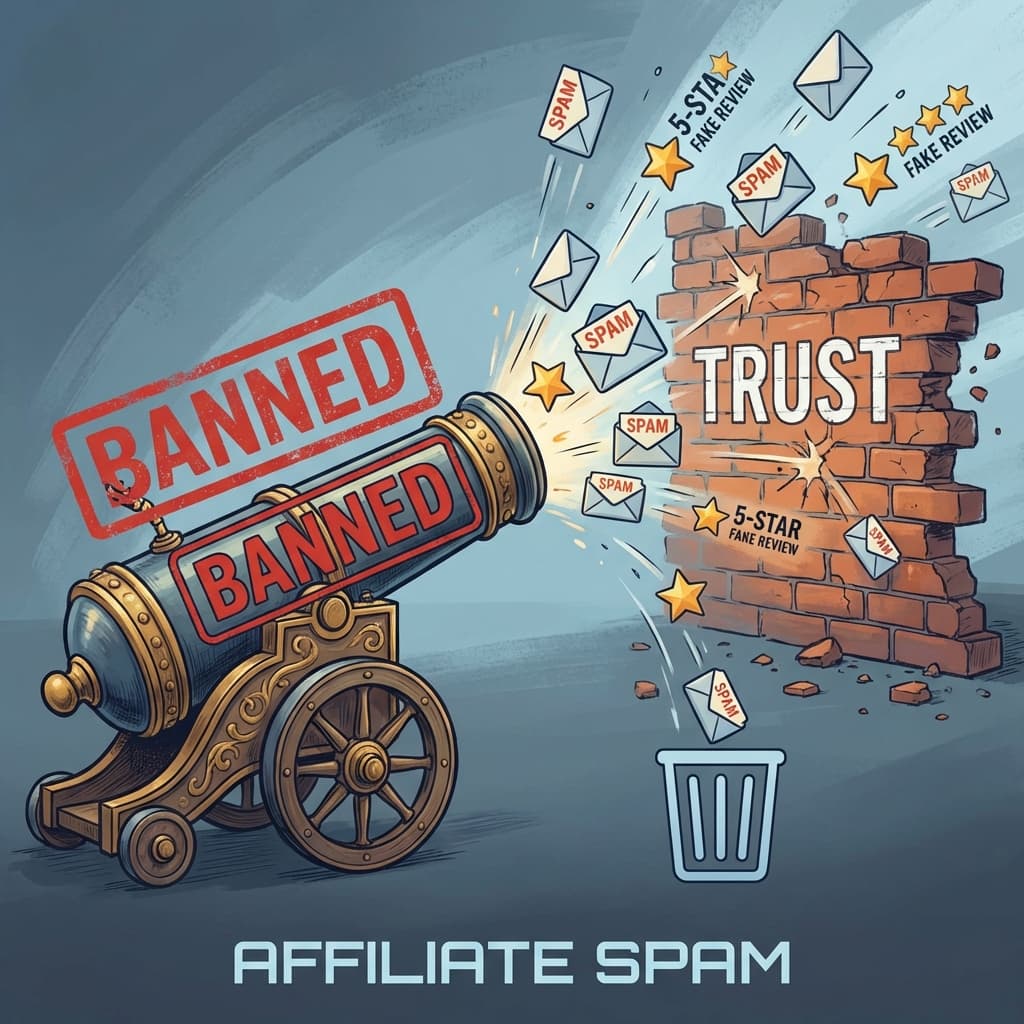
Here's the full story of why open affiliate programs are a "Spam Cannon"—they spray traffic everywhere, but you can't aim them at quality customers.
Section 1: The Misaligned Incentive—Clicks vs. Customers
The fundamental problem with affiliate programs is incentive misalignment. You and your affiliates want different things.
What Affiliates Optimize For
An affiliate's goal is simple: Get the Click.
Their commission is triggered when someone clicks their link and eventually signs up. They're optimizing for conversion—turning readers into clickers, clickers into signups.
What they're NOT optimizing for:
- Whether the customer is a good fit for your product
- Whether the customer understood what they were buying
- Whether the customer will be successful and stay long-term
- Whether the customer's expectations match your product's reality
These concerns are invisible to the affiliate. They only see the conversion. They don't see the support ticket two weeks later, the angry email to the founder, or the churn event at day 45.
The Lying Problem
When affiliates realized that "comparison review" content converts well, they started producing it at scale. "XQA vs. Competitor—Which Should You Choose?"
These videos needed to position us favorably (since they were selling our affiliate link). So they emphasized strengths—and invented some.
- "XQA supports offline mode!" (We didn't.)
- "XQA integrates natively with SAP!" (We didn't.)
- "XQA offers 24/7 phone support!" (We offered email support with a 24-hour SLA.)
- "XQA's basic tier includes unlimited users!" (It included 5 users.)
Customers signed up expecting these features. When they discovered reality, they did three things:
- Filed support tickets asking how to enable the feature they were promised
- Got frustrated when told the feature didn't exist
- Churned and left negative reviews describing us as "misleading"
The affiliates didn't care. They'd already earned their first-month commission. By the time the customer churned, the affiliate had moved on to promoting the next tool.
The Math of Lying
From the affiliate's perspective, lying is profitable:
- Promise fake features → higher signup conversion → more commission
- Customer churns in month 2 → affiliate already earned month 1 commission
- Brand damage → not the affiliate's problem
The incentive structure actively encourages misrepresentation. The affiliate bears no cost for the churn they cause.
Section 2: Brand Damage—When Spam Defines Your Search Results
Within three months of launching the affiliate program, our brand's search presence transformed—and not in a good way.
The Organic Search Takeover
If you Googled "XQA Review" or "XQA vs [competitor]", the first page was dominated by affiliate content:
- "Is XQA Legit? Read This Before Buying!"
- "XQA Review 2026: Pros, Cons, and Hidden Truth"
- "XQA vs CompetitorX: Which One Will Save Your Business?"
- "XQA Discount Code - Get 50% Off!" (We didn't offer discount codes.)
- "XQA Free Trial Hack - Secret Method Inside!"
These were AI-generated spam blogs designed to rank for search queries and harvest affiliate clicks. They had zero original insight. Many were factually wrong. Some hadn't even used the product.
Our brand was being represented to potential customers by strangers who didn't understand our product and had no stake in accurately portraying it.
The Trust Signal Backfires
Sophisticated B2B buyers—exactly the customers we wanted—saw these spammy results and drew conclusions:
"If they need this much affiliate hype, the product must not be able to sell itself."
"This looks like a 'get rich quick' scheme, not serious enterprise software."
"All these 'reviews' feel fake. I don't trust the organic testimonials now."
The affiliate spam made us look desperate and untrustworthy to precisely the buyer persona we cared most about: careful, research-driven enterprise buyers who do due diligence.
We Couldn't Control It
We tried to take action. We sent takedown requests to affiliates with inaccurate content. Most ignored us—they weren't violating any law, just our terms of service that we couldn't enforce. We rejected affiliates with spammy sites. They created new accounts. We required content approval. They'd submit clean content for approval, then change it after.
Trying to moderate 2,000 affiliates was a full-time job we weren't staffed for. And we were fighting a losing battle—the spam was SEO-optimized to outrank us for our own brand queries.
Section 3: Brand Bidding Wars—Competing Against Ourselves
The final straw came when we analyzed our paid advertising performance.
Affiliates Bidding on Our Name
Our affiliates discovered something profitable: they could buy Google Ads for our brand keywords and collect commissions from the traffic.
Someone searches "XQA pricing." Previously, they'd click our organic listing and arrive at our pricing page. No commission paid to anyone.
With affiliates bidding, they might see: "[AD] XQA Discount - Get 30% Off Today - mycouponsite.com/xqa"
They click the ad. They land on a fake coupon site (which has no real coupon). They click through to our actual site via an affiliate link. They sign up. The affiliate earns 30% of their monthly payment—forever.
The customer would have signed up anyway. The affiliate added zero value. They just intercepted traffic that was already looking for us.
The CPC Spiral
When affiliates bid on our brand keywords, they drove up our Cost Per Click for those same keywords. We were now in a bidding war with our own "partners" for our own name.
Our CPC for "XQA" went from $1.50 to $6.00. For a customer we would have acquired organically.
We banned brand bidding in our affiliate terms. Affiliates ignored it, or used close variants ("XQ-A", "XQA tool", "XQA software"). Enforcement was whack-a-mole.
Cannibalization Math
We ran the analysis: of customers acquired through affiliate links, what percentage would have found us anyway?
Answer: approximately 60%. These were people who had already heard of us, were already searching for our brand, and would have signed up regardless. We were paying 30% commission on revenue we would have captured at 0% commission.
The affiliate program was cannibalizing our organic acquisition while increasing our customer acquisition cost.
Section 4: The Pivot to Certified Partners—Quality Over Quantity
We didn't just cancel the affiliate program—we replaced it with something better: a Certified Partner Program.
The Barrier to Entry
To become a Certified Partner:
- Complete training: A 4-hour self-paced course on our product, target customers, and positioning.
- Pass an exam: A 50-question test demonstrating product knowledge.
- Pay a partnership fee: $500/year, refundable as commission credit after 3 successful referrals.
- Sign an agreement: Including content guidelines, brand usage rules, and accuracy requirements.
These requirements eliminated 98% of the spray-and-pray affiliates. The remaining 2% were serious—agencies, consultants, implementation partners, and power users who wanted to recommend something they genuinely understood.
The Reward Structure
Certified Partners receive:
- 20% revenue share (lower than the old 30%, but on higher-quality customers)
- Official directory listing on our website, driving leads to them
- Co-marketing opportunities: Case studies, webinars, event appearances
- Early access: Beta features and roadmap visibility
- Dedicated partner manager: Human support for their referrals
The relationship became mutually valuable beyond just commissions. Partners got business development support. We got quality referrals.
The Results
After one year of the Certified Partner Program:
- Partners: 52 (down from 2,000 affiliates)
- Traffic from partners: Down 80%
- Signups from partners: Down 75%
- Revenue from partner-referred customers: Up 35%
- Churn of partner-referred customers: 3% (vs. 25% for old affiliate-referred)
- LTV of partner-referred customers: 4x higher than affiliate-referred
Fewer partners. Fewer signups. More revenue. Better customers. The math was unambiguous: quality over quantity wins.
The partners who remained were agencies implementing our product for clients, consultants recommending us in their practice, and power users earning side income from their expertise. They sold the product correctly because they understood it. They set appropriate expectations because they'd be around to answer questions.
Conclusion: You Can't Aim a Spam Cannon
Open affiliate programs are a "spam cannon." You point it at the market and pull the trigger. Volume pours out. But you can't aim it. You can't control what gets said. You can't ensure quality.
For some products, this is fine. If you're selling a $10 ebook with no ongoing relationship, fire the cannon. Volume wins. Who cares if expectations are mismanaged?
For B2B SaaS—where reputation matters, where trust takes years to build and minutes to destroy, where customer lifetime value depends on proper initial fit—the cannon is suicide.
Your brand is your most valuable asset. Don't outsource its representation to strangers incentivized to lie.
If you want referral growth, build relationships with partners who understand your product, serve your actual customer base, and share your incentive for long-term customer success. Fewer partners. Better partners. Real partnerships.
Don't pay people to lie about your product. Invest in people who'll tell the truth about it—and make the truth compelling.
Written by XQA Team
Our team of experts delivers insights on technology, business, and design. We are dedicated to helping you build better products and scale your business.