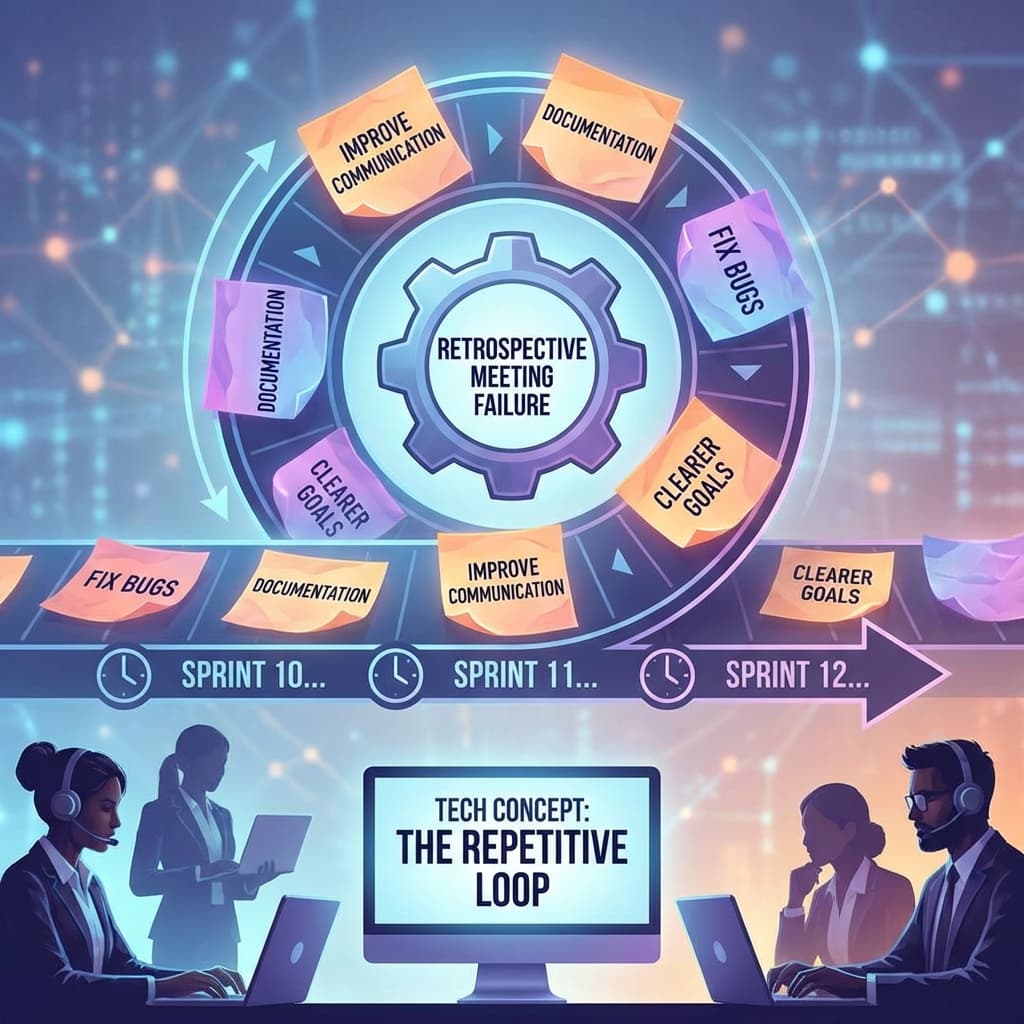
Sprint retrospective. Every two weeks. Same questions: "What went well? What didn't? What should we change?"
Same answers. Every time.
"Communication could be better."
"Too many meetings."
"Need more time for testing."
We'd write action items. Put them in Jira. Nobody followed up. Next retro: the same problems. The same complaints. The same action items.
We'd been running the same retrospective for 2 years with zero improvement.
The ritual had become a performance of self-improvement without any actual self-improvement.
We killed it. Here's what we do instead.
Section 1: The Retrospective Ritual
Retrospectives are sacred in Agile canon.
The Theory:
Regular reflection leads to continuous improvement. After each sprint, the team asks: What worked? What didn't? What should we try differently?
The answers drive change. The team adapts. Process improves incrementally. This is how Agile teams get better.
Beautiful in theory.
The Reality:
Most retrospectives produce no lasting change.
Action items are created with enthusiasm. "We'll definitely do this!" By the next sprint, they're forgotten. The urgent crowds out the important. Nobody owns the follow-through.
Same problems recur. Same complaints surface. The cycle repeats.
The Performance:
Teams know they should do retrospectives. It's "best practice." So they go through the motions.
They sit in the room. They write sticky notes. They vote on priorities. They assign action items.
Nothing changes. But the box is checked. "We did a retro." The performance of improvement is complete.
This isn't improvement. This is theater.
Section 2: Why Retros Fail
Retrospectives fail for predictable reasons.
No Follow-Through:
Action items require someone to own them. To prioritize them. To actually do them.
But retro action items compete with sprint work. Sprint work has deadlines. Action items don't. Sprint work has stakeholders asking for updates. Action items don't.
Action items evaporate. They're created with good intentions and abandoned within days.
Safe Topics Only:
The real issues — the interpersonal tensions, the leadership failures, the structural problems — are too risky to raise.
So teams discuss safe topics. "We need better documentation." "Our tests are flaky." These are real issues but not the important ones.
The elephant in the room stays unmentioned. The retro addresses symptoms, not causes.
Recency Bias:
Retros naturally focus on the last few days. Whatever happened on Thursday is fresh; what happened two weeks ago is forgotten.
Systemic issues — the ones that persist across sprints — get attention briefly when they flare up. Then they fade. The pattern continues.
Ritual Exhaustion:
Every two weeks. Same format. Same questions. Same people.
Teams get tired. Creativity dies. Engagement drops. People check boxes instead of thinking.
By retro #50, nobody has anything new to say. They're just rotating through the same complaints with different wording.
Section 3: When Reflection Actually Works
Reflection can produce change. But it requires different conditions than the standard retro.
Incident Reviews:
When something goes wrong — production outage, missed deadline, major bug — incident reviews work.
Why? Because there's a specific event. Concrete details. A clear question: "How do we prevent this from happening again?"
The output is specific changes, not vague intentions. "We'll add monitoring for X." "We'll change the deploy process to include Y." Concrete, verifiable, owned.
Team Health Surveys:
Anonymous, longitudinal, data-driven assessments of team health.
Quarterly surveys asking about workload, clarity, collaboration, trust. Tracked over time. Trends identified.
Anonymity lets people say what they won't say in a meeting. Scale data reveals patterns that anecdotes miss.
Quarterly Deeper Dives:
Instead of frequent shallow retros, infrequent deep ones.
Every quarter, 2-3 hours of serious reflection. Enough time to discuss difficult topics. Enough time for real conversation.
Less frequent means more novel. People save their observations for the quarterly review instead of repeating the same weekly.
The Pattern:
Effective reflection is: intentional (specific purpose), accountable (clear ownership), and infrequent (novelty preserved).
Standard retros are: routine (no specific purpose), unaccountable (no ownership), and frequent (ritual exhaustion).
Section 4: Our Replacement System
We killed the sprint retro. Here's what replaced it.
Bi-Monthly Health Checks:
Every 8 weeks instead of every 2. Six times per year instead of 26.
Long enough between sessions that things actually change. Short enough that problems don't fester.
Anonymous Survey First:
Before the meeting, everyone fills out a short anonymous survey. "What's working? What isn't? What's one thing you'd change?"
Anonymity surfaces what people won't say publicly. The meeting starts with actual data, not whoever speaks first.
3 Items Maximum:
We discuss 3 things maximum. Not 10. Not "whatever comes up." Three.
This forces prioritization. The three things that matter most get real attention. Everything else waits.
Explicit Owners:
Each item gets an owner. Not "the team." A person. With a name. Who is accountable for follow-through.
At the next health check, we review: Did the owner complete the item? What happened?
Results:
- Recurring problems: Down 60%. Issues actually got fixed.
- Engagement: Up significantly. Meetings people don't dread.
- Time spent: Down 75%. Fewer meetings, better outcomes.
- Real issues raised: Anonymous surveys surfaced things retros never did.
Conclusion
Retrospectives are supposed to drive improvement. Most don't. They've become rituals — performances of improvement that produce no actual change.
The solution isn't better retro facilitation. It's recognizing when a practice isn't working and replacing it with something that does.
Reflection should produce change. If it doesn't, the reflection process is broken. Fix it or stop wasting everyone's time.
Stop performing improvement. Start actually improving.
Written by XQA Team
Our team of experts delivers insights on technology, business, and design. We are dedicated to helping you build better products and scale your business.