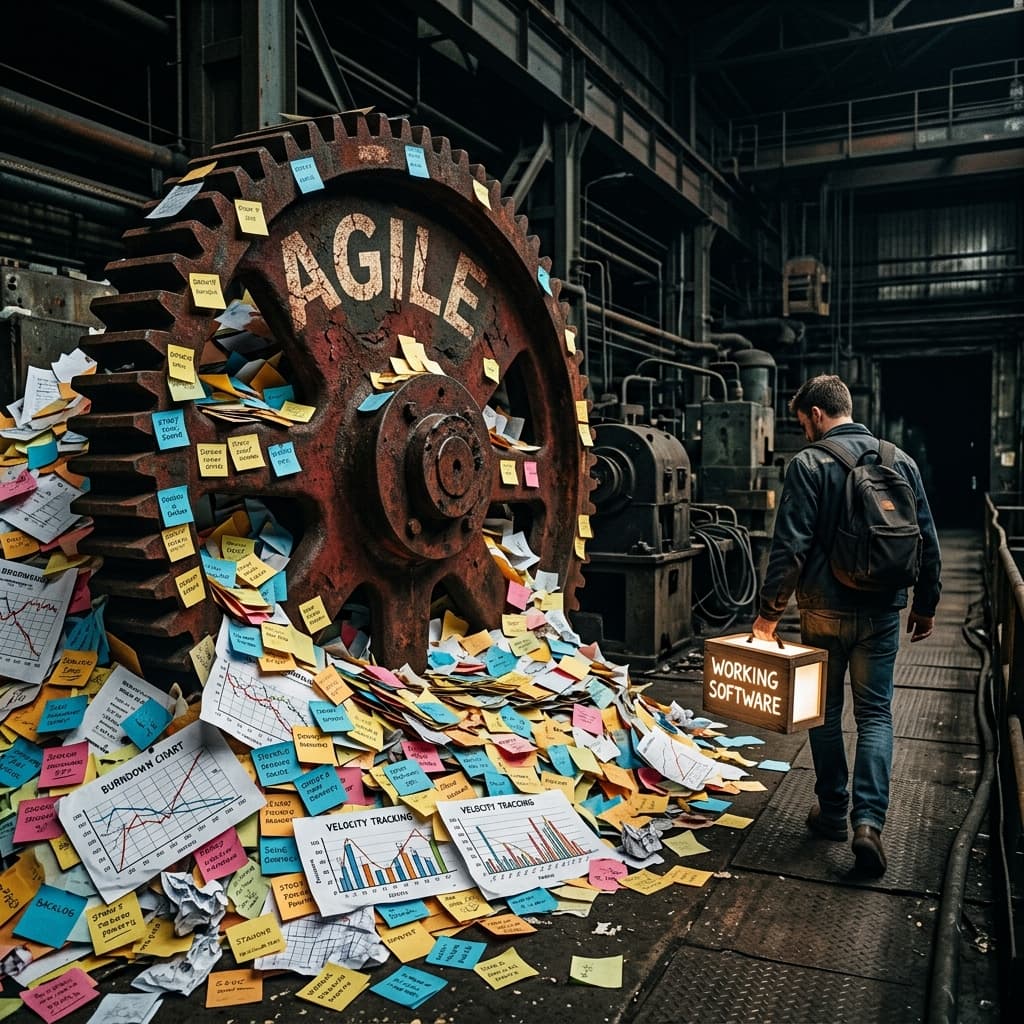
By 2024, our "Agile" process had become a bureaucratic nightmare. We were following the Scrum guide to the letter: 15-minute daily standups that lasted 45 minutes, two-week sprints that were always 'incomplete,' and exhaustive 'retrospectives' where we complained about the same problems for the tenth month in a row.
The "Agile Industrial Complex" had convinced us that software development was a predictable manufacturing process that could be managed with enough colored sticky notes and "velocity" tracking. In reality, we were moving slower than ever. The process was the product, and the actual software was an afterthought.
We decided to stop. We fired the dedicated Scrum masters, we replaced Jira with a single text file of priorities, we ended the sprints, and we told the engineers to just ship software when it was ready. We moved back to a "Continuous Shipping" model, and the transformation was instantaneous.
The Ritual of the Standup
The daily standup is the most expensive and least productive meeting in the tech industry. It is designed to be a "sync," but it almost always becomes a "reporting" session. Engineers stand in a circle (or on a Zoom call) and recite what they did yesterday—information that should already be visible in the code commits.
When you have a 10-person team, a 30-minute standup costs 5 engineering hours every day. That's 25 hours a week—more than a half-time employee—spent simply talking about work. We replaced it with a Slack thread. If you have a blocker, you post it. If you don't, you keep coding. We gained 100 hours of engineering time per month by simply stop-standing up.
The Sprint Fallacy
Sprints are an artificial construct designed to give managers a sense of control. They assume that software features can be neatly packaged into two-week chunks. This leads to two destructive behaviors: "Sprint Padding" (engineers choosing small, easy tasks to ensure they 'finish' the sprint) and "Cutting Corners" (pushing buggy code at 4 PM on Friday just to meet the sprint deadline).
Software development is not a race; it's a marathon. You don't "finish" building a product every two weeks. By moving to a continuous flow model, we removed the artificial stress of the sprint boundary. Features are shipped when they are ready—whether that takes three days or three weeks. The quality of our releases improved dramatically because we stopped racing against a calendar.
The 'Story Point' Delusion
We spent hours in "Poker Planning," debating whether a task was a 3, a 5, or an 8. This was a monumental waste of time. Story points are a fictional currency used to calculate "velocity," which is then used by management to set unrealistic deadlines.
We realized that any estimation beyond "Small," "Medium," or "Large" is pure guesswork. We stopped estimating. We started prioritizing. We took the most important feature and worked on it until it was done. Then we took the next one. We found that without the overhead of estimation, we were actually completing features faster because we were focused on the code, not the math.
Why 'Agile' Fails at Scale
Agile was designed for small, co-located teams. When applied to a 200-person engineering organization, it becomes "SAFe" (Scaled Agile Framework) or similar monstrosities. These are essentially just Waterfall management disguised in Agile terminology. You have "Release Trains," "Program Increments," and layers of management that exist only to coordinate the coordination.
We realized that the solution to scale is not more process; it's more Autonomy. We broke our organization into small, independent squads of 3-5 engineers. Each squad has a clear mission and full control over their own roadmap and stack. They don't need a "Scrum Master" because they are professional adults who know how to talk to each other.
Conclusion
The Agile Manifesto was a beautiful document that prioritized "Individuals and interactions over processes and tools." Ironically, the "Agile" industry has become exactly what the manifesto was trying to prevent: a bloated, process-heavy bureaucracy that stifles individual creativity.
Software is built by people, not by processes. Stop tracking your velocity and start tracking your deployments. Stop planning your poker and start planning your architecture. If you want to move fast, get out of the way and let your engineers ship.
Written by XQA Team
Our team of experts delivers insights on technology, business, and design. We are dedicated to helping you build better products and scale your business.