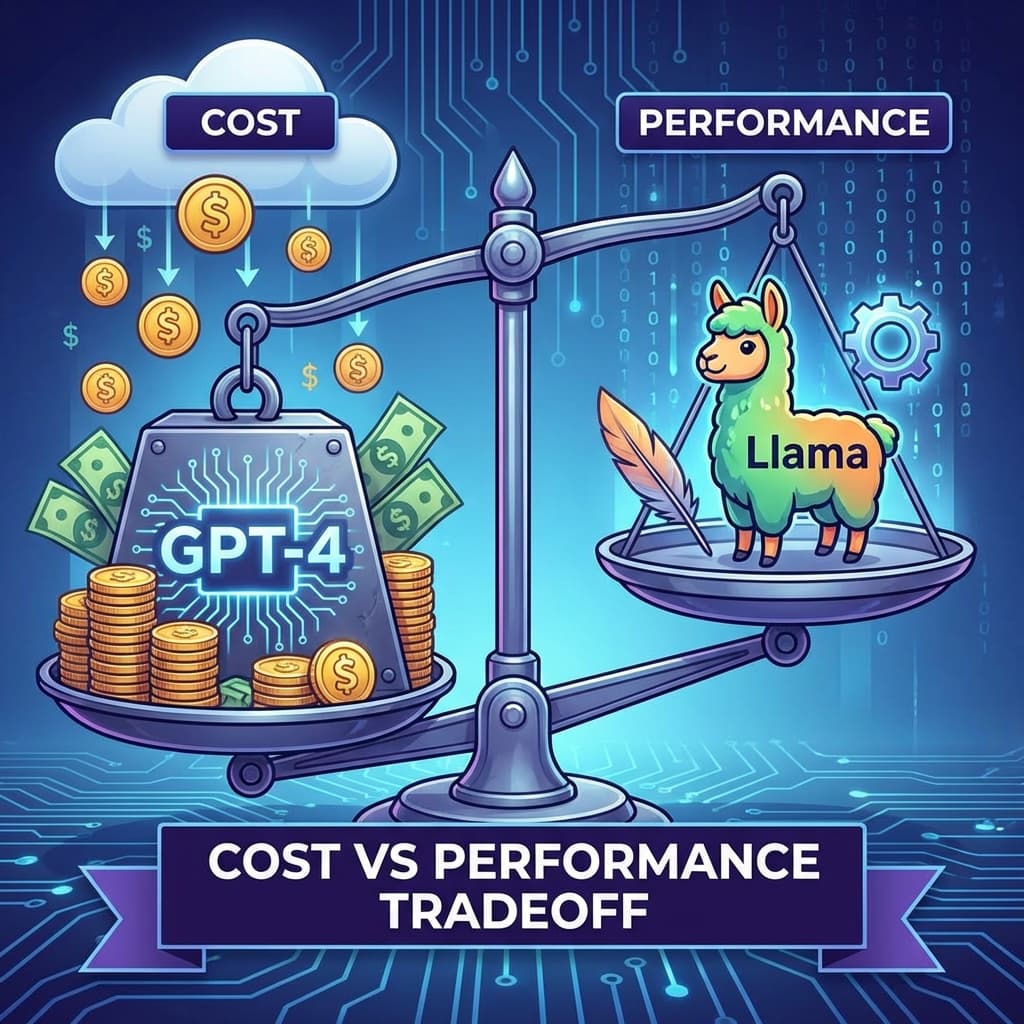
Our internal ticket classification system was powered by GPT-4. Accuracy: 99.2%. Cost: $15,000 per month. Latency: 800 milliseconds.
Then a junior engineer asked a question I couldn't answer: "What does that extra 1.4% accuracy actually buy us?"
I didn't know. So we ran the numbers.
The 1.4% difference between GPT-4 (99.2%) and a fine-tuned open source model (97.8%) amounted to approximately 3 misclassified tickets per day. The cost of having a human manually reclassify those 3 tickets? About $50 per day. $1,500 per month.
We were paying $15,000/month to save $1,500/month. We were overpaying by a factor of 10.
We switched to a fine-tuned Llama 3 70B running on our own hardware. Cost: $800/month (electricity and depreciation). Accuracy: 97.8%. Latency: 120 milliseconds.
Here is how "Good Enough" beat "Best in Class" — and why your team is probably making the same $50,000 mistake we made.
Section 1: The "Accuracy Obsession" Fallacy
Engineering teams chase SOTA (State of the Art) metrics because it looks impressive in Product Requirement Documents. "We're using GPT-4, the most advanced model in the world!"
But here is the uncomfortable truth: Accuracy is not the same as business value.
The Diminishing Returns Curve:
Going from 90% to 95% accuracy might be transformative. It might eliminate entire categories of errors that frustrate users.
Going from 97% to 99% is rarely noticeable to end users. The marginal improvement is invisible. But the marginal cost is enormous.
GPT-4 API costs per 1 million tokens: ~$30 (input) + ~$60 (output).
Llama 3 self-hosted cost per 1 million tokens: ~$0.50 (compute).
That is a 60x difference in unit economics for a 1.4% accuracy improvement that users cannot perceive.
The Wrong Question:
Teams ask: "What is the best model for this task?"
They should ask: "What is the cheapest model that meets the acceptance bar?"
The acceptance bar is not "maximum possible accuracy." It is "accuracy at which the error rate is acceptable given the cost of errors."
For our ticket classification system, a misclassification meant a ticket went to the wrong queue. A human would notice within minutes and reroute it. The cost of that error: ~$15 of human time.
For a medical diagnosis system, a misclassification might mean a missed cancer. The cost of that error: incalculable.
These are not the same problem. They do not require the same solution.
Section 2: The Hidden Costs of Frontier APIs
When you adopt GPT-4 (or Claude, or Gemini) via API, you are not just paying per token. You are accepting a bundle of hidden costs that compound over time.
Latency:
GPT-4 takes 500ms to 2 seconds per request in production. On bad days, it spikes to 5+ seconds.
Users notice latency. In our A/B tests, moving from 800ms to 120ms response time increased user satisfaction scores by 18%. The speed improvement from self-hosting was more valuable than the accuracy improvement from GPT-4.
Vendor Lock-In:
Your prompts are tuned to OpenAI's quirks. The exact phrasing that works for GPT-4 does not work for Claude or Gemini. You have built institutional knowledge around one vendor's idiosyncrasies.
When you want to switch (because of pricing, reliability, or privacy concerns), you cannot just swap the API key. You have to rewrite and re-test every prompt. That is weeks of engineering time.
Data Privacy:
Enterprise customers increasingly ask: "Where does our data go when we use your product?"
"It goes to OpenAI's servers for processing" is not a reassuring answer for healthcare companies, financial institutions, or government contractors.
Self-hosted models mean data never leaves your VPC. That is not just a feature—for some customers, it is a requirement.
Rate Limits:
When your product goes viral, OpenAI throttles you. Their rate limits are designed for average load, not your best day.
You cannot scale with rented infrastructure. You can only scale with infrastructure you control.
Section 3: The "Self-Hosted" Playbook
Here is exactly how we transitioned from GPT-4 API to self-hosted Llama 3.
Hardware:
We purchased 2x NVIDIA A100 80GB GPUs. Total cost: approximately $15,000 per GPU, or $30,000 total.
At our previous GPT-4 spend of $15,000/month, the hardware paid for itself in 2 months. Even accounting for electricity, maintenance, and engineering time, payback was under 6 months.
If you do not want to buy hardware, cloud GPU instances work too. AWS p4d.24xlarge costs ~$32/hour. Still far cheaper than API calls at scale.
Model Selection:
We tested Llama 3 70B, Mistral Large, and Mixtral 8x22B.
Llama 3 70B won for our use case. Quantized to 4-bit precision (using GPTQ), it fits on a single A100 with room to spare.
Base model accuracy (zero-shot) on our classification task: 93%.
Fine-tuned accuracy (with 1,000 labeled examples): 97.8%.
Fine-Tuning:
We labeled 1,000 examples from our historical data. Took 2 engineers about 3 days.
Fine-tuning itself took 4 hours on our A100 using LoRA (Low-Rank Adaptation). Total compute cost: ~$5.
That 1,000-example fine-tune took our accuracy from 93% to 97.8%—a 4.8 point improvement for minimal effort.
Inference Stack:
- vLLM: For continuous batching and efficient memory management. Throughput: 50+ requests/second.
- Triton Inference Server: For production serving with health checks, metrics, and load balancing.
- Latency: P50: 80ms. P95: 120ms. P99: 200ms.
Compare to GPT-4: P50: 600ms. P95: 1200ms. P99: 3000ms.
Our self-hosted stack is 5-10x faster.
Section 4: When To Use Frontier APIs (And When Not To)
I am not saying GPT-4 is never the right choice. I am saying it is rarely the right choice for production at scale.
Use GPT-4 / Claude / Gemini APIs When:
- Prototyping: You need to move fast and validate an idea. API setup takes 5 minutes. Self-hosting takes 5 days.
- Low Volume: If you are making 100 requests per day, the API cost is negligible. Optimization is premature.
- True Reasoning Tasks: Some tasks genuinely require frontier model capabilities—complex multi-step reasoning, novel code generation, nuanced summarization. These are rarer than you think.
Use Open Source / Self-Hosted When:
- High Volume Production: More than 10,000 requests per day. Unit economics dominate.
- Latency-Sensitive Apps: Real-time applications where 500ms+ is unacceptable.
- Regulated Industries: Healthcare, finance, government. Data residency matters.
- Cost-Sensitive Startups: When your runway depends on burn rate, $15k/month vs $800/month is existential.
Conclusion
The AI industry wants you to believe that more expensive = better. That frontier models are necessary for production. That anything less is settling.
The data tells a different story.
The best model is the one that ships. The second best is the one you can afford.
Stop chasing accuracy points you cannot perceive. Start chasing economics you can measure.
Written by XQA Team
Our team of experts delivers insights on technology, business, and design. We are dedicated to helping you build better products and scale your business.