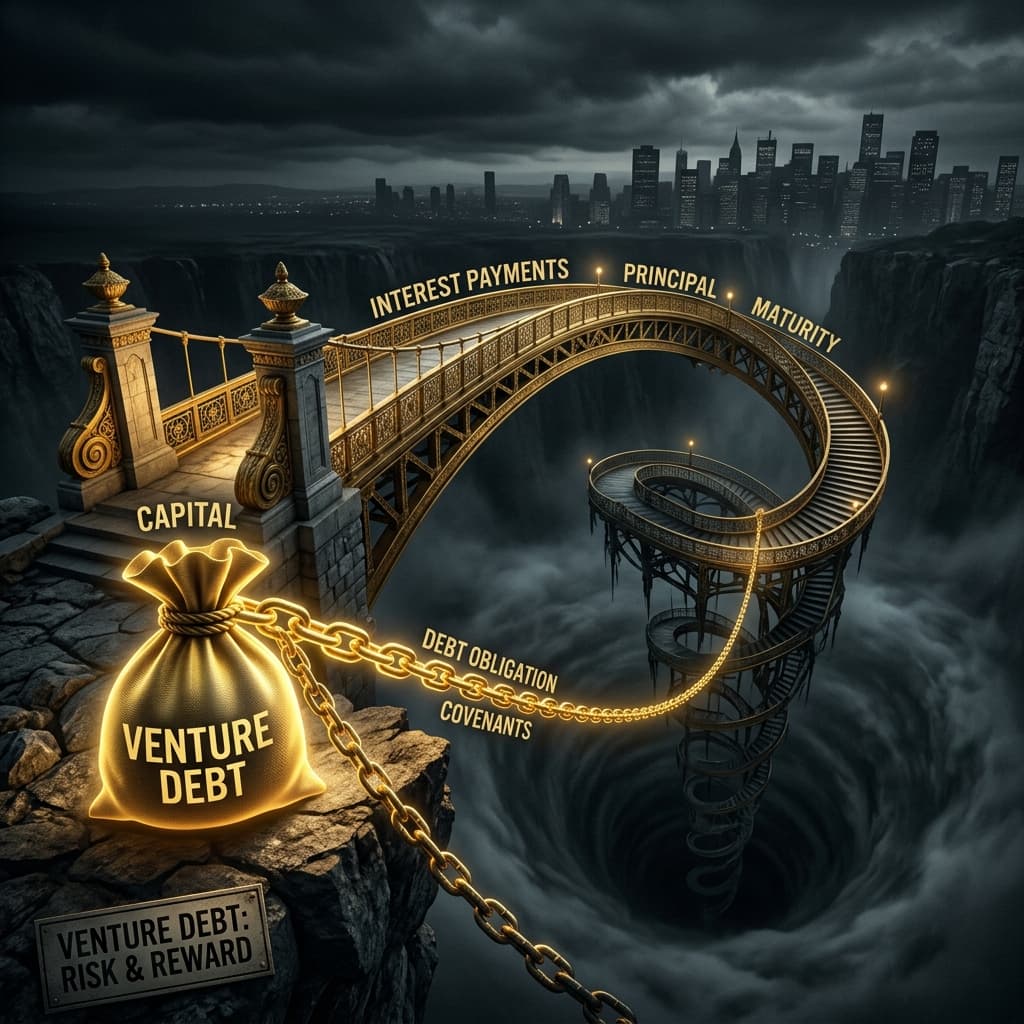
By 2024, our Series B funding was starting to look thin. Our lead investor suggested we take out $5 million in 'Venture Debt' to extend our runway. They told us it was the smart move: 'Don't raise equity at a flat valuation; take the debt, hit your targets, and raise your Series C at a 3x premium.' It sounded like a financial cheat code. It was, in fact, a death spiral.
Venture debt is sold to founders as 'founder-friendly capital.' It is, in reality, a predatory instrument designed to extract maximum value from a high-growth company with a minimum of risk for the lender. When times are good, it's a minor nuisance. When growth slows—even slightly—it becomes an existential threat that can strip a founder of their company overnight.
We spent eighteen months living under the shadow of restrictive covenants, warrant coverage, and the constant fear of a 'technical default.' We finally paid it off, and we will never touch it again. Here is why venture debt is the most dangerous drug in the Silicon Valley ecosystem.
The Illusion of 'Cheap' Capital
The marketing pitch for venture debt is that it's cheaper than equity because it doesn't dilute you. This is a lie of omission. While the interest rate (often Prime + 2% or 3%) looks manageable, the hidden costs are staggering.
- Warrants: Lenders almost always demand 'warrants'—the right to buy equity in your company at a fixed price in the future. This is dilution, often at a very disadvantageous price.
- Fees: Closing fees, facility fees, unused line fees, and legal fees (which you pay for both sides) can easily eat 3-5% of the total loan amount before you see a dime.
- Prepayment Penalties: If your company gets acquired or you want to pay off the loan early, you are hit with massive penalties that ensure the lender gets their full interest 'yield' regardless of how long you had the money.
When you calculate the Effective APR (including the value of the warrants and fees), venture debt often costs 15-20%. That is not 'cheap' capital; it's high-interest corporate credit card debt disguised as sophisticated finance.
The Covenant Straightjacket
Unlike equity investors who are aligned with your long-term success, a debt lender only cares about one thing: Being Rempaid. To ensure this, they impose 'Covenants'—financial rules you must follow to avoid defaulting on the loan.
Common covenants include 'Minimum Cash Balance' or 'Maximum Burn Rate.' These sound reasonable until you need to pivot. Suppose you want to invest heavily in a new AI feature that will increase your burn for six months but double your revenue in a year. An equity investor would likely support this. A debt lender might block it because it violates your 'Minimum Cash' covenant.
We found ourselves managing our business to satisfy the lender's spreadsheet rather than our customers' needs. We were making sub-optimal strategic decisions just to stay within the 'safe' lanes of our loan agreement. We had traded our agility for a line of credit.
The 'Technical Default' Weapon
The most terrifying aspect of venture debt is the 'Material Adverse Change' (MAC) clause. This is a vague, catch-all provision that allows a lender to declare a default if they believe the company's prospects have significantly worsened—even if you've never missed a payment.
When the tech market corrected in late 2024, our lender started hinting at a 'technical default' because our peer group valuations had dropped. They used this threat to demand additional warrants and higher interest rates. We weren't in financial trouble—we had plenty of cash—but we were being squeezed by a lender who smelled blood in the water. We realized that we didn't own our company; our lender did.
The Better Alternative: Revenue
We paid off the debt by ruthlessly cutting our non-core expenses and focusing every engineering hour on our highest-margin product features. We stopped trying to 'buy' growth with debt and started 'earning' it with revenue.
We discovered that Free Cash Flow is the only 'cheap' capital. It doesn't come with warrants, it doesn't have covenants, and it doesn't have a MAC clause. When you have profit, you have power. When you have debt, you have a master.
Conclusion
Venture debt is a tool for a very specific type of company in a very specific stage: a company that is 100% certain of its future revenue and just needs a bridge to the next quarter. For a startup in the volatile world of AI and SaaS, it is an unacceptable risk.
Don't let a banker determine the fate of your engineering team. Don't trade your future equity for a temporary extension of your burn. If you need more money, build a better product and sell it. Debt is a weight; profit is a wing.
Written by XQA Team
Our team of experts delivers insights on technology, business, and design. We are dedicated to helping you build better products and scale your business.